Department of Postgraduate Program in Nursing, Federal University of Pelotas (UFPel), Pelotas, Rio Grande do Sul, Brazil.
Department of Epidemiology & Public Health, University College London (UCL), London, United Kingdom.
Sci Rep. 2020 Mar 9;10(1):4375. doi: 10.1038/s41598-020-61127-7.
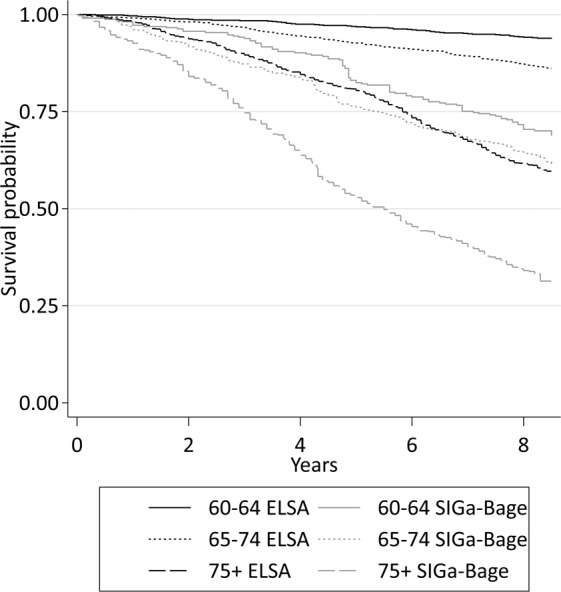
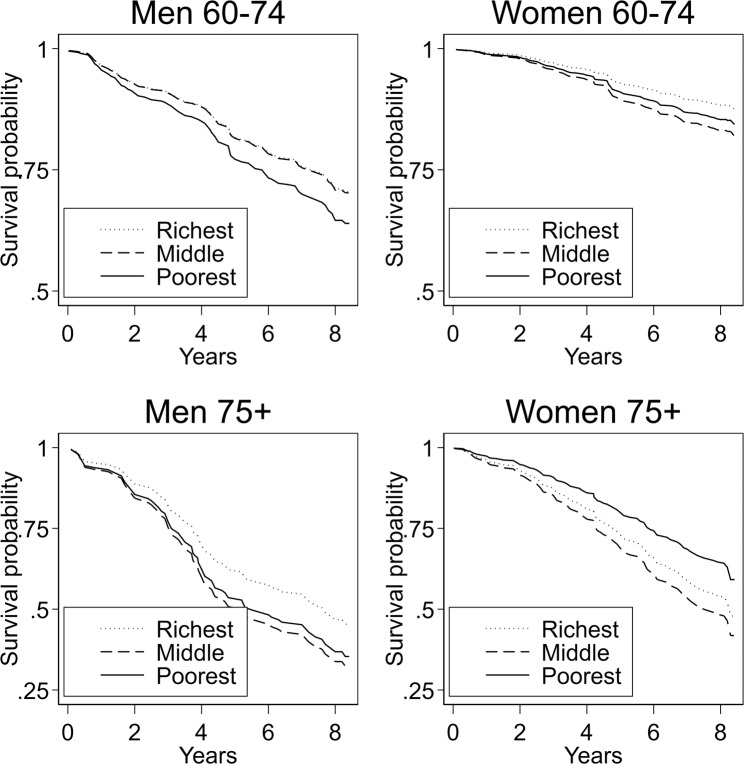
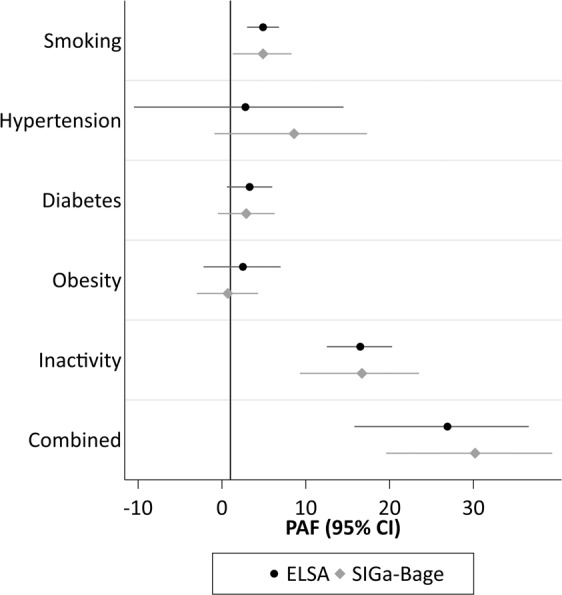
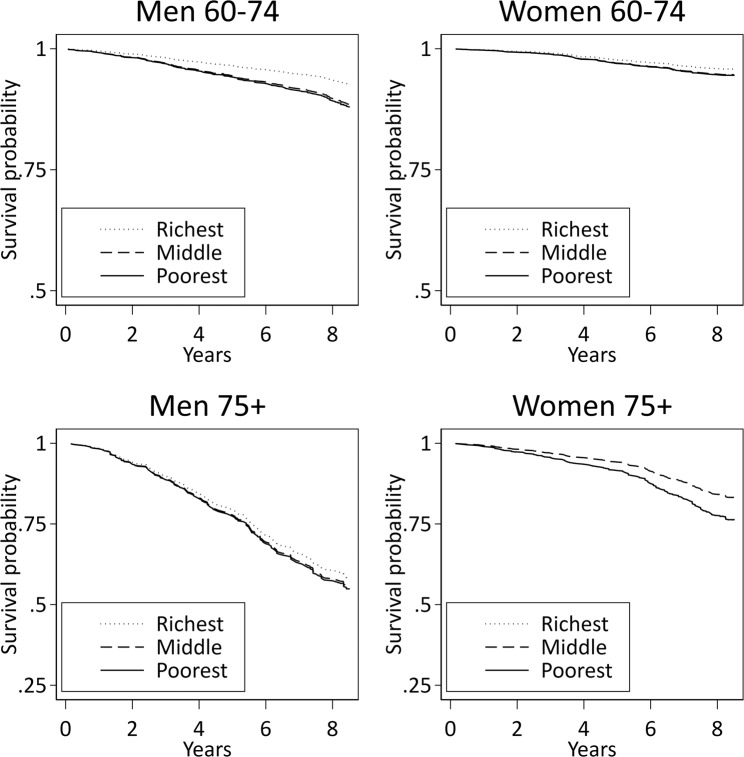
To quantify and compare 9-year all-cause mortality risk attributable to modifiable risk factors among older English and Brazilian adults. We used data for participants aged 60 years and older from the English Longitudinal Study of Ageing (ELSA) and the Bagé Cohort Study of Ageing (SIGa-Bagé). The five modifiable risk factors assessed at baseline were smoking, hypertension, diabetes, obesity and physical inactivity. Deaths were identified through linkage to mortality registers. For each risk factor, estimated all-cause mortality hazard ratios (HR) and population attributable fractions (PAF) were adjusted by age, sex, all other risk factors and socioeconomic position (wealth) using Cox proportional hazards modelling. We also quantified the risk factor adjusted wealth gradients in mortality, by age and sex. Among the participants, 659 (ELSA) and 638 (SIGa-Bagé) died during the 9-year follow-up. Mortality rates were higher in SIGa-Bagé. HRs and PAFs showed more similarities than differences, with physical inactivity (PAF 16.5% ELSA; 16.7% SIGa-Bagé) and current smoking (PAF 4.9% for both cohorts) having the strongest association. A clear graded relationship existed between the number of risk factors and subsequent mortality. Wealth gradients in mortality were apparent in both cohorts after full adjustment, especially among men aged 60-74 in ELSA. A different pattern was found among older women, especially in SIGa-Bagé. These findings call attention for the challenge to health systems to prevent and modify the major risk factors related to non-communicable diseases, especially physical inactivity and smoking. Furthermore, wealth inequalities in mortality persist among older adults.
为了量化和比较英国和巴西老年人群中可改变的风险因素对 9 年全因死亡率的影响。我们使用了来自英国老龄化纵向研究(ELSA)和巴伊亚老龄化队列研究(SIGa-Bagé)的 60 岁及以上参与者的数据。在基线评估了五种可改变的风险因素,即吸烟、高血压、糖尿病、肥胖和身体活动不足。通过与死亡率登记处的联系来确定死亡人数。对于每个风险因素,使用 Cox 比例风险模型,通过年龄、性别、所有其他风险因素和社会经济地位(财富)对全因死亡率风险比(HR)和人群归因分数(PAF)进行调整。我们还根据年龄和性别量化了调整风险因素后的财富梯度与死亡率的关系。在参与者中,ELSA 中有 659 人(ELSA)和 SIGa-Bagé 中有 638 人(SIGa-Bagé)在 9 年的随访中死亡。SIGa-Bagé 的死亡率较高。HR 和 PAF 显示出更多的相似之处而不是差异,身体活动不足(ELSA 的 PAF 为 16.5%;SIGa-Bagé 的 PAF 为 16.7%)和当前吸烟(两个队列的 PAF 均为 4.9%)与死亡率的关联最强。在随后的死亡率与风险因素数量之间存在明显的分级关系。在两个队列中,经过充分调整后,财富梯度在死亡率方面明显存在,尤其是在 ELSA 中 60-74 岁的男性中。在年龄较大的女性中,特别是在 SIGa-Bagé 中,发现了一种不同的模式。这些发现提醒人们注意卫生系统面临的挑战,即预防和改变与非传染性疾病相关的主要风险因素,特别是身体活动不足和吸烟。此外,老年人的财富不平等现象仍然存在。