Kinder Michelle, Greenplate Allison R, Strohl William R, Jordan Robert E, Brezski Randall J
a Biologics Research; Janssen Research & Development, LLC; Spring House , PA , USA.
MAbs. 2015;7(3):494-504. doi: 10.1080/19420862.2015.1022692.
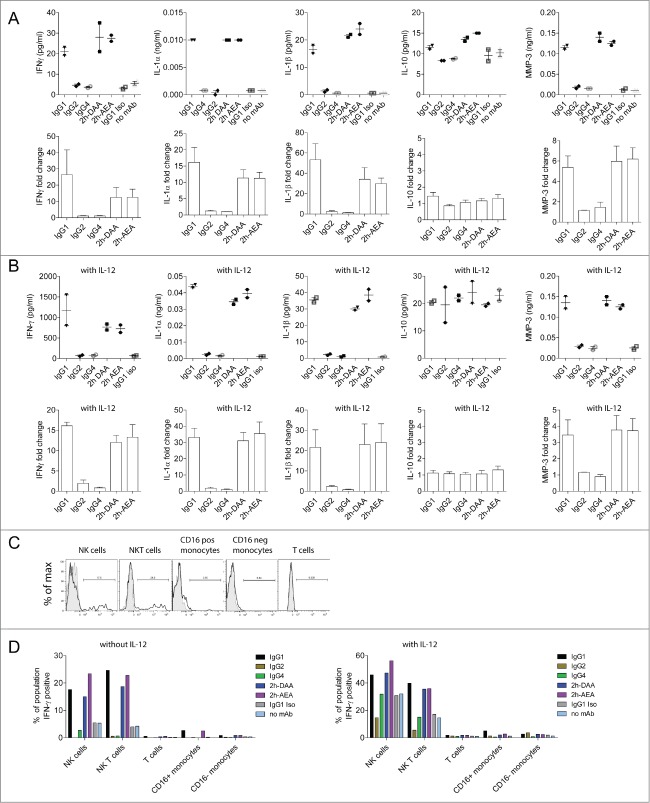
Cytotoxic therapeutic monoclonal antibodies (mAbs) often mediate target cell-killing by eliciting immune effector functions via Fc region interactions with cellular and humoral components of the immune system. Key functions include antibody-dependent cell-mediated cytotoxicity (ADCC), antibody-dependent cellular phagocytosis (ADCP), and complement-dependent cytotoxicity (CDC). However, there has been increased appreciation that along with cell-killing functions, the induction of antibody-dependent cytokine release (ADCR) can also influence disease microenvironments and therapeutic outcomes. Historically, most Fc engineering approaches have been aimed toward modulating ADCC, ADCP, or CDC. In the present study, we describe an Fc engineering approach that, while not resulting in impaired ADCC or ADCP, profoundly affects ADCR. As such, when peripheral blood mononuclear cells are used as effector cells against mAb-opsonized tumor cells, the described mAb variants elicit a similar profile and quantity of cytokines as IgG1. In contrast, although the variants elicit similar levels of tumor cell-killing as IgG1 with macrophage effector cells, the variants do not elicit macrophage-mediated ADCR against mAb-opsonized tumor cells. This study demonstrates that Fc engineering approaches can be employed to uncouple macrophage-mediated phagocytic and subsequent cell-killing functions from cytokine release.
细胞毒性治疗性单克隆抗体(mAb)通常通过与免疫系统的细胞和体液成分的Fc区域相互作用引发免疫效应功能来介导靶细胞杀伤。关键功能包括抗体依赖性细胞介导的细胞毒性(ADCC)、抗体依赖性细胞吞噬作用(ADCP)和补体依赖性细胞毒性(CDC)。然而,人们越来越认识到,除了细胞杀伤功能外,抗体依赖性细胞因子释放(ADCR)的诱导也会影响疾病微环境和治疗结果。从历史上看,大多数Fc工程方法都旨在调节ADCC、ADCP或CDC。在本研究中,我们描述了一种Fc工程方法,该方法虽然不会导致ADCC或ADCP受损,但会深刻影响ADCR。因此,当使用外周血单核细胞作为针对mAb调理的肿瘤细胞的效应细胞时,所描述的mAb变体引发的细胞因子谱和数量与IgG1相似。相比之下,尽管这些变体与巨噬细胞效应细胞引发的肿瘤细胞杀伤水平与IgG1相似,但这些变体不会引发巨噬细胞介导的针对mAb调理的肿瘤细胞的ADCR。这项研究表明,Fc工程方法可用于将巨噬细胞介导的吞噬作用和随后的细胞杀伤功能与细胞因子释放解耦。