Beyene Abebe, Hailu Tamene, Faris Kebede, Kloos Helmut
Department of Environmental Health Science and Technology, Jimma University, P. O. Box: 378, Jimma, Ethiopia.
Research and Development Directorate, Ministry of Water, Irrigation & Energy (MoWIE), P. O. Box: 5744, Addis Ababa, Ethiopia.
BMC Public Health. 2015 May 2;15:451. doi: 10.1186/s12889-015-1804-4.
Investigating the current level and trends of access and identifying the underlying challenges to sanitation system development will be useful in determining directions developing countries are heading as they plan to promote sustainable development goals (post 2015 agenda). This research investigates the status and trends of access to improved sanitation coverage (ISC) in relation to the MDG target in Ethiopia with the aim of identifying prevailing constraints and suggesting the way forward in the post-MDG era.
We examined data from a nationwide inventory conducted in accordance with the sanitation ladder at the national level and from a household survey in randomly selected urban slums in Addis Ababa. The inventory data were analyzed and interpreted using the conceptual model of the sanitation ladder. We used administrative reports and survey results to plot the time trend of the ISC.
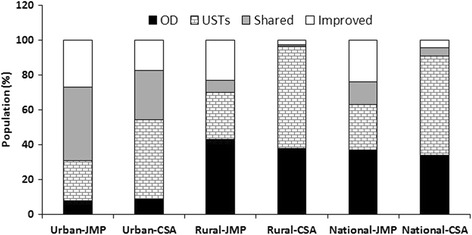
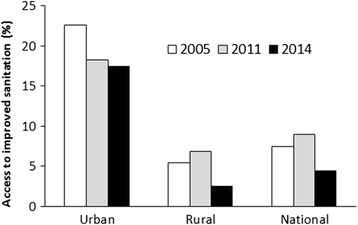
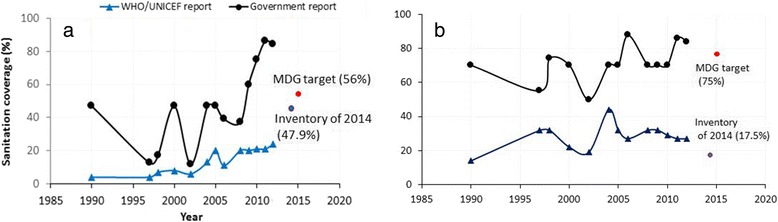
The data from the nationwide inventory of sanitation facilities, which are presented along the sanitation ladder reveal that more than half of the Ethiopian population (52.1%) still used unimproved sanitation facilities in 2014. The majority (35.6%) practiced open defecation, implying that the country is far from the MDG target for access to improved sanitation (56%). Most people in urban slums (88.6%) used unimproved sanitation facilities, indicating that the urban poor did not receive adequate sanitation services. Trend analysis shows that access to ISC has increased, but Central Statistical Authority (CSA) data reveal a decline. This discrepancy is due to differences in data collection methods and tools. Dry pit latrines are the most widely used toilet facilities in Ethiopia, accounting for about 97.5% of the ISC.
The sanitation coverage is far from the MDG target and the majority of the population, mainly the urban poor, are living in a polluted environment, exposed to water and sanitation-related diseases. The sanitation coverage estimates might be even lower if proper utilization, regular emptying, and fecal sludge management (FSM) of dry pit latrines were considered as indicators. In order to enhance sanitation services for all in the post-MDG era, urgent action is required that will establish proper monitoring and evaluation systems that can measure real access to ISC.
调查当前卫生设施的普及水平和趋势,并确定卫生系统发展的潜在挑战,将有助于确定发展中国家在规划促进可持续发展目标(2015年后议程)时的发展方向。本研究调查了埃塞俄比亚与千年发展目标(MDG)目标相关的改善卫生设施覆盖率(ISC)的现状和趋势,旨在确定当前存在的制约因素,并为后千年发展目标时代提出前进方向。
我们研究了根据全国范围内的卫生设施阶梯进行的全国性清查数据,以及在亚的斯亚贝巴随机选取的城市贫民窟进行的住户调查数据。利用卫生设施阶梯的概念模型对清查数据进行了分析和解读。我们使用行政报告和调查结果绘制了ISC的时间趋势图。
沿卫生设施阶梯呈现的全国卫生设施清查数据显示,2014年超过一半的埃塞俄比亚人口(52.1%)仍在使用未改善的卫生设施。大多数人(35.6%)露天排便,这意味着该国距离千年发展目标中改善卫生设施普及情况的目标(56%)还很远。城市贫民窟中的大多数人(88.6%)使用未改善的卫生设施,这表明城市贫困人口没有得到足够的卫生服务。趋势分析表明,获得ISC的情况有所增加,但中央统计局(CSA)的数据显示有所下降。这种差异是由于数据收集方法和工具的不同。旱厕是埃塞俄比亚使用最广泛的厕所设施,约占ISC的97.5%。
卫生设施覆盖率远未达到千年发展目标,大多数人口,主要是城市贫困人口,生活在污染环境中,易感染与水和卫生设施相关的疾病。如果将旱厕的合理使用、定期清空和粪便污泥管理(FSM)作为指标,卫生设施覆盖率估计可能会更低。为了在千年发展目标后时代为所有人加强卫生服务,需要采取紧急行动,建立能够衡量实际获得ISC情况的适当监测和评估系统。