School of Nutrition, Chung Shan Medical University, Taichung, Taiwan.
Department of Nutrition, Chung Shan Medical University Hospital, Taichung, Taiwan.
Food Nutr Res. 2015 Apr 29;59:25702. doi: 10.3402/fnr.v59.25702. eCollection 2015.
Vitamin B6 may directly or indirectly play a role in oxidative stress and the antioxidant defense system.
The purpose of this study was to examine the associations of vitamin B6 status with cysteine, glutathione, and its related enzyme activities in mice with homocysteine-induced oxidative stress.
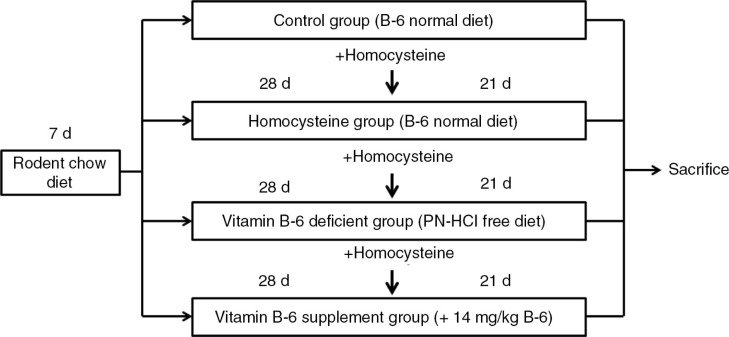
Four-week-old male BALB/c mice were weighed and divided into one of four dietary treatment groups fed either a normal diet (as a control group and a homocysteine group), a vitamin B6-deficient diet (as a B6-deficient group), or a B6-supplemented diet (a pyridoxine-HCl-free diet supplemented with 14 mg/kg of pyridoxine-HCl, as a B6 supplement group) for 28 days. Homocysteine thiolactone was then added to drinking water in three groups for 21 days to induce oxidative stress. At the end of the study, mice were sacrificed by decapitation and blood and liver samples were obtained.
Mice with vitamin B6-deficient diet had the highest homocysteine concentration in plasma and liver among groups. Significantly increased hepatic malondialdehyde levels were observed in the vitamin B6-deficient group. Among homocysteine-treated groups, mice with vitamin B6-deficient diet had the highest plasma glutathione concentration and relatively lower hepatic glutathione concentration. The glutathione peroxidase activities remained relatively stable in plasma and liver whether vitamin B6 was adequate, deficient, or supplemented.
Mice with deficient vitamin B6 intakes had an aggravate effect under homocysteine-induced oxidative stress. The vitamin B6-deficient status seems to mediate the oxidative stress in connection with the redistribution of glutathione from liver to plasma, but not further affect glutathione-related enzyme activities in mice with homocysteine-induced oxidative stress.
维生素 B6 可能直接或间接地在氧化应激和抗氧化防御系统中发挥作用。
本研究旨在探讨维生素 B6 状态与同型半胱氨酸诱导氧化应激小鼠胱氨酸、谷胱甘肽及其相关酶活性的关系。
4 周龄雄性 BALB/c 小鼠称重后分为 4 组膳食处理组,分别给予正常饮食(对照组和同型半胱氨酸组)、维生素 B6 缺乏饮食(B6 缺乏组)或 B6 补充饮食(不含吡哆醇-HCl 的吡啶酮-HCl 补充饮食,补充 14mg/kg 吡哆醇-HCl,B6 补充组)28 天。然后在三组饮用水中添加同型半胱氨酸硫内酯 21 天诱导氧化应激。研究结束时,通过断头处死小鼠,采集血液和肝脏样本。
维生素 B6 缺乏饮食组小鼠血浆和肝脏同型半胱氨酸浓度最高。B6 缺乏组肝丙二醛水平显著升高。在同型半胱氨酸处理组中,维生素 B6 缺乏饮食组小鼠血浆谷胱甘肽浓度最高,而肝谷胱甘肽浓度相对较低。无论维生素 B6 是否充足、缺乏或补充,血浆和肝脏中的谷胱甘肽过氧化物酶活性均保持相对稳定。
维生素 B6 摄入不足的小鼠在同型半胱氨酸诱导的氧化应激下加重了病情。维生素 B6 缺乏状态似乎通过将谷胱甘肽从肝脏重新分配到血浆来介导氧化应激,但不会进一步影响同型半胱氨酸诱导氧化应激小鼠的谷胱甘肽相关酶活性。