Twine Wayne, Hunter Lori Mae
Respectively, Senior Lecturer, School of Animal, Plant and Environmental Sciences, University of the Witwatersrand, Wits Rural Facility, Acornhoek, South Africa.
Associate Professor, Department of Sociology, Faculty Research Associate, Institute of Behavioral Science, University of Colorado at Boulder, USA.
Dev South Afr. 2011 Oct;28(4):431-444. doi: 10.1080/0376835X.2011.605559.
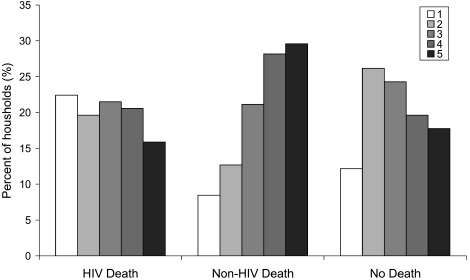
HIV/AIDS has been described as a household shock distinct from others faced by rural households. This study examines this characterisation by analysing the impact of an adult HIV/AIDS-related death on household food security, compared with households experiencing either no mortality or a sudden non-HIV/AIDS adult death. The research is based in the Agincourt Health and Demographic Surveillance Site in rural South Africa, and focuses on a sample of 290 households stratified by experience of a recent prime-age adult death. HIV/AIDS-related mortality was associated with reduced household food security. However, much of this negative association also characterised households experiencing a non-HIV/AIDS mortality. In addition, other household characteristics, especially socioeconomic status, were strong determinants of food security regardless of mortality experience. We therefore recommend that development policy and interventions aimed at enhancing food security target vulnerable households broadly, rather than solely targeting those directly affected by HIV/AIDS mortality.
艾滋病毒/艾滋病被描述为一种与农村家庭面临的其他冲击不同的家庭冲击。本研究通过分析与艾滋病毒/艾滋病相关的成人死亡对家庭粮食安全的影响,与未经历死亡或突然发生非艾滋病毒/艾滋病成人死亡的家庭进行比较,来检验这一特征。该研究基于南非农村的阿金库尔健康与人口监测点,重点关注290个家庭的样本,这些家庭按近期青壮年成人死亡经历进行了分层。与艾滋病毒/艾滋病相关的死亡率与家庭粮食安全下降有关。然而,这种负面关联在很大程度上也表现在经历非艾滋病毒/艾滋病死亡的家庭中。此外,无论死亡经历如何,其他家庭特征,尤其是社会经济地位,都是粮食安全的重要决定因素。因此,我们建议,旨在加强粮食安全的发展政策和干预措施应广泛针对脆弱家庭,而不是仅仅针对那些直接受艾滋病毒/艾滋病死亡率影响的家庭。