Sartorius Kurt, Sartorius Benn Kd, Collinson Mark A, Tollman Stephen M
Professor, School of Accountancy, University of the Witwatersrand , Private Bag 3, Wits 2050 , South Africa.
Associate Professor, Discipline of Public Health Medicine, School of Nursing and Public Health, College of Health Sciences, University of Kwazulu-Natal , Durban , South Africa ; MRC/Wits Rural Public Health and Health Transitions Research Unit (Agincourt), School of Public Health, Faculty of Health Sciences, University of the Witwatersrand , Johannesburg , South Africa.
Dev South Afr. 2014 Nov 2;31(6):775-795. doi: 10.1080/0376835X.2014.951991.
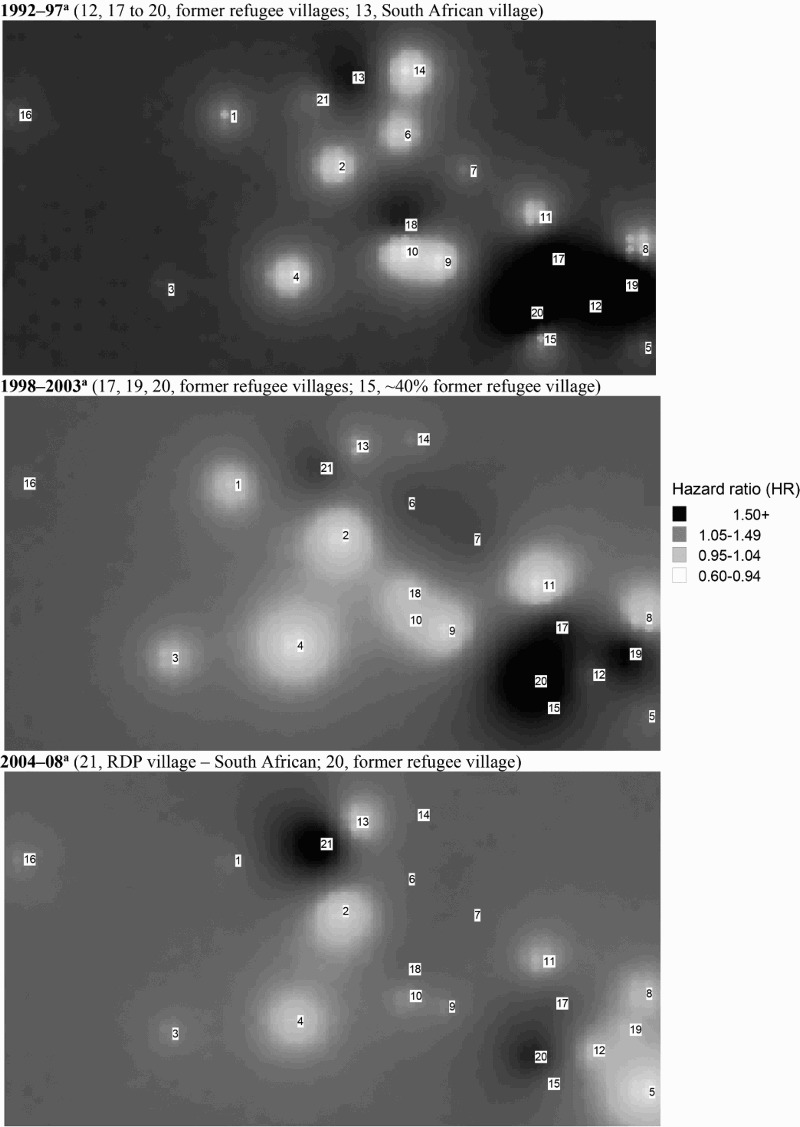
This paper investigates household dissolution and changes in asset wealth (socio-economic position) in a rural South African community containing settled refugees. Survival analysis applied to a longitudinal dataset indicated that the covariates increasing the risk of forced household dissolution were a reduction in socio-economic position (asset wealth), adult deaths and the permanent outmigration of more than 40% of the household. Conversely, the risk of dissolution was reduced by bigger households, state grants and older household heads. Significant spatial clusters of former refugee villages also showed a higher risk of dissolution after 20 years of permanent residence. A discussion of the dynamics of dissolution showed how an outflow/inflow of household assets (socio-economic position) was precipitated by each of the selected covariates. The paper shows how an understanding of the dynamics of forced household dissolution, combined with the use of geo-spatial mapping, can inform inter-disciplinary policy in a rural community.
本文研究了南非一个有定居难民的农村社区中的家庭解体及资产财富(社会经济地位)变化。对一个纵向数据集进行生存分析表明,增加家庭被迫解体风险的协变量包括社会经济地位(资产财富)下降、成年人死亡以及超过40%的家庭成员永久迁出。相反,家庭规模较大、有国家补助以及户主年龄较大则会降低解体风险。在前难民村庄的显著空间聚类中,常住20年后解体风险也更高。对解体动态的讨论表明了每个选定协变量是如何促使家庭资产(社会经济地位)外流/流入的。本文展示了对被迫家庭解体动态的理解,结合地理空间映射的运用,如何能为农村社区的跨学科政策提供信息。