Lu Xin, Zhang Xu-Xiang, Wang Zhu, Huang Kailong, Wang Yuan, Liang Weigang, Tan Yunfei, Liu Bo, Tang Junying
State Key Laboratory of Pollution Control and Resource Reuse, School of the Environment, Nanjing University, Nanjing, China.
Environmental Science Research Institute of Jiangsu, Nanjing, China.
PLoS One. 2015 May 4;10(5):e0125549. doi: 10.1371/journal.pone.0125549. eCollection 2015.
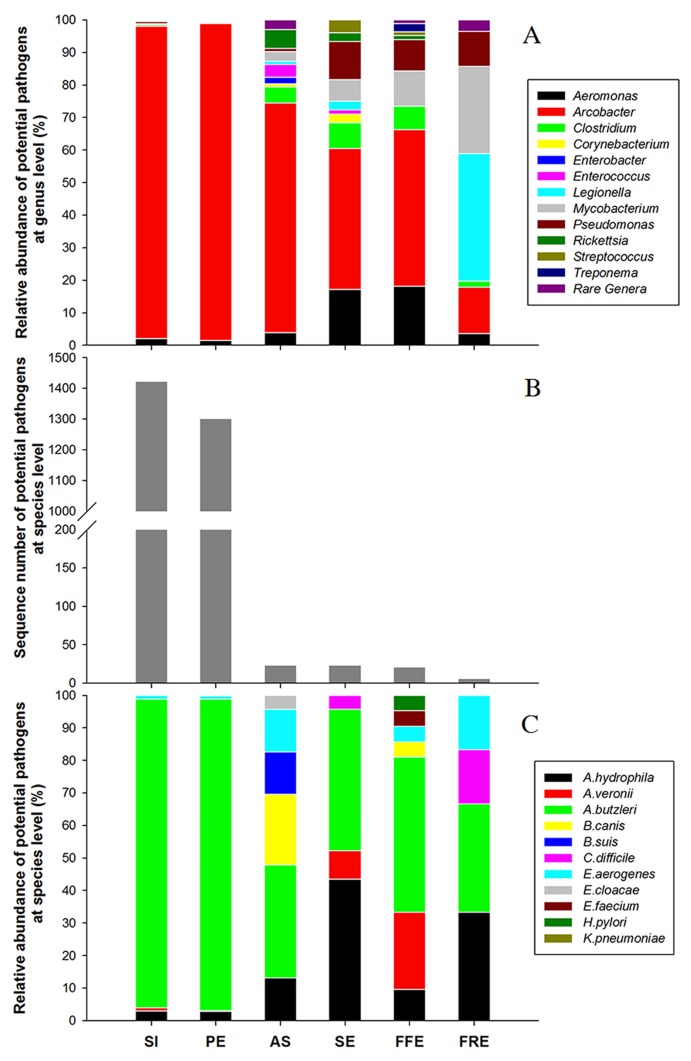
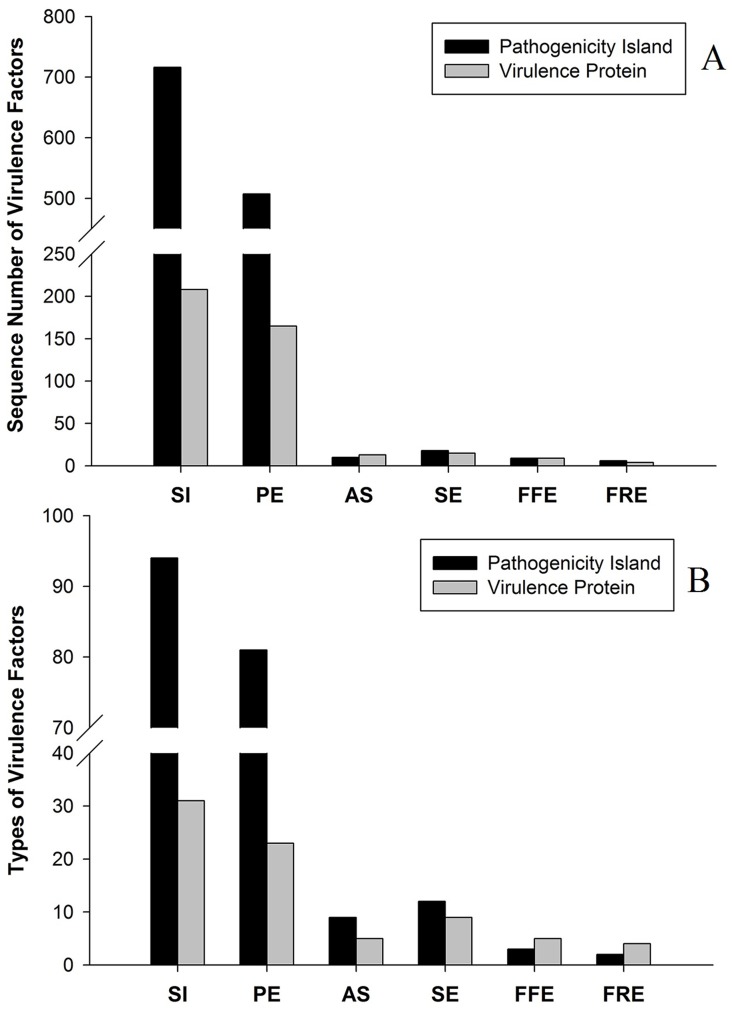
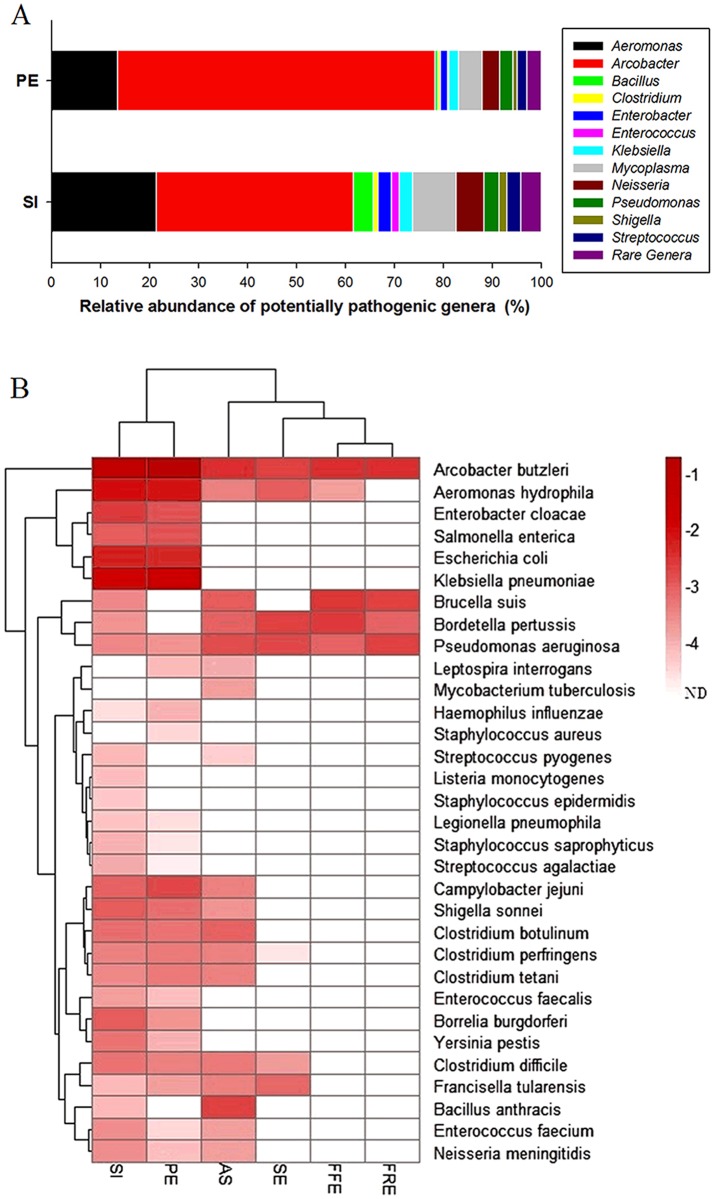
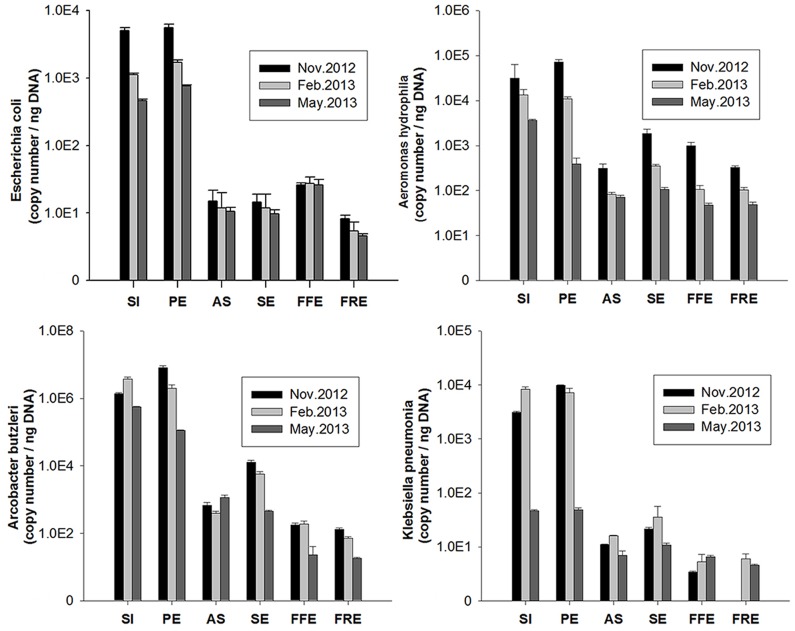
This study used 454 pyrosequencing, Illumina high-throughput sequencing and metagenomic analysis to investigate bacterial pathogens and their potential virulence in a sewage treatment plant (STP) applying both conventional and advanced treatment processes. Pyrosequencing and Illumina sequencing consistently demonstrated that Arcobacter genus occupied over 43.42% of total abundance of potential pathogens in the STP. At species level, potential pathogens Arcobacter butzleri, Aeromonas hydrophila and Klebsiella pneumonia dominated in raw sewage, which was also confirmed by quantitative real time PCR. Illumina sequencing also revealed prevalence of various types of pathogenicity islands and virulence proteins in the STP. Most of the potential pathogens and virulence factors were eliminated in the STP, and the removal efficiency mainly depended on oxidation ditch. Compared with sand filtration, magnetic resin seemed to have higher removals in most of the potential pathogens and virulence factors. However, presence of the residual A. butzleri in the final effluent still deserves more concerns. The findings indicate that sewage acts as an important source of environmental pathogens, but STPs can effectively control their spread in the environment. Joint use of the high-throughput sequencing technologies is considered a reliable method for deep and comprehensive overview of environmental bacterial virulence.
本研究采用454焦磷酸测序、Illumina高通量测序和宏基因组分析,以调查一家同时采用传统和先进处理工艺的污水处理厂(STP)中的细菌病原体及其潜在毒力。焦磷酸测序和Illumina测序一致表明,弓形杆菌属在该污水处理厂潜在病原体的总丰度中占比超过43.42%。在物种水平上,潜在病原体布氏弓形杆菌、嗜水气单胞菌和肺炎克雷伯菌在原污水中占主导地位,这也通过定量实时PCR得到了证实。Illumina测序还揭示了该污水处理厂中各种类型致病岛和毒力蛋白的流行情况。大多数潜在病原体和毒力因子在污水处理厂中被去除,去除效率主要取决于氧化沟。与砂滤相比,磁性树脂似乎对大多数潜在病原体和毒力因子具有更高的去除率。然而,最终出水仍存在残留的布氏弓形杆菌,这仍值得更多关注。研究结果表明,污水是环境病原体的重要来源,但污水处理厂可以有效控制它们在环境中的传播。联合使用高通量测序技术被认为是深入全面了解环境细菌毒力的可靠方法。