Roh Sandy S, Smith Laura E, Lee Jong Seok, Via Laura E, Barry Clifton E, Alland David, Chakravorty Soumitesh
Department of Medicine, New Jersey Medical School, Rutgers University, Newark, New Jersey, United States of America.
Department of Microbiology, International Tuberculosis Research Center, Changwon, Gyeongsang, Republic of Korea.
PLoS One. 2015 May 4;10(5):e0126257. doi: 10.1371/journal.pone.0126257. eCollection 2015.
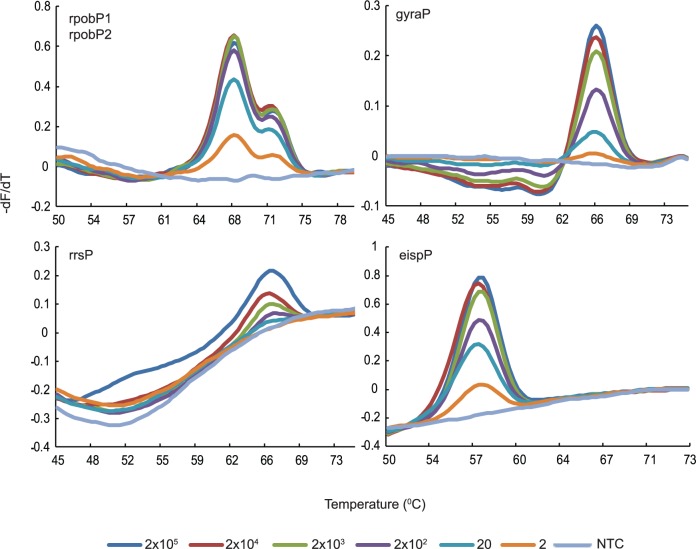
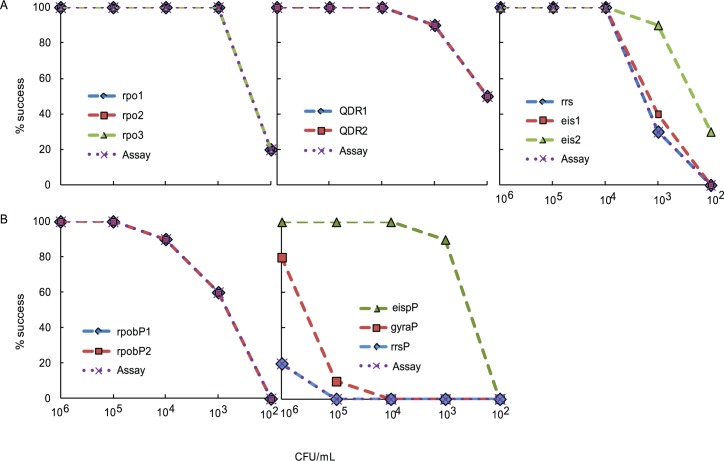
Several molecular assays to detect resistance to Rifampin, the Fluoroquinolones, and Aminoglycosides in Mycobacterium tuberculosis (M. tuberculosis) have been recently described. A systematic approach for comparing these assays in the laboratory is needed in order to determine the relative advantage of each assay and to decide which ones should be advanced to evaluation. We performed an analytic comparison of a Sloppy Molecular Beacon (SMB) melting temperature (Tm) assay and a Dual labeled probe (DLP) Tm assay. Both assays targeted the M. tuberculosis rpoB, gyrA, rrs genes and the eis promoter region. The sensitivity and specificity to detect mutations, analytic limit of detection (LOD) and the detection of heteroresistance were tested using a panel of 56 clinical DNA samples from drug resistant M. tuberculosis strains. Both SMB and DLP assays detected 29/29 (100%) samples with rpoB RRDR mutations and 3/3 (100%) samples with eis promoter mutations correctly. The SMB assay detected all 17/17 gyrA mutants and 22/22 rrs mutants, while the DLP assay detected 16/17 (94%) gyrA mutants and 12/22 (55%) rrs mutants. Both assays showed comparable LODs for detecting rpoB and eis mutations; however, the SMB assay LODs were at least two logs better for detecting wild type and mutants in gyrA and rrs targets. The SMB assay was also moderately better at detecting heteroresistance. In summary, both assays appeared to be promising methods to detect drug resistance associated mutations in M. tuberculosis; however, the relative advantage of each assay varied under each test condition.
最近已经描述了几种用于检测结核分枝杆菌(M. tuberculosis)对利福平、氟喹诺酮类和氨基糖苷类耐药性的分子检测方法。为了确定每种检测方法的相对优势并决定哪些方法应推进到评估阶段,需要一种在实验室中比较这些检测方法的系统方法。我们对一种简易分子信标(SMB)熔解温度(Tm)检测方法和一种双标记探针(DLP)Tm检测方法进行了分析比较。两种检测方法均针对结核分枝杆菌的rpoB、gyrA、rrs基因以及eis启动子区域。使用一组来自耐药结核分枝杆菌菌株的56份临床DNA样本测试了检测突变的灵敏度和特异性、分析检测限(LOD)以及异质性耐药的检测情况。SMB和DLP检测方法均正确检测出29/29(100%)份具有rpoB RRDR突变的样本和3/3(100%)份具有eis启动子突变的样本。SMB检测方法检测出了所有17/17份gyrA突变体和22/22份rrs突变体,而DLP检测方法检测出了16/17(94%)份gyrA突变体和12/22(55%)份rrs突变体。两种检测方法在检测rpoB和eis突变方面显示出相当的LOD;然而,在检测gyrA和rrs靶点中的野生型和突变体时,SMB检测方法的LOD至少低两个数量级。SMB检测方法在检测异质性耐药方面也略胜一筹。总之,两种检测方法似乎都是检测结核分枝杆菌耐药相关突变的有前景的方法;然而,每种检测方法的相对优势在每种测试条件下各不相同。