Zhang Jian, Chen Min, Dong Xiaoyu, Lin Ruozhu, Fan Jianhua, Chen Zhiduan
State Key Laboratory of Systematic and Evolutionary Botany, Institute of Botany, Chinese Academy of Sciences, Beijing, P.R. China.
State Key Laboratory of Systematic and Evolutionary Botany, Institute of Botany, Chinese Academy of Sciences, Beijing, P.R. China; Graduate University of the Chinese Academy of Sciences, Beijing, P.R. China.
PLoS One. 2015 May 4;10(5):e0125574. doi: 10.1371/journal.pone.0125574. eCollection 2015.
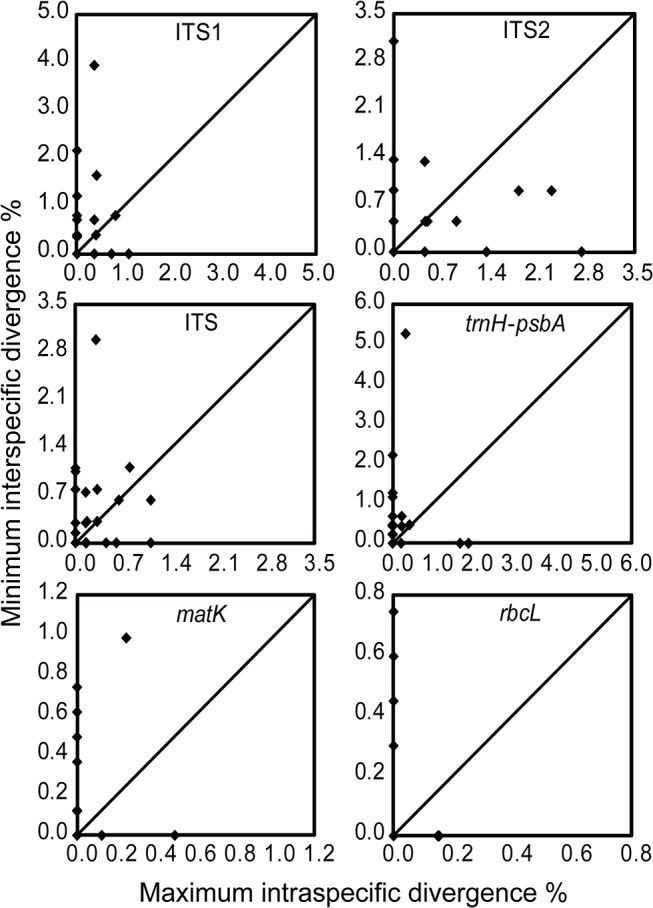
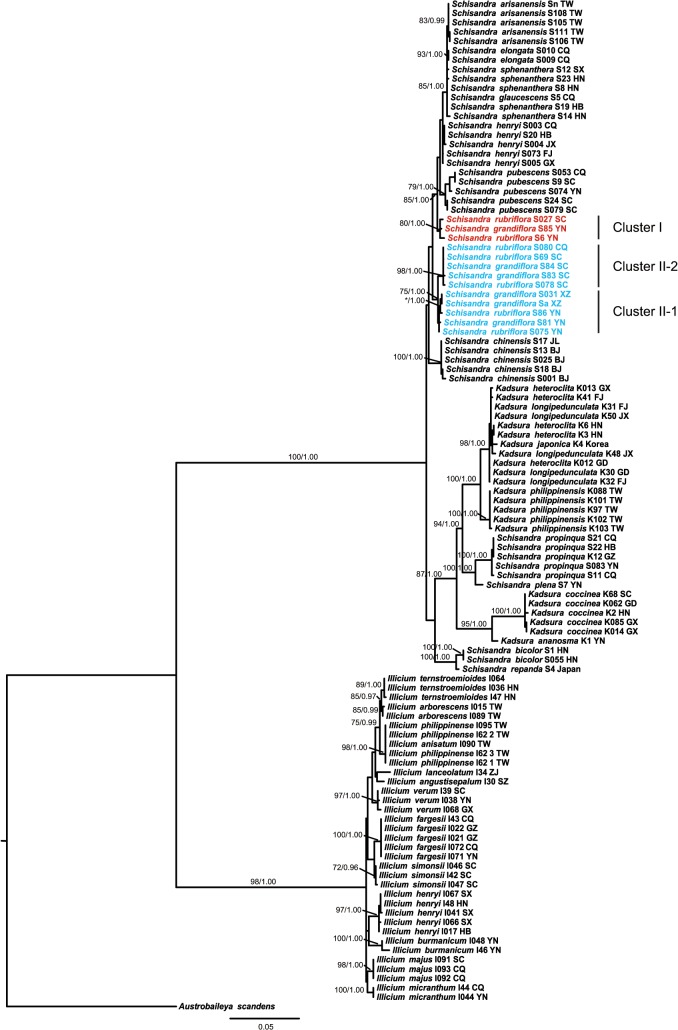
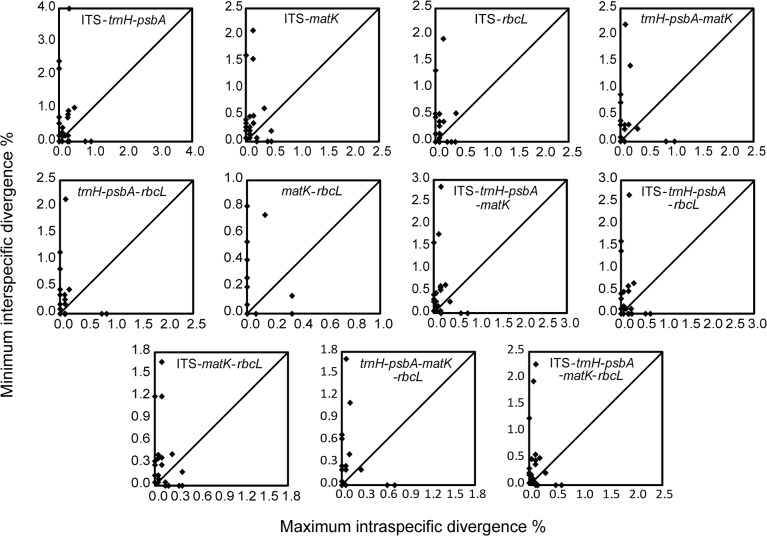
Many species of Schisandraceae are used in traditional Chinese medicine and are faced with contamination and substitution risks due to inaccurate identification. Here, we investigated the discriminatory power of four commonly used DNA barcoding loci (ITS, trnH-psbA, matK, and rbcL) and corresponding multi-locus combinations for 135 individuals from 33 species of Schisandraceae, using distance-, tree-, similarity-, and character-based methods, at both the family level and the genus level. Our results showed that the two spacer regions (ITS and trnH-psbA) possess higher species-resolving power than the two coding regions (matK and rbcL). The degree of species resolution increased with most of the multi-locus combinations. Furthermore, our results implied that the best DNA barcode for the species discrimination at the family level might not always be the most suitable one at the genus level. Here we propose the combination of ITS+trnH-psbA+matK+rbcL as the most ideal DNA barcode for discriminating the medicinal plants of Schisandra and Kadsura, and the combination of ITS+trnH-psbA as the most suitable barcode for Illicium species. In addition, the closely related species Schisandra rubriflora Rehder & E. H. Wilson and Schisandra grandiflora Hook.f. & Thomson, were paraphyletic with each other on phylogenetic trees, suggesting that they should not be distinct species. Furthermore, the samples of these two species from the southern Hengduan Mountains region formed a distinct cluster that was separated from the samples of other regions, implying the presence of cryptic diversity. The feasibility of DNA barcodes for identification of geographical authenticity was also verified here. The database and paradigm that we provide in this study could be used as reference for the authentication of traditional Chinese medicinal plants utilizing DNA barcoding.
五味子科的许多物种都被用于传统中药,并且由于鉴定不准确而面临污染和替代风险。在此,我们使用基于距离、树、相似度和特征的方法,在科水平和属水平上,研究了四个常用DNA条形码位点(ITS、trnH-psbA、matK和rbcL)以及相应的多位点组合对五味子科33个物种的135个个体的鉴别能力。我们的结果表明,两个间隔区(ITS和trnH-psbA)比两个编码区(matK和rbcL)具有更高的物种分辨能力。大多数多位点组合的物种分辨率程度有所提高。此外,我们的结果表明,在科水平上用于物种鉴别的最佳DNA条形码在属水平上可能并不总是最合适的。在此,我们提出ITS+trnH-psbA+matK+rbcL组合作为鉴别五味子属和南五味子属药用植物的最理想DNA条形码,而ITS+trnH-psbA组合作为八角属物种的最合适条形码。此外,近缘物种红花五味子Rehder & E. H. Wilson和大花五味子Hook.f. & Thomson在系统发育树上彼此并系,这表明它们不应是不同的物种。此外,这两个物种来自横断山脉南部地区的样本形成了一个与其他地区样本分离的独特聚类,这意味着存在隐存多样性。在此还验证了DNA条形码用于鉴定地理真实性的可行性。我们在本研究中提供的数据库和范例可作为利用DNA条形码鉴定传统中药植物的参考。