Fisher Joanna J, Hajek Ann E
Department of Entomology, Cornell University, Ithaca, New York, United States of America.
PLoS One. 2015 May 4;10(5):e0125197. doi: 10.1371/journal.pone.0125197. eCollection 2015.
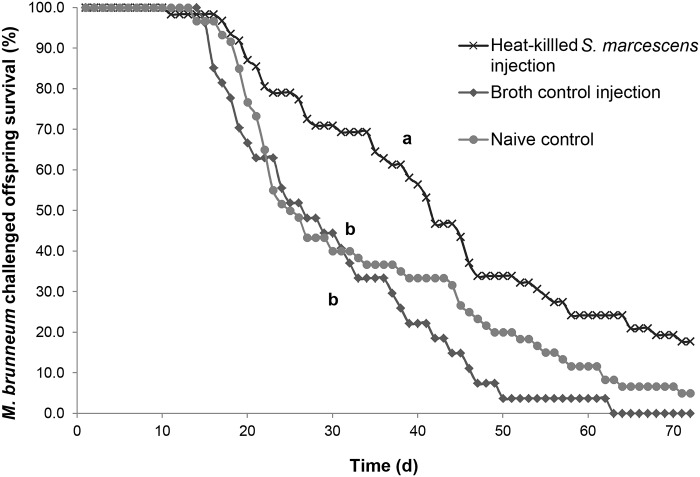
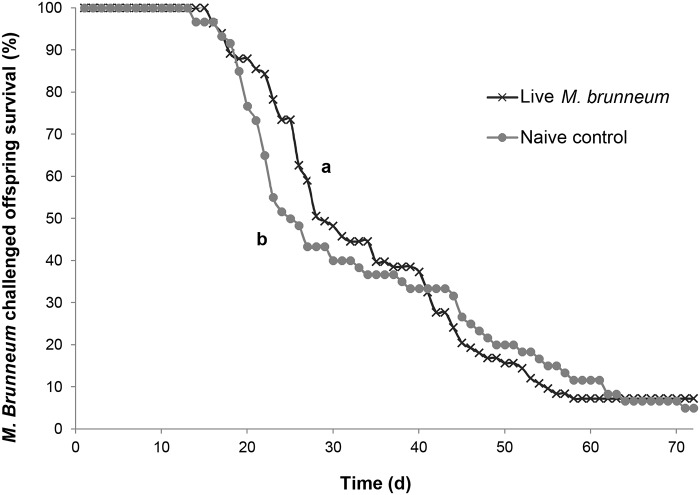
Maternal exposure to an immune challenge can convey enhanced immunity to invertebrate offspring in the next generation. We investigated whether maternal exposure of the Asian longhorned beetle, Anoplophora glabripennis, to two species of the fungus Metarhizium or the bacterium Serratia marcescens elicited transgenerational immune priming (TGIP). We tested specificity of this protection and whether occurrence of TGIP was dependent on maternal exposure to living versus dead pathogens. Our results show that TGIP occurred and protected offspring against Metarhizium brunneum. Maternal exposure to S. marcescens provided non-specific protection to offspring against a fungal pathogen, but TGIP in response to Metarhizium only occurred when offspring were exposed to the same fungal species that was used to prime mothers. Moreover, TGIP in response to M. brunneum occurred only after maternal exposure to living rather than dead fungus. Our findings suggest that occurrence of TGIP could be both specific and dependent on whether the pathogen was alive.
母体暴露于免疫刺激可使下一代无脊椎动物后代的免疫力增强。我们研究了亚洲长角甲虫(Anoplophora glabripennis)的母体暴露于两种绿僵菌或粘质沙雷氏菌是否会引发跨代免疫致敏(TGIP)。我们测试了这种保护的特异性,以及TGIP的发生是否取决于母体暴露于活病原体还是死病原体。我们的结果表明,TGIP发生并保护后代免受球孢白僵菌的侵害。母体暴露于粘质沙雷氏菌为后代提供了针对真菌病原体的非特异性保护,但仅当后代暴露于用于刺激母体的相同真菌物种时,才会发生针对绿僵菌的TGIP。此外,仅在母体暴露于活真菌而非死真菌后,才会发生针对球孢白僵菌的TGIP。我们的研究结果表明,TGIP的发生可能既具有特异性,又取决于病原体是否存活。