Department of Bioresources, Fraunhofer Institute for Molecular Biology and Applied Ecology, Winchester Strasse 2, 35395 Giessen, Germany.
Institute for Insect Biotechnology, Justus-Liebig-University of Giessen, Heinrich-Buff-Ring 26-32, 35392 Giessen, Germany.
Biol Lett. 2015 Dec;11(12):20150885. doi: 10.1098/rsbl.2015.0885.
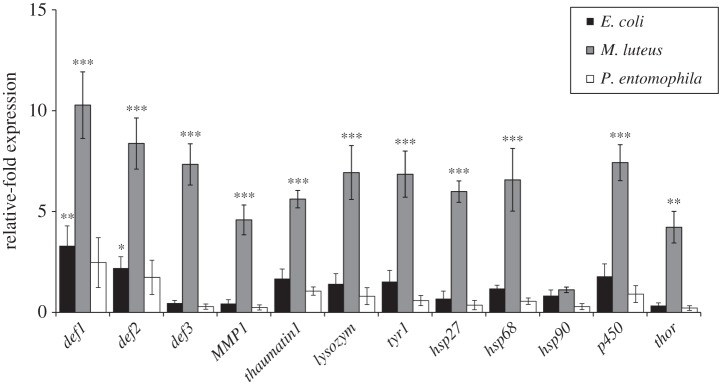
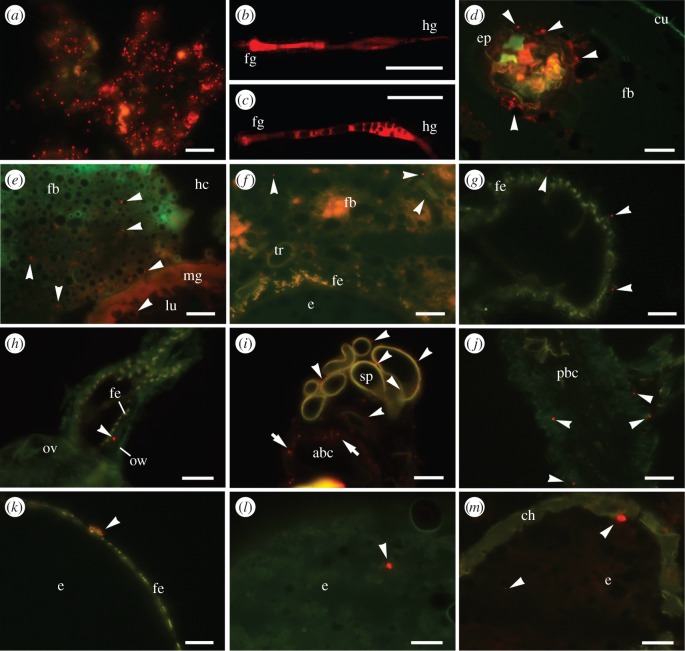
Invertebrates can be primed to enhance their protection against pathogens they have encountered before. This enhanced immunity can be passed maternally or paternally to the offspring and is known as transgenerational immune priming. We challenged larvae of the red flour beetle Tribolium castaneum by feeding them on diets supplemented with Escherichia coli, Micrococcus luteus or Pseudomonas entomophila, thus mimicking natural exposure to pathogens. The oral uptake of bacteria induced immunity-related genes in the offspring, but did not affect the methylation status of the egg DNA. However, we observed the translocation of bacteria or bacterial fragments from the gut to the developing eggs via the female reproductive system. Such translocating microbial elicitors are postulated to trigger bacterial strain-specific immune responses in the offspring and provide an alternative mechanistic explanation for maternal transgenerational immune priming in coleopteran insects.
无脊椎动物可以通过预先处理来增强它们对以前遇到过的病原体的保护。这种增强的免疫力可以通过母体或父体传递给后代,被称为跨代免疫启动。我们通过用大肠杆菌、藤黄微球菌或蕈样芽孢杆菌喂养幼虫来挑战红粉甲虫 Tribolium castaneum 的幼虫,从而模拟自然接触病原体。细菌的口服摄取诱导了后代的免疫相关基因,但不会影响卵 DNA 的甲基化状态。然而,我们观察到细菌或细菌片段从肠道转移到正在发育的卵子中,通过雌性生殖系统。这种转移的微生物激发子被假设为在后代中引发细菌株特异性免疫反应,并为鞘翅目昆虫的母体跨代免疫启动提供了一种替代的机制解释。