Boss Paul K, Pearce Anthony D, Zhao Yanjia, Nicholson Emily L, Dennis Eric G, Jeffery David W
CSIRO Agriculture Flagship, PMB 2, Glen Osmond, SA 5064, Australia.
School of Agriculture, Food and Wine, Waite Research Institute, The University of Adelaide, PMB 1, Glen Osmond, SA 5064, Australia.
Molecules. 2015 Apr 29;20(5):7845-73. doi: 10.3390/molecules20057845.
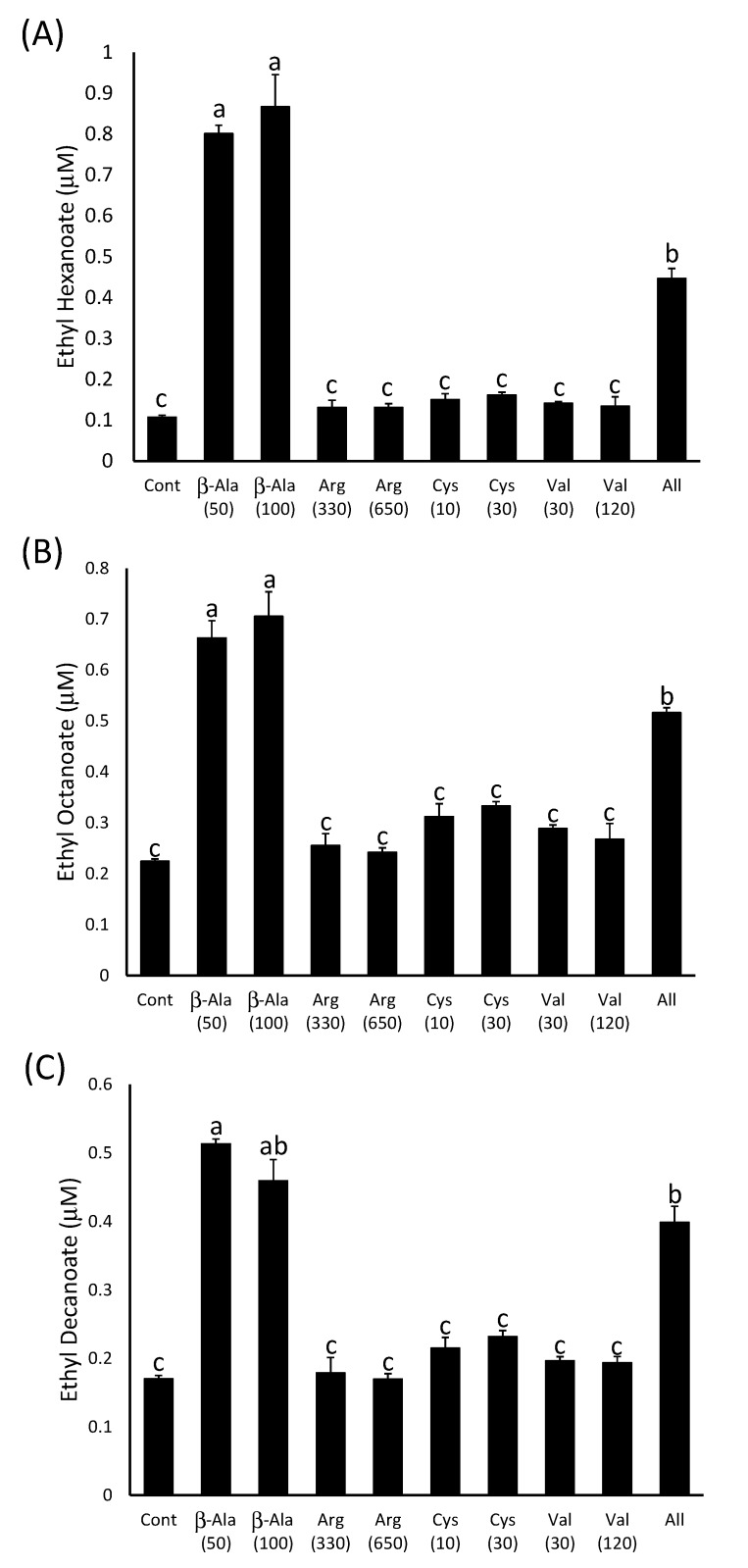
Grape composition affects wine flavour and aroma not only through varietal compounds, but also by influencing the production of volatile compounds by yeast. C9 and C12 compounds that potentially influence ethyl ester synthesis during fermentation were studied using a model grape juice medium. It was shown that the addition of free fatty acids, their methyl esters or acyl-carnitine and acyl-amino acid conjugates can increase ethyl ester production in fermentations. The stimulation of ethyl ester production above that of the control was apparent when lower concentrations of the C9 compounds were added to the model musts compared to the C12 compounds. Four amino acids, which are involved in CoA biosynthesis, were also added to model grape juice medium in the absence of pantothenate to test their ability to influence ethyl and acetate ester production. β-Alanine was the only one shown to increase the production of ethyl esters, free fatty acids and acetate esters. The addition of 1 mg∙L(-1) β-alanine was enough to stimulate production of these compounds and addition of up to 100 mg∙L(-1) β-alanine had no greater effect. The endogenous concentrations of β-alanine in fifty Cabernet Sauvignon grape samples exceeded the 1 mg∙L(-1) required for the stimulatory effect on ethyl and acetate ester production observed in this study.
葡萄的成分不仅通过品种化合物影响葡萄酒的风味和香气,还通过影响酵母挥发性化合物的产生来实现。使用模拟葡萄汁培养基研究了在发酵过程中可能影响乙酯合成的C9和C12化合物。结果表明,添加游离脂肪酸、其甲酯或酰基肉碱以及酰基氨基酸共轭物可增加发酵过程中的乙酯产量。与C12化合物相比,当向模拟酒醪中添加较低浓度的C9化合物时,乙酯产量高于对照的刺激作用明显。在没有泛酸的情况下,还将四种参与辅酶A生物合成的氨基酸添加到模拟葡萄汁培养基中,以测试它们影响乙酯和乙酸酯产量的能力。β-丙氨酸是唯一被证明能增加乙酯、游离脂肪酸和乙酸酯产量的氨基酸。添加1mg∙L(-1)β-丙氨酸足以刺激这些化合物的产生,添加高达100mg∙L(-1)β-丙氨酸也没有更大的效果。50个赤霞珠葡萄样品中β-丙氨酸的内源浓度超过了本研究中观察到的对乙酯和乙酸酯产量产生刺激作用所需的1mg∙L(-1)。