Šikuten Iva, Štambuk Petra, Tomaz Ivana, Marchal Cecile, Kontić Jasminka Karoglan, Lacombe Thierry, Maletić Edi, Preiner Darko
Department of Viticulture and Enology, Faculty of Agriculture, University of Zagreb, Zagreb, Croatia.
Centre of Excellence for Biodiversity and Molecular Plant Breeding, Faculty of Agriculture, University of Zagreb, Zagreb, Croatia.
Front Plant Sci. 2022 Oct 20;13:942148. doi: 10.3389/fpls.2022.942148. eCollection 2022.
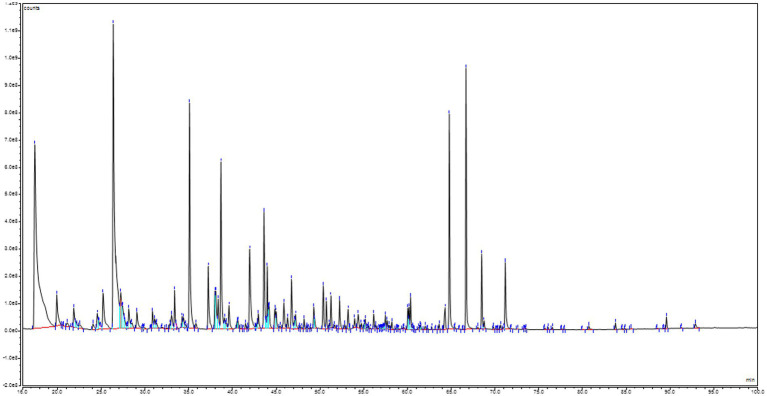
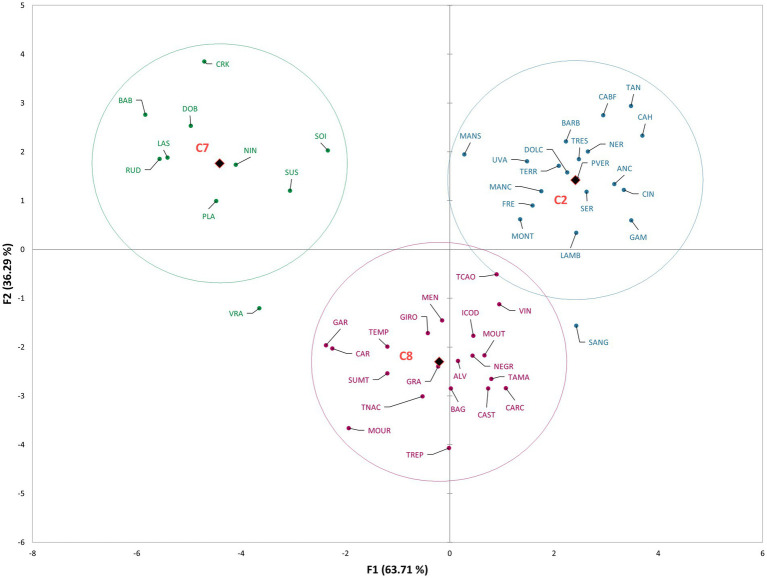
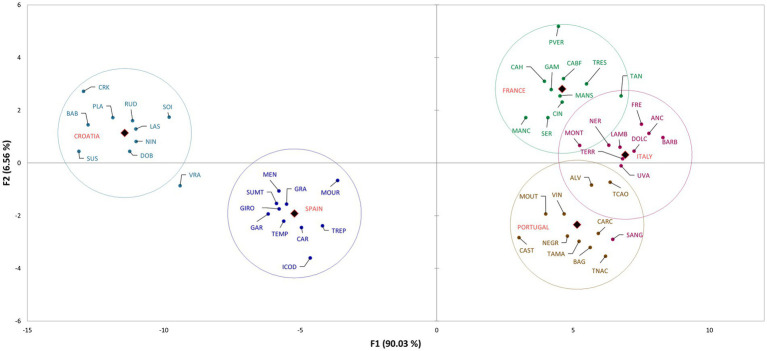
Grape volatile organic compounds (VOCs) play an important role in the winemaking industry due to their contribution to wine sensory characteristics. Another important role in the winemaking industry have the grapevine varieties used in specific regions or countries for wine production. Due to the high variability of grapevine germplasm, grapevine varieties are as classified based on their genetic and geographical origin into genetic-geographic groups (GEN-GEO). The aim of this research was to investigate VOCs in 50 red grapevine varieties belonging to different GEN-GEO groups. The study included varieties from groups C2 (Italy and France), C7 (Croatia), and C8 (Spain and Portugal). The analysis of VOCs was performed by SPME-Arrow-GC/MS directly from grape skins. The analyzed VOCs included aldehydes, ketones, acids, alcohols, monoterpenes, and sesquiterpenes. The most abundant VOCs were aldehydes and alcohols, while the most numerous were sesquiterpenes. The most abundant compounds, aldehydes and alcohols, were found to be ()-2-hexenal, hexenal, ()-2-hexen-1-ol, and 1-hexanol. Using discriminant analysis, the GEN-GEO groups were separated based on their volatile profile. Some of the individual compounds contributing to the discrimination were found in relatively small amounts, such as benzoic acid, ()-2,4-hexadienal, 4-pentenal, and nonanoic acid. The groups were also discriminated by their overall volatile profile: group C2 was characterized by a higher content of aldehydes and alcohols, and group C8 was characterized by a higher content of sesquiterpenes and acids. Group C7 was characterized by all low amount of all classes of VOCs.
葡萄挥发性有机化合物(VOCs)对葡萄酒的感官特性有重要贡献,在葡萄酒酿造行业中发挥着重要作用。特定地区或国家用于葡萄酒生产的葡萄品种在葡萄酒酿造行业中也起着重要作用。由于葡萄种质的高度变异性,葡萄品种根据其遗传和地理起源被分类为遗传地理组(GEN-GEO)。本研究的目的是调查属于不同GEN-GEO组的50个红葡萄品种中的VOCs。该研究包括来自C2组(意大利和法国)、C7组(克罗地亚)和C8组(西班牙和葡萄牙)的品种。通过SPME-Arrow-GC/MS直接从葡萄皮中对VOCs进行分析。分析的VOCs包括醛、酮、酸、醇、单萜和倍半萜。含量最丰富的VOCs是醛和醇,而种类最多的是倍半萜。含量最丰富的化合物醛和醇被发现是()-2-己烯醛、己烯醛、()-2-己烯-1-醇和1-己醇。使用判别分析,根据其挥发性特征将GEN-GEO组分开。导致这种区分的一些个别化合物含量相对较少,如苯甲酸、()-2,4-己二烯醛、4-戊烯醛和壬酸。这些组也通过其整体挥发性特征来区分:C2组的特征是醛和醇含量较高,C8组的特征是倍半萜和酸含量较高。C7组的特征是所有类别的VOCs含量都较低。