Yao Baojin, Wang Qiuqing, Liu Chia-Feng, Bhattaram Pallavi, Li Wei, Mead Timothy J, Crish James F, Lefebvre Véronique
Department of Cellular & Molecular Medicine, and Orthopaedic and Rheumatologic Research Center, Cleveland Clinic Lerner Research Institute, Cleveland, OH 44195, USA.
Department of Cellular & Molecular Medicine, and Orthopaedic and Rheumatologic Research Center, Cleveland Clinic Lerner Research Institute, Cleveland, OH 44195, USA
Nucleic Acids Res. 2015 Jun 23;43(11):5394-408. doi: 10.1093/nar/gkv426. Epub 2015 May 4.
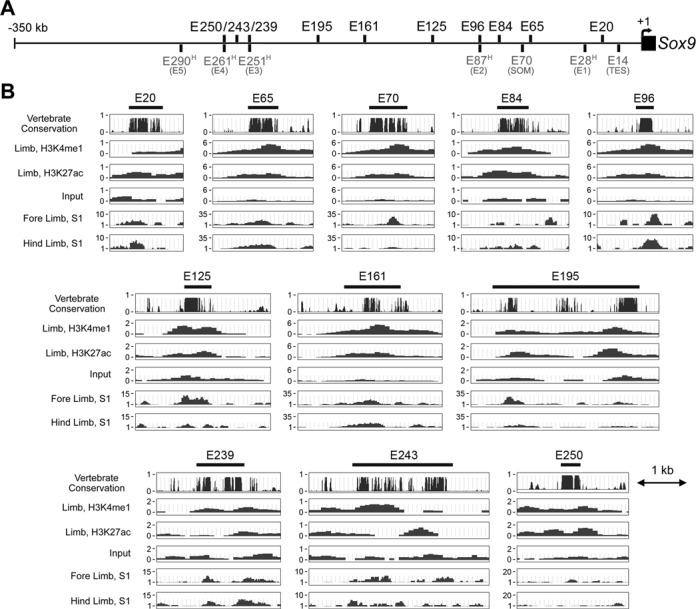
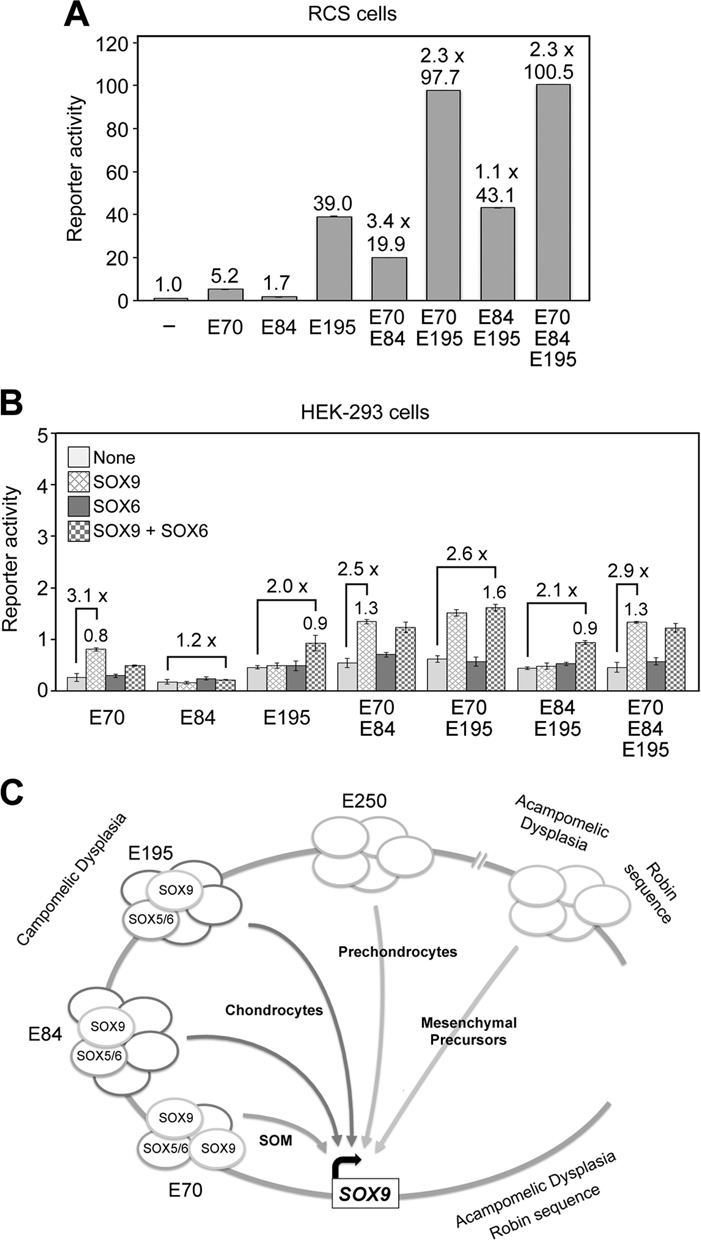
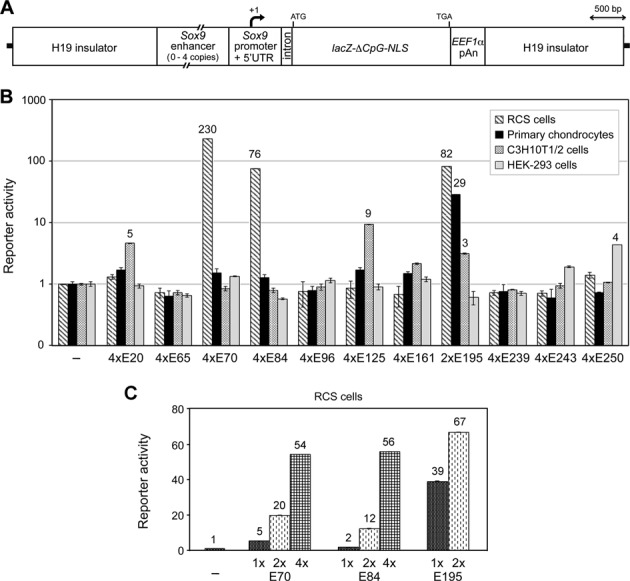
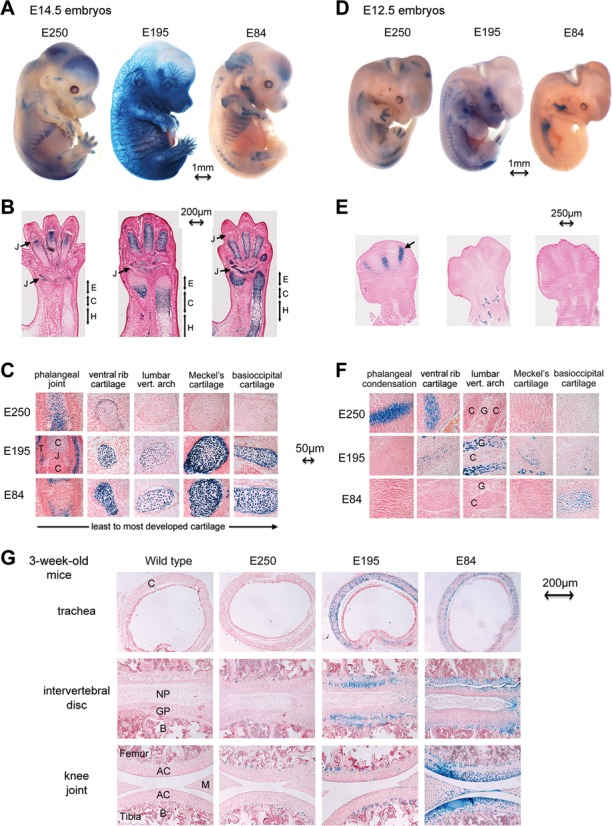
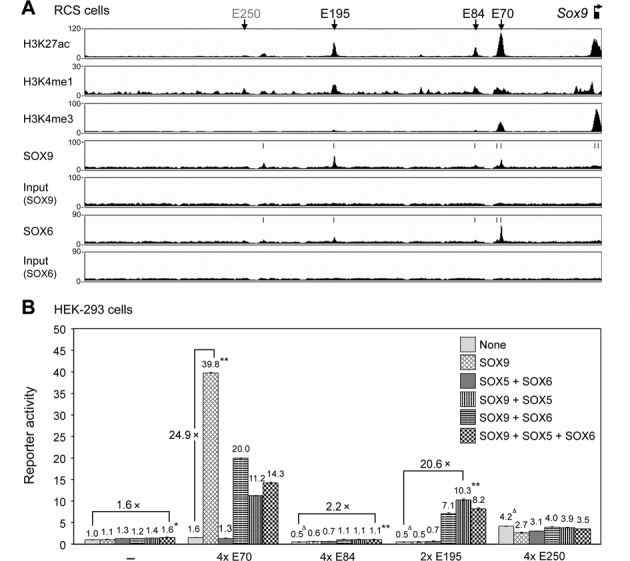
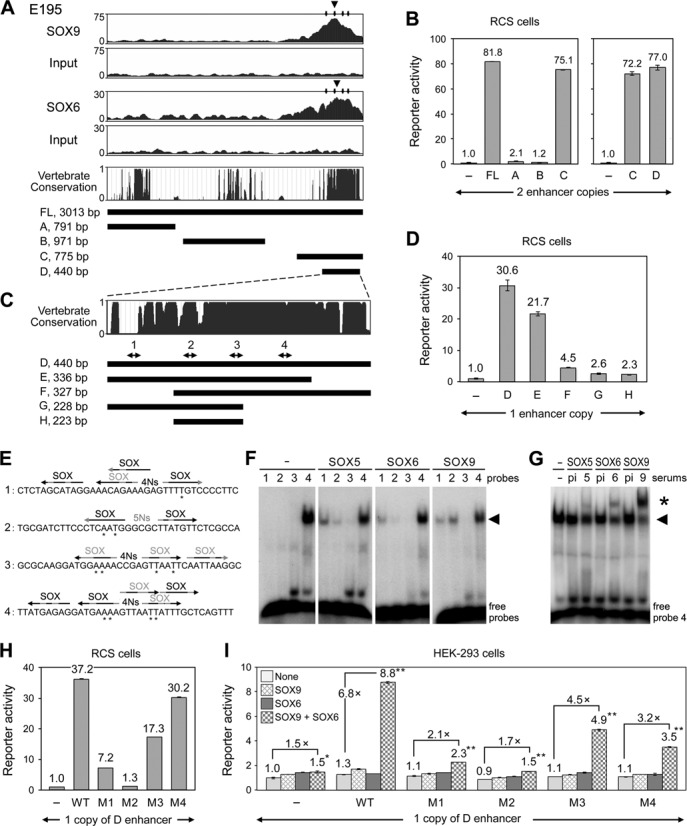
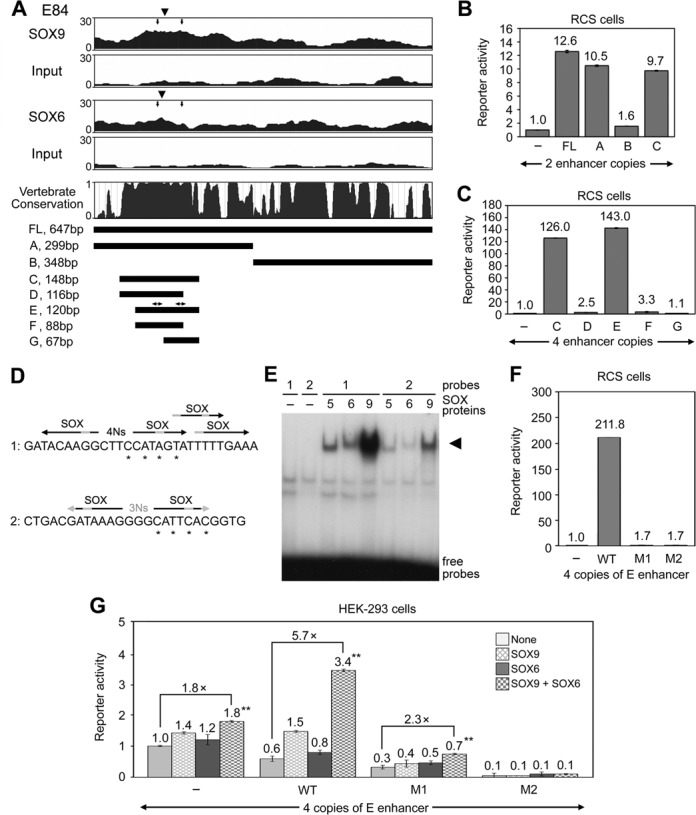
Two decades after the discovery that heterozygous mutations within and around SOX9 cause campomelic dysplasia, a generalized skeleton malformation syndrome, it is well established that SOX9 is a master transcription factor in chondrocytes. In contrast, the mechanisms whereby translocations in the --350/-50-kb region 5' of SOX9 cause severe disease and whereby SOX9 expression is specified in chondrocytes remain scarcely known. We here screen this upstream region and uncover multiple enhancers that activate Sox9-promoter transgenes in the SOX9 expression domain. Three of them are primarily active in chondrocytes. E250 (located at -250 kb) confines its activity to condensed prechondrocytes, E195 mainly targets proliferating chondrocytes, and E84 is potent in all differentiated chondrocytes. E84 and E195 synergize with E70, previously shown to be active in most Sox9-expressing somatic tissues, including cartilage. While SOX9 protein powerfully activates E70, it does not control E250. It requires its SOX5/SOX6 chondrogenic partners to robustly activate E195 and additional factors to activate E84. Altogether, these results indicate that SOX9 expression in chondrocytes relies on widely spread transcriptional modules whose synergistic and overlapping activities are driven by SOX9, SOX5/SOX6 and other factors. They help elucidate mechanisms underlying campomelic dysplasia and will likely help uncover other disease mechanisms.
在发现SOX9基因内部及其周围的杂合突变会导致弯肢侏儒症(一种全身性骨骼畸形综合征)二十年后,人们已经充分认识到SOX9是软骨细胞中的主要转录因子。相比之下,位于SOX9基因5'端-350/-50-kb区域的易位导致严重疾病的机制以及SOX9在软骨细胞中特异性表达的机制仍鲜为人知。我们在此筛选该上游区域,发现了多个在SOX9表达域中激活Sox9启动子转基因的增强子。其中三个主要在软骨细胞中活跃。E250(位于-250 kb处)将其活性限制在浓缩的前软骨细胞中,E195主要靶向增殖的软骨细胞,而E84在所有分化的软骨细胞中都具有活性。E84和E195与E70协同作用,E70先前已被证明在包括软骨在内的大多数表达Sox9的体细胞组织中具有活性。虽然SOX9蛋白能强力激活E70,但它并不控制E250。它需要其SOX5/SOX6软骨生成伙伴来强力激活E195,并需要其他因子来激活E84。总之,这些结果表明软骨细胞中SOX9的表达依赖于广泛分布的转录模块,其协同和重叠活动由SOX9、SOX5/SOX6和其他因子驱动。它们有助于阐明弯肢侏儒症的潜在机制,并可能有助于揭示其他疾病机制。