Wang Weiguang, Rigueur Diana, Lyons Karen M
Department of Orthopaedic Surgery and Orthopaedic Institute for Children, David Geffen School of Medicine, University of California, Los Angeles, California, 90095.
Birth Defects Res C Embryo Today. 2014 Mar;102(1):37-51. doi: 10.1002/bdrc.21058.
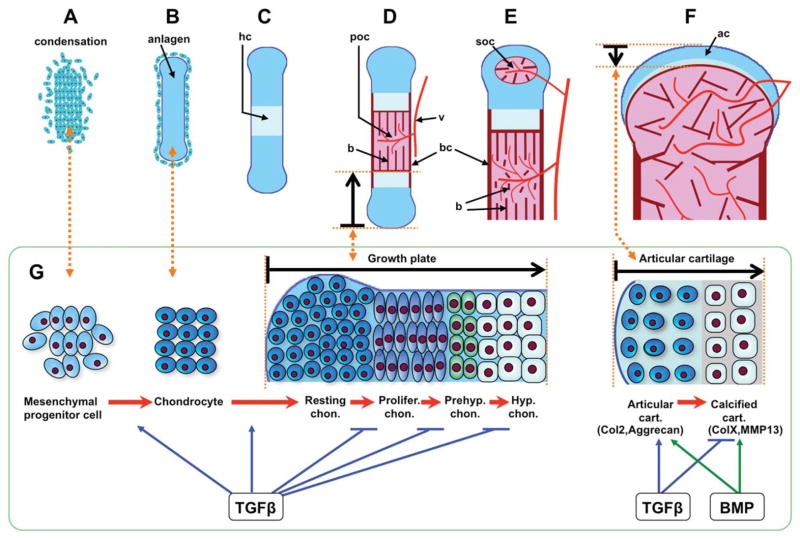
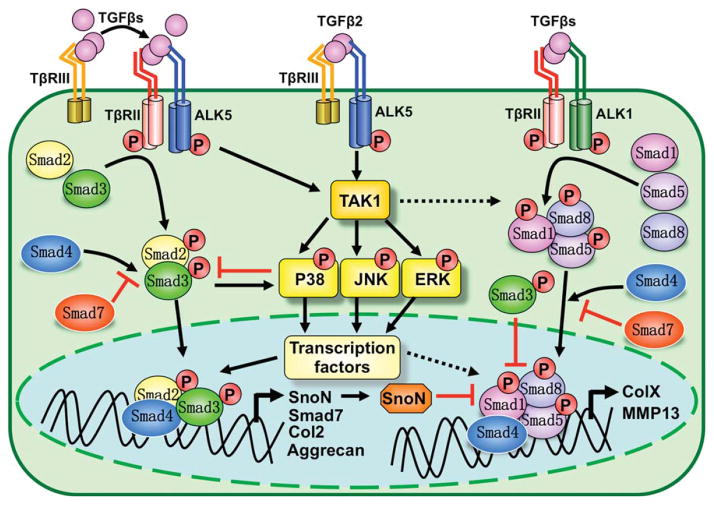
Members of the transforming growth factor beta (TGFβ) superfamily of secreted factors play essential roles in nearly every aspect of cartilage formation and maintenance. However, the mechanisms by which TGFβs transduce their effects in cartilage in vivo remain poorly understood. Mutations in several TGFβ family members, their receptors, extracellular modulators, and intracellular transducers have been described, and these usually impact the development of the cartilaginous skeleton. Furthermore, genome-wide association studies have linked components of the (TGFβ) superfamily to susceptibility to osteoarthritis. This review focuses on recent discoveries from genetic studies in the mouse regarding the regulation of TGFβ signaling in developing growth plate and articular cartilage, as well as the different modes of crosstalk between canonical and noncanonical TGFβ signaling. These new insights into TGFβ signaling in cartilage may open new prospects for therapies that maintain healthy articular cartilage.
分泌因子转化生长因子β(TGFβ)超家族的成员在软骨形成和维持的几乎每个方面都发挥着重要作用。然而,TGFβs在体内软骨中传导其作用的机制仍知之甚少。已经描述了几种TGFβ家族成员、其受体、细胞外调节剂和细胞内转导器中的突变,这些通常会影响软骨骨骼的发育。此外,全基因组关联研究已将(TGFβ)超家族的成分与骨关节炎易感性联系起来。本综述重点关注小鼠遗传学研究中关于发育中的生长板和关节软骨中TGFβ信号调节的最新发现,以及经典和非经典TGFβ信号之间不同的串扰模式。这些对软骨中TGFβ信号的新见解可能为维持健康关节软骨的治疗开辟新前景。