Pongpan Surangrat, Wisitwong Apichart, Tawichasri Chamaiporn, Patumanond Jayanton, Namwongprom Sirianong
Program in Clinical Epidemiology, Faculty of Medicine, Chiang Mai University, Chiang Mai 50200, Thailand ; Department of Occupational Medicine, Phrae Hospital, Phrae 54000, Thailand.
ISRN Pediatr. 2013 Nov 12;2013:845876. doi: 10.1155/2013/845876. eCollection 2013.
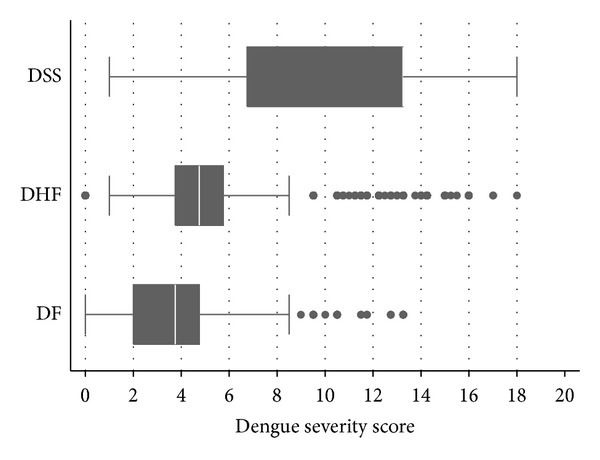
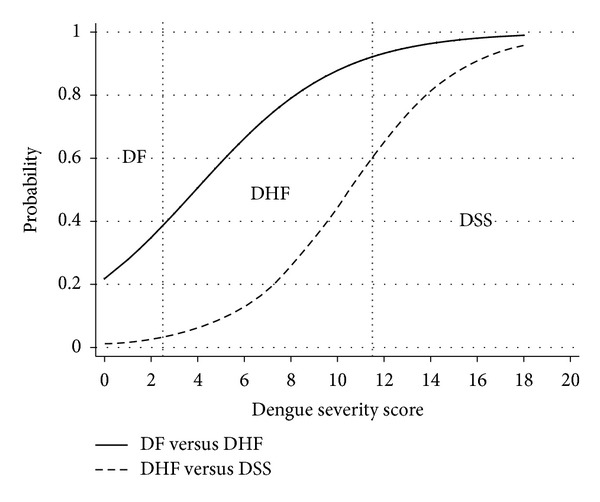
Objectives. To develop a simple scoring system to predict dengue infection severity based on patient characteristics and routine clinical profiles. Methods. Retrospective data of children with dengue infection from 3 general hospitals in Thailand were reviewed. Dengue infection was categorized into 3 severity levels: dengue infection (DF), dengue hemorrhagic fever (DHF), and dengue shock syndrome (DSS). Coefficients of significant predictors of disease severity under ordinal regression analysis were transformed into item scores. Total scores were used to classify patients into 3 severity levels. Results. Significant clinical predictors of dengue infection severity were age >6 years, hepatomegaly, hematocrit ≥40%, systolic pressure <90 mmHg, white cell count >5000 / μ L, and platelet ≤50000 / μ L. The derived total scores, which ranged from 0 to 18, classified patients into 3 severity levels: DF (scores <2.5, n = 451, 58.1%), DHF (scores 2.5-11.5, n = 276, 35.5%), and DSS (scores >11.5, n = 50, 6.4%). The derived score correctly classified patients into their original severity levels in 60.7%. An under-estimation of 25.7% and an over-estimation of 13.5% were clinically acceptable. Conclusions. The derived dengue infection severity score classified patients into DF, DHF, or DSS, correctly into their original severity levels. Validation of the score should be reconfirmed before application of routine practice.
目的。基于患者特征和常规临床资料开发一种简单的评分系统,以预测登革热感染的严重程度。方法。回顾泰国3家综合医院登革热感染儿童的回顾性数据。登革热感染分为3个严重程度级别:登革热感染(DF)、登革出血热(DHF)和登革休克综合征(DSS)。将有序回归分析中疾病严重程度的显著预测因素的系数转换为项目得分。总得分用于将患者分为3个严重程度级别。结果。登革热感染严重程度的显著临床预测因素为年龄>6岁、肝肿大、血细胞比容≥40%、收缩压<90 mmHg、白细胞计数>5000 /μL和血小板≤50000 /μL。得出的总得分范围为0至18分,将患者分为3个严重程度级别:DF(得分<2.5,n = 451,58.1%)、DHF(得分2.5 - 11.5,n = 276,35.5%)和DSS(得分>11.5,n = 50,6.4%)。得出的得分将患者正确分类到其原始严重程度级别的比例为60.7%。临床可接受的低估率为25.7%,高估率为13.5%。结论。得出的登革热感染严重程度评分可将患者分为DF、DHF或DSS,并正确分类到其原始严重程度级别。在常规实践应用前,应再次确认该评分的有效性。