Nguyen Minh Tuan, Ho Thi Nhan, Nguyen Van Vinh Chau, Nguyen Thanh Hung, Ha Manh Tuan, Ta Van Tram, Nguyen Le Da Ha, Phan Loi, Han Khoi Quang, Duong Thi Hue Kien, Tran Nguyen Bich Chau, Wills Bridget, Wolbers Marcel, Simmons Cameron P
Children's Hospital No. 1, Ho Chi Minh City, Vietnam
Oxford University Clinical Research Unit, Hospital for Tropical Diseases, Oxford, England, UK.
Clin Infect Dis. 2017 Mar 1;64(5):656-663. doi: 10.1093/cid/ciw863.
Early prediction of severe dengue could significantly assist patient triage and case management.
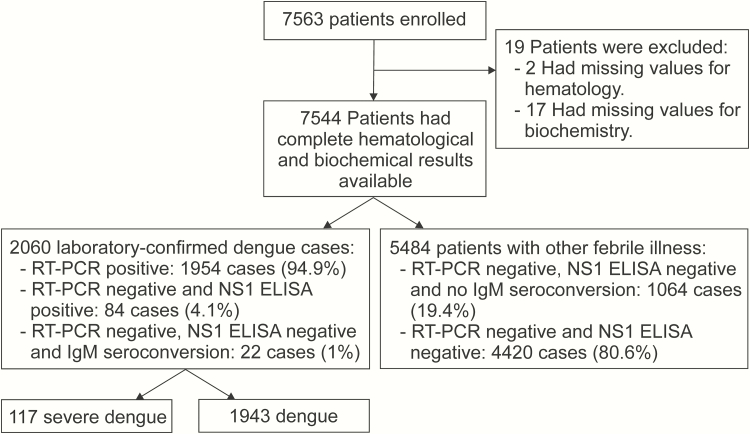
We prospectively investigated 7563 children with ≤3 days of fever recruited in the outpatient departments of 6 hospitals in southern Vietnam between 2010 and 2013. The primary endpoint of interest was severe dengue (2009 World Health Organization Guidelines), and predefined risk variables were collected at the time of enrollment to enable prognostic model development.
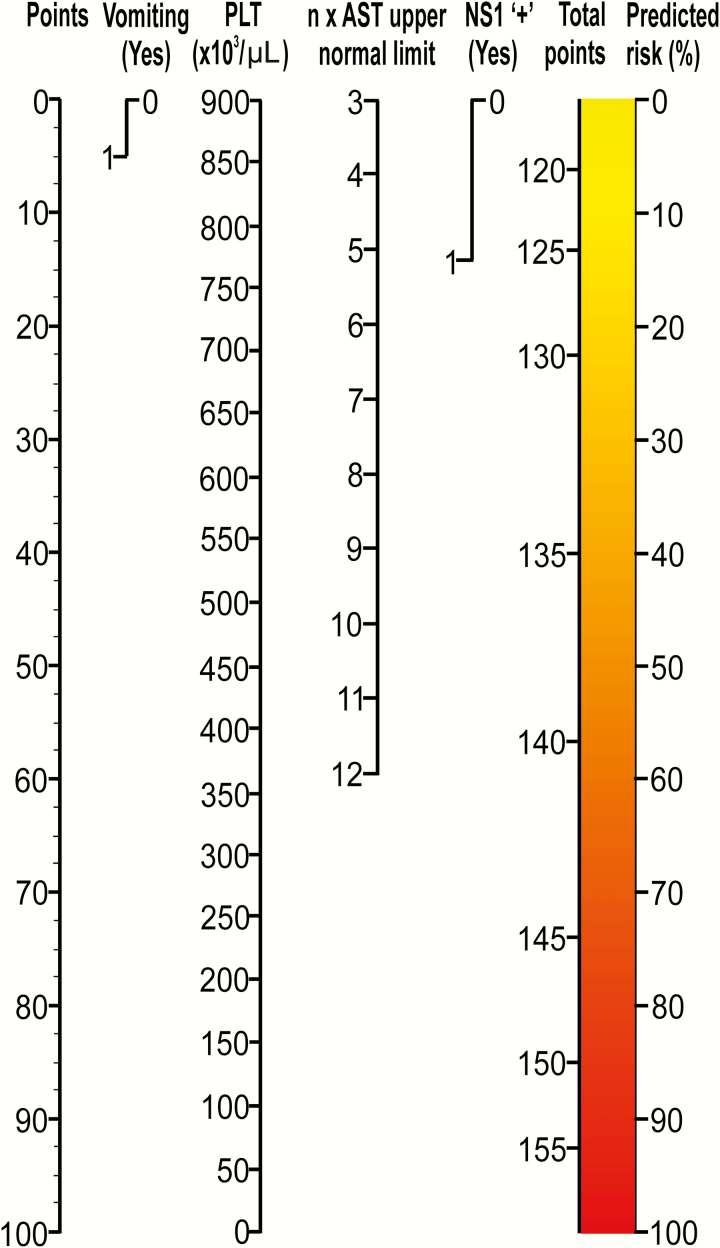
The analysis population comprised 7544 patients, of whom 2060 (27.3%) had laboratory-confirmed dengue; nested among these were 117 (1.5%) severe cases. In the multivariate logistic model, a history of vomiting, lower platelet count, elevated aspartate aminotransferase (AST) level, positivity in the nonstructural protein 1 (NS1) rapid test, and viremia magnitude were all independently associated with severe dengue. The final prognostic model (Early Severe Dengue Identifier [ESDI]) included history of vomiting, platelet count, AST level. and NS1 rapid test status.
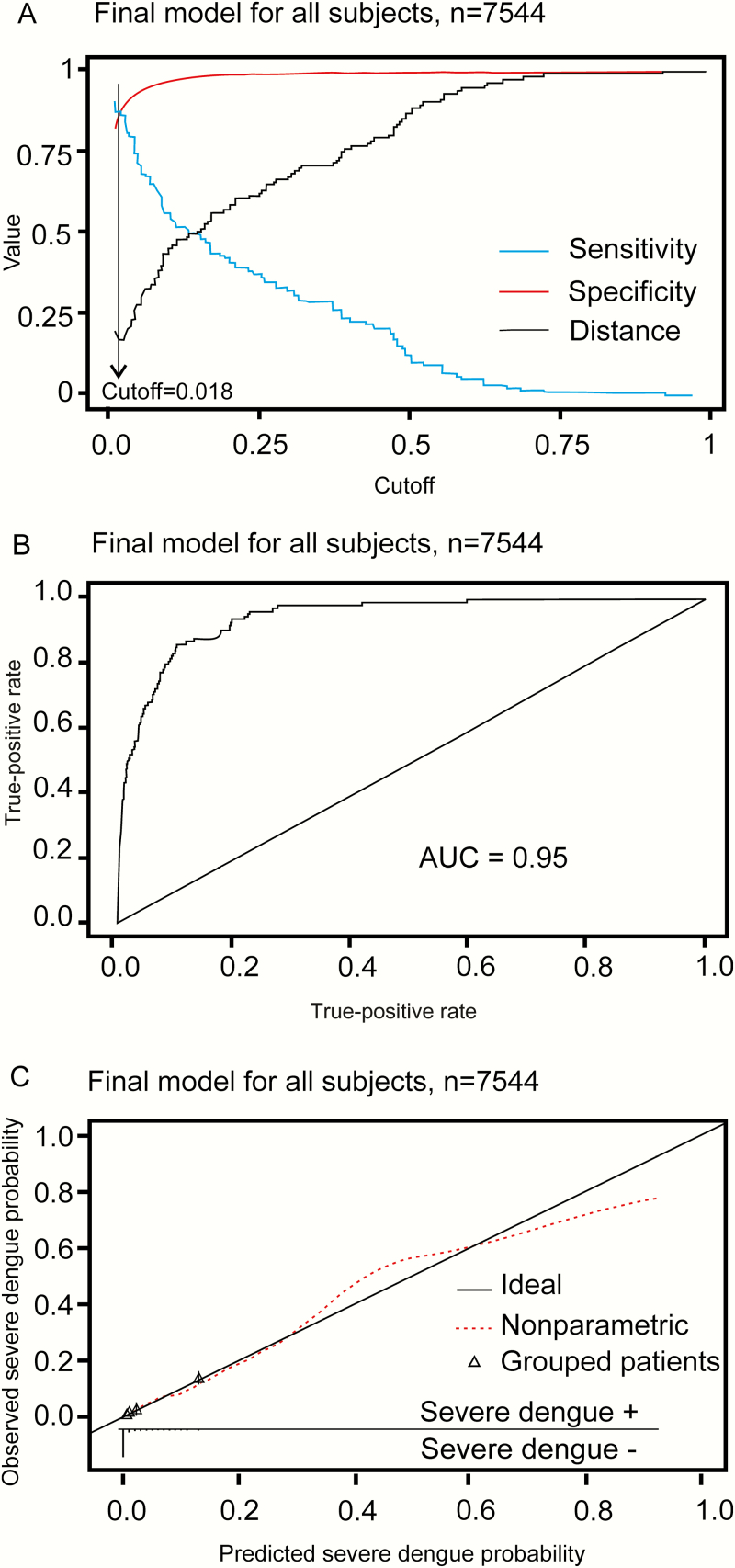
The ESDI had acceptable performance features (area under the curve = 0.95, sensitivity 87% (95% confidence interval [CI], 80%-92%), specificity 88% (95% CI, 87%-89%), positive predictive value 10% (95% CI, 9%-12%), and negative predictive value of 99% (95% CI, 98%-100%) in the population of all 7563 enrolled children. A score chart, for routine clinical use, was derived from the prognostic model and could improve triage and management of children presenting with fever in dengue-endemic areas.
早期预测重症登革热可显著有助于患者分流和病例管理。
我们对2010年至2013年间在越南南部6家医院门诊部招募的7563名发热≤3天的儿童进行了前瞻性研究。主要关注终点为重症登革热(2009年世界卫生组织指南),并在入组时收集预先定义的风险变量以建立预后模型。
分析人群包括7544例患者,其中2060例(27.3%)实验室确诊为登革热;其中有117例(1.5%)为重症病例。在多因素逻辑模型中,呕吐史、较低的血小板计数、天冬氨酸转氨酶(AST)水平升高、非结构蛋白1(NS1)快速检测呈阳性以及病毒血症程度均与重症登革热独立相关。最终的预后模型(早期重症登革热识别器[ESDI])包括呕吐史、血小板计数、AST水平和NS1快速检测状态。
在所有7563名入组儿童人群中,ESDI具有可接受的性能特征(曲线下面积=0.95,敏感性87%(95%置信区间[CI],80%-92%),特异性88%(95%CI,87%-89%),阳性预测值10%(95%CI,9%-12%),阴性预测值99%(95%CI,98%-100%)。从预后模型得出了一份供常规临床使用的评分表,可改善登革热流行地区发热儿童的分流和管理。