Lehne Moritz, Engel Philipp, Rohrmeier Martin, Menninghaus Winfried, Jacobs Arthur M, Koelsch Stefan
Cluster "Languages of Emotion", Freie Universität Berlin, Berlin, Germany.
Institut für Kunst- und Musikwissenschaft, TU Dresden, Dresden, Germany.
PLoS One. 2015 May 6;10(5):e0124550. doi: 10.1371/journal.pone.0124550. eCollection 2015.
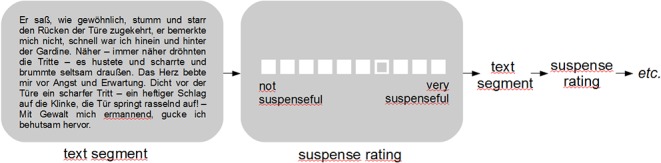
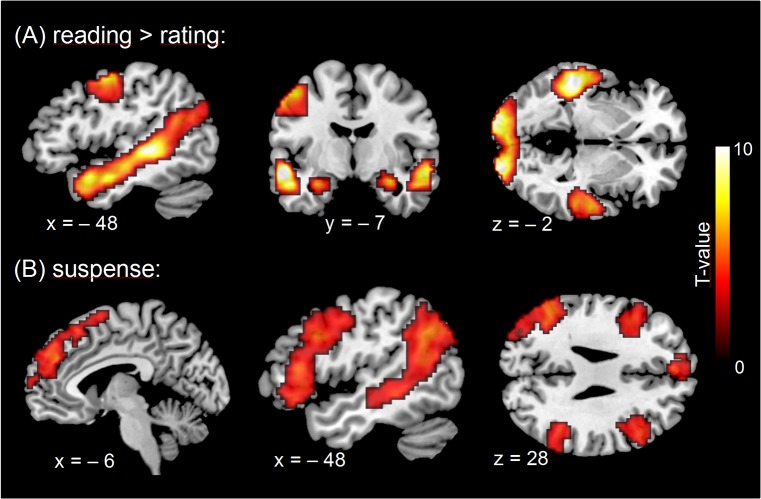
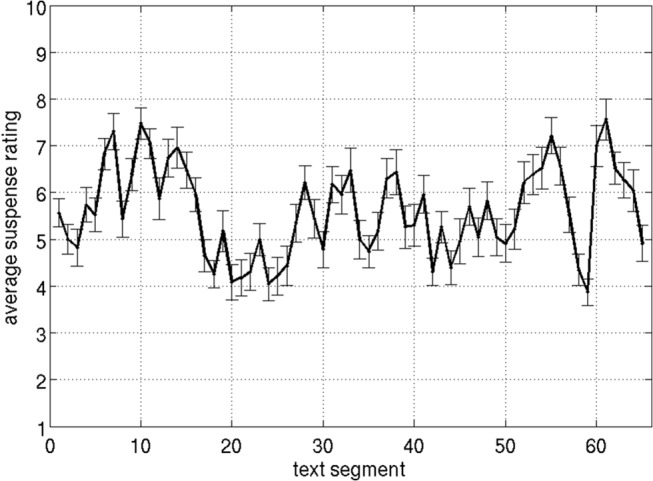
Stories can elicit powerful emotions. A key emotional response to narrative plots (e.g., novels, movies, etc.) is suspense. Suspense appears to build on basic aspects of human cognition such as processes of expectation, anticipation, and prediction. However, the neural processes underlying emotional experiences of suspense have not been previously investigated. We acquired functional magnetic resonance imaging (fMRI) data while participants read a suspenseful literary text (E.T.A. Hoffmann's "The Sandman") subdivided into short text passages. Individual ratings of experienced suspense obtained after each text passage were found to be related to activation in the medial frontal cortex, bilateral frontal regions (along the inferior frontal sulcus), lateral premotor cortex, as well as posterior temporal and temporo-parietal areas. The results indicate that the emotional experience of suspense depends on brain areas associated with social cognition and predictive inference.
故事能够引发强烈的情感。对叙事情节(如小说、电影等)的一种关键情感反应是悬念。悬念似乎建立在人类认知的基本方面,如期望、预期和预测过程之上。然而,悬念情感体验背后的神经过程此前尚未得到研究。我们在参与者阅读一篇悬疑文学文本(E.T.A. 霍夫曼的《睡魔》)并将其细分为短文本段落时获取了功能磁共振成像(fMRI)数据。发现每次文本段落之后获得的个人悬念体验评分与内侧前额叶皮层、双侧额叶区域(沿额下回沟)、外侧运动前皮层以及颞叶后部和颞顶区域的激活有关。结果表明,悬念的情感体验取决于与社会认知和预测推理相关的脑区。