Chassot Mônica, Dussan-Sarria Jairo Alberto, Sehn Francislea Cristina, Deitos Alícia, de Souza Andressa, Vercelino Rafael, Torres Iraci L S, Fregni Felipe, Caumo Wolnei
Post-Graduate Program in Medical Sciences, School of Medicine, Universidade Federal do Rio Grande do Sul (UFRGS), Porto Alegre, Brazil.
Laboratory of Pain and Neuromodulation, Hospital de Clínicas de Porto Alegre at UFRGS, Rua Ramiro Barcelos, 2350 - CEP 90035-003 Bairro Rio Branco, Porto, Brazil.
BMC Complement Altern Med. 2015 May 7;15:144. doi: 10.1186/s12906-015-0664-x.
Chronic tension-type headache (CTTH) is characterized by almost daily headaches and central sensitization, for which electroacupuncture (EA) might be effective. The central nervous system (CNS) plasticity can be tracked in serum using the brain-derived neurotrophic factor (BDNF), a neuroplasticity mediator. Thus, we tested the hypothesis that EA analgesia in CTTH is related to neuroplasticity indexed by serum BDNF.
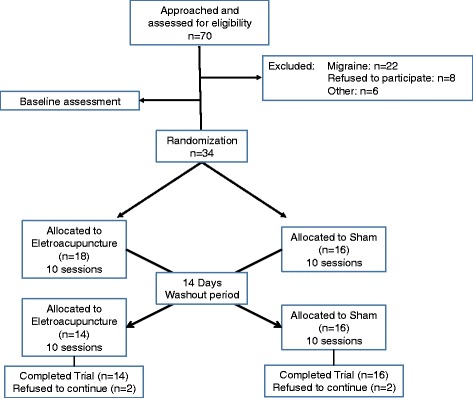
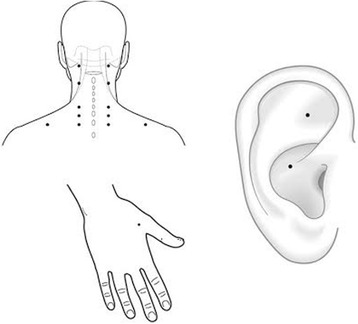
We enrolled females aged 18-60 years with CTTH in a randomized, blinded, placebo-controlled crossover trial, comparing ten EA sessions applied for 30 minutes (2-10 Hz, intensity by tolerance) in cervical areas twice per week vs. a sham intervention. Treatment periods were separated by two washout weeks. Pain on the 10-cm visual analog scale (VAS) and serum BDNF were assessed as primary outcomes.
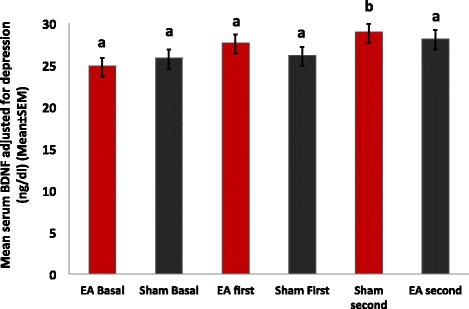
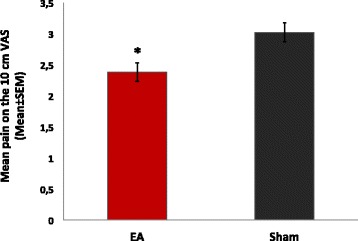
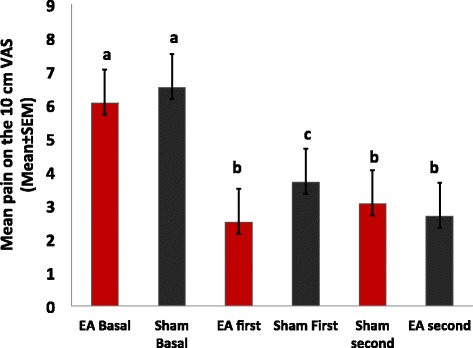
Thirty-four subjects underwent randomization, and twenty-nine completed the protocol. EA was superior to sham to alleviate pain (VAS scores 2.38 ± 1.77 and 3.02 ± 2.49, respectively, P = 0.005). The VAS scores differed according to the intervention sequence, demonstrating a carryover effect (P < 0.05). Using multiple regression, serum BDNF was adjusted for the Hamilton depression rating scale (HDRS) and the VAS scores (r-squared = 0.07, standard β coefficients = -0.2 and -0.14, respectively, P < 0.001). At the end of the first intervention period, the adjusted BDNF was higher in the EA phase (29.31 ± 3.24, 27.53 ± 2.94 ng/mL, Cohen's d = 0.55).
EA analgesia is related to neuroplasticity indexed by the adjusted BDNF. EA modulation of pain and BDNF occurs according to the CNS situation at the moment of its administration, as it was related to depression and the timing of its administration.
慢性紧张型头痛(CTTH)的特征是几乎每日头痛及中枢敏化,电针(EA)可能对此有效。中枢神经系统(CNS)可塑性可通过血清中的脑源性神经营养因子(BDNF,一种神经可塑性介质)进行追踪。因此,我们检验了如下假设:CTTH患者中电针镇痛与血清BDNF所标记的神经可塑性相关。
我们将年龄在18至60岁的CTTH女性纳入一项随机、双盲、安慰剂对照的交叉试验,比较每周两次在颈部区域进行30分钟的电针治疗(2 - 10Hz,强度依耐受而定)与假干预。治疗周期之间间隔两周洗脱期。采用10厘米视觉模拟量表(VAS)评估疼痛程度,并将血清BDNF作为主要结局指标。
34名受试者接受随机分组,29名完成试验方案。电针在缓解疼痛方面优于假干预(VAS评分分别为2.38±1.77和3.02±2.49,P = 0.005)。VAS评分因干预顺序而异,显示出遗留效应(P < 0.05)。采用多元回归分析,对血清BDNF进行汉密尔顿抑郁量表(HDRS)及VAS评分校正(决定系数 = 0.07,标准β系数分别为 - 0.2和 - 0.14,P < 0.001)。在第一个干预期结束时,电针阶段校正后的BDNF水平更高(29.31±3.24,27.53±2.94 ng/mL,Cohen's d = 0.55)。
电针镇痛与校正后的BDNF所标记的神经可塑性相关。电针对疼痛和BDNF的调节取决于给药时的中枢神经系统状况,因为其与抑郁及给药时间有关。