Wang Yimeng, Lu Wang, Wang Yongjun, Chen Wei, Zhao Haiyin
Department of Acupuncture, Longhua Hospital Affiliated to Shanghai University of Traditional Chinese Medicine, Shanghai, China.
Key Laboratory of Theory and Therapy of Muscles and Bones, Shanghai University of Traditional Chinese Medicine, Shanghai, China.
Front Neurol. 2024 Dec 5;15:1481715. doi: 10.3389/fneur.2024.1481715. eCollection 2024.
Tension-type headache (TTH) is among the most common primary headache disorders, characterized by recurrent episodes that are difficult to manage, thus posing a significant public health challenge. Acupuncture, a well-recognized non-pharmacological treatment, is frequently employed for pain management, including TTH. However, the variety of acupuncture techniques and inconsistent treatment outcomes underscore the need for a thorough evaluation. This study aims to update the current evidence on acupuncture and related therapies for TTH, evaluate the efficacy and safety of various acupuncture therapies, and identify the most effective therapeutic strategies, providing valuable guidance for clinical practice.
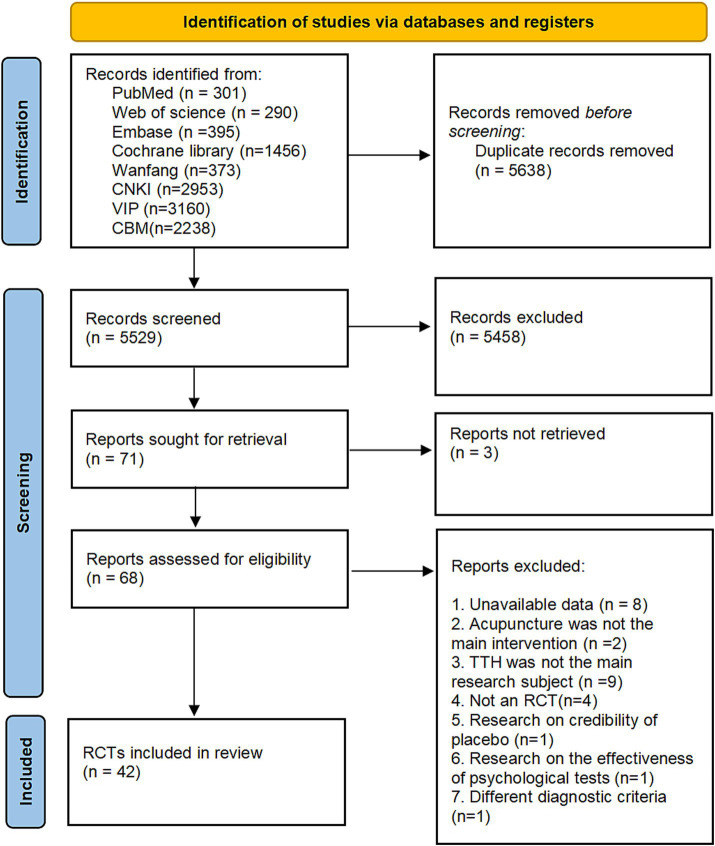
We systematically searched randomized controlled trials (RCTs) from four English databases (PubMed, Embase, Cochrane Library, and Web of Science) and four Chinese databases (Wanfang, VIP, CNKI, and SinoMed), including gray literature, up to April 19, 2024. The outcome measures included headache frequency, duration, pain intensity, and responder rate. A Bayesian network meta-analysis was conducted using Stata 17.0 to assess the relative effectiveness and safety of the different acupuncture therapies. This study was registered with the Prospective Register of Systematic Reviews (CRD42024537187).
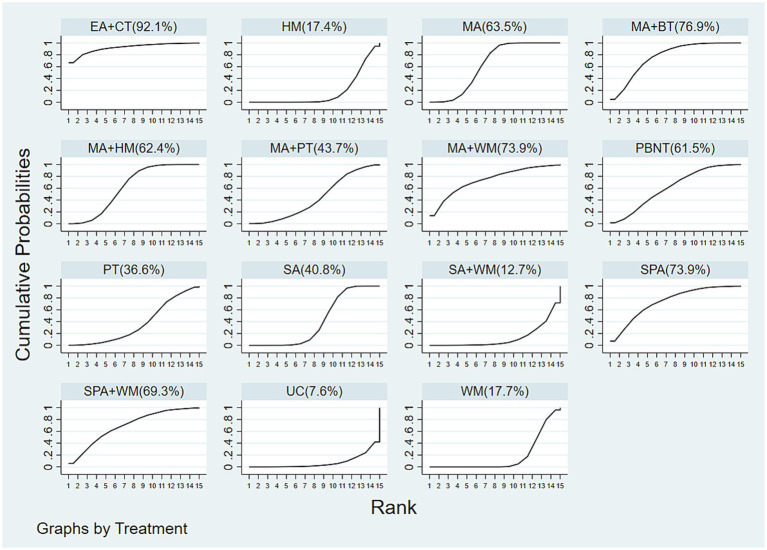
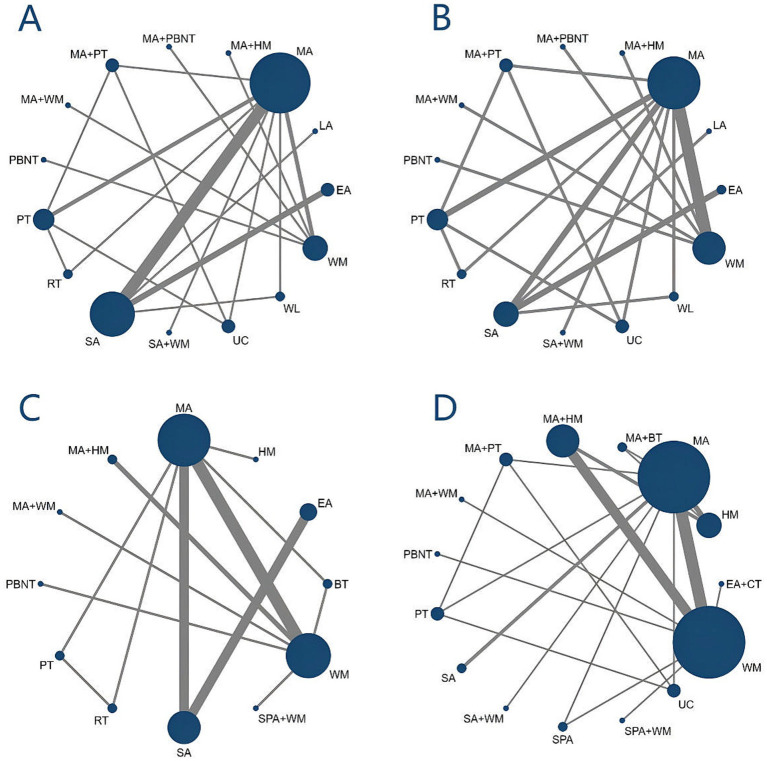
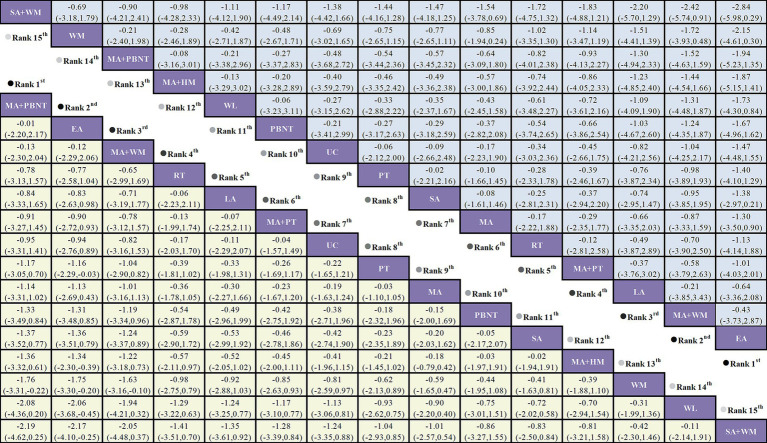
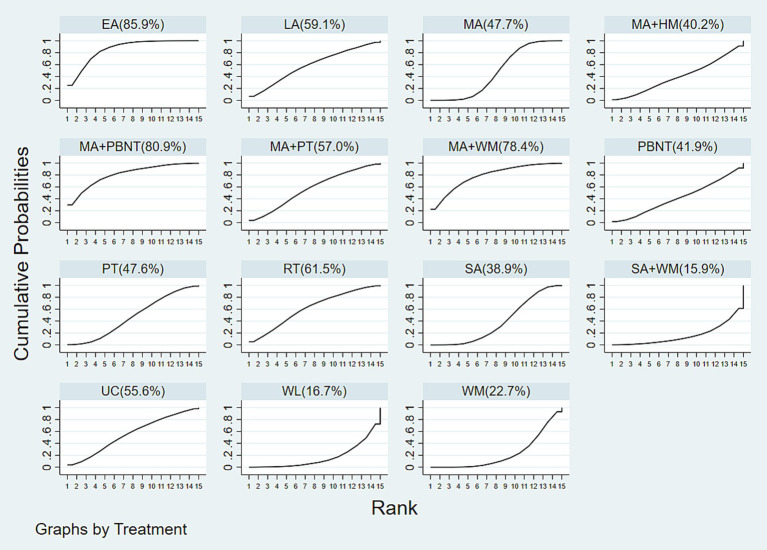
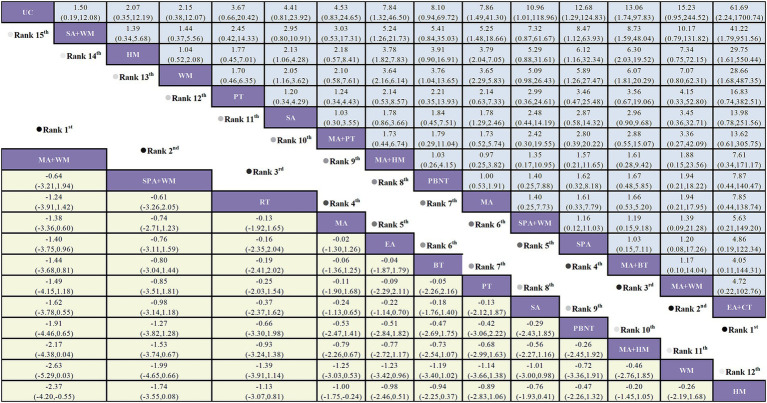
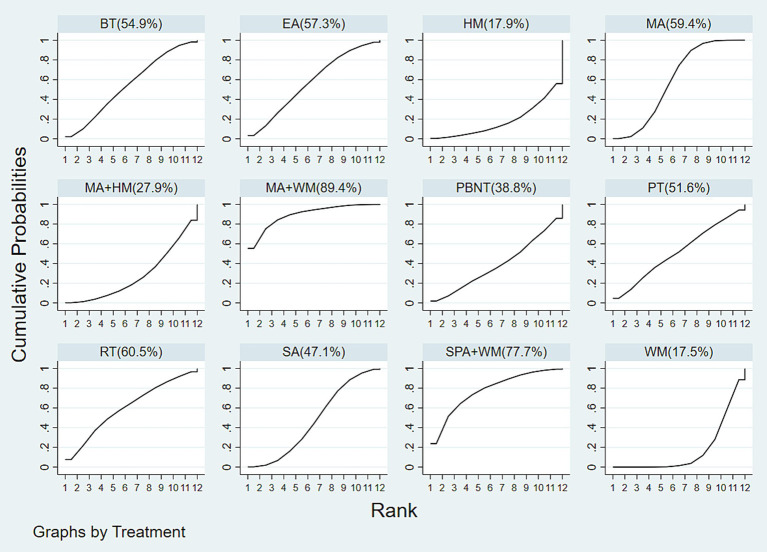
A total of 42 RCTs, encompassing 4,103 participants and 21 distinct treatment therapies, were included in the analysis. The network meta-analysis yielded the following findings: (1) regarding responder rate, several acupuncture or combined acupuncture and medication approaches, such as electro-acupuncture (EA) + cupping therapy (CT) [odds ratio (OR) = 28.66, 95% CI: 1.68 to 487.35], manual acupuncture (MA) + bloodletting therapy (BT) (OR = 6.07, 95% CI: 1.81 to 20.29), plum blossom needle tapping (PBNT) (OR = 3.76, 95% CI: 1.04 to 13.65), and scalp acupuncture (SPA) (OR = 3.65, 95% CI: 2.29 to 5.83), were significantly more effective than western medicine (WM) alone, with EA + CT (92.1%) being the most effective. (2) In terms of reducing headache frequency, EA (85.9%) was the most effective, followed by MA + PBNT (80.9%) and MA + WM (78.4%). Compared to WM, both MA + PBNT (SMD = -1.76, 95% CI: -3.31 to -0.22) and EA (SMD = -1.75, 95% CI: -3.30 to -0.20) significantly reduced headache frequency. (3) For shortening headache duration, EA (83.9%) emerged as the most effective treatment, followed by MA + WM (73.5%) and laser acupuncture (LA) (68.5%). (4) In terms of pain intensity reduction, the MA + WM combination (89.4%) was superior to other treatments, with SPA + WM (77.7%) being the next most effective. Compared to herbal medicine (HM), both MA + WM (SMD = -2.37, 95% CI: -4.20 to -0.55) and MA alone (SMD = -1.00, 95% CI: -1.75 to -0.24) significantly alleviated pain intensity.
This comprehensive analysis of 21 acupuncture and related therapies demonstrates that EA is the most effective in reducing headache frequency and shortening headache duration, while EA + CT and MA + WM are the optimal therapies for enhancing responder rate and reducing pain intensity, respectively. However, clinical decisions should be individualized based on the specific needs of each patient.
The study protocol was registered on the PROSPERO database under registration number CRD42024537187 (https://www.crd.york.ac.uk/prospero/#recordDetails).
紧张型头痛(TTH)是最常见的原发性头痛疾病之一,其特点是发作反复且难以控制,对公共卫生构成重大挑战。针灸作为一种公认的非药物治疗方法,常用于疼痛管理,包括TTH的治疗。然而,针灸技术的多样性以及治疗效果的不一致性凸显了进行全面评估的必要性。本研究旨在更新当前关于针灸及相关疗法治疗TTH的证据,评估各种针灸疗法的疗效和安全性,并确定最有效的治疗策略,为临床实践提供有价值的指导。
我们系统检索了截至2024年4月19日的四个英文数据库(PubMed、Embase、Cochrane图书馆和Web of Science)以及四个中文数据库(万方、维普、知网和中国生物医学文献数据库)中的随机对照试验(RCT),包括灰色文献。结局指标包括头痛频率、持续时间、疼痛强度和缓解率。使用Stata 17.0进行贝叶斯网络荟萃分析,以评估不同针灸疗法的相对有效性和安全性。本研究已在系统评价前瞻性注册库(CRD42024537187)注册。
分析共纳入42项RCT,涉及4103名参与者和21种不同的治疗方法。网络荟萃分析得出以下结果:(1)关于缓解率,几种针灸或针灸联合药物治疗方法,如电针(EA)+拔罐疗法(CT)[比值比(OR)=28.66,95%置信区间(CI):1.68至487.35]、手针(MA)+放血疗法(BT)(OR = 6.07,95% CI:1.81至20.29)、梅花针叩刺(PBNT)(OR = 3.76,95% CI:1.04至13.65)和头皮针(SPA)(OR = 3.65,95% CI:2.29至5.83),比单纯西药(WM)显著更有效,其中EA + CT(92.1%)最有效。(2)在减少头痛频率方面,EA(85.9%)最有效,其次是MA + PBNT(80.9%)和MA + WM(78.4%)。与WM相比,MA + PBNT(标准化均数差(SMD)=-1.76,95% CI:-3.31至-0.22)和EA(SMD = -1.75,95% CI:-3.30至-0.20)均显著降低了头痛频率。(3)对于缩短头痛持续时间,EA(83.9%)是最有效的治疗方法,其次是MA + WM(73.5%)和激光针(LA)(68.5%)。(4)在减轻疼痛强度方面,MA + WM联合治疗(89.4%)优于其他治疗方法,其次是SPA + WM(77.7%)。与草药(HM)相比,MA + WM(SMD = -2.37,95% CI:-4.20至-0.55)和单纯MA(SMD = -1.00,95% CI:-1.75至-0.24)均显著减轻了疼痛强度。
对21种针灸及相关疗法的综合分析表明,EA在减少头痛频率和缩短头痛持续时间方面最有效,而EA + CT和MA + WM分别是提高缓解率和减轻疼痛强度的最佳疗法。然而,临床决策应根据每个患者的具体需求个体化制定。
该研究方案已在PROSPERO数据库注册,注册号为CRD42024537187(https://www.crd.york.ac.uk/prospero/#recordDetails)。