Eichstaedt Christina A, Antão Tiago, Cardona Alexia, Pagani Luca, Kivisild Toomas, Mormina Maru
Division of Biological Anthropology, University of Cambridge, Cambridge, Cambridgeshire, UK Centre for Pulmonary Hypertension, Thoraxclinic at the University Hospital Heidelberg, Heidelberg, Baden-Württemberg, Germany
Department of Vector Biology, Liverpool School of Tropical Medicine, Liverpool, Lancashire, UK.
Physiol Rep. 2015 May;3(5). doi: 10.14814/phy2.12376.
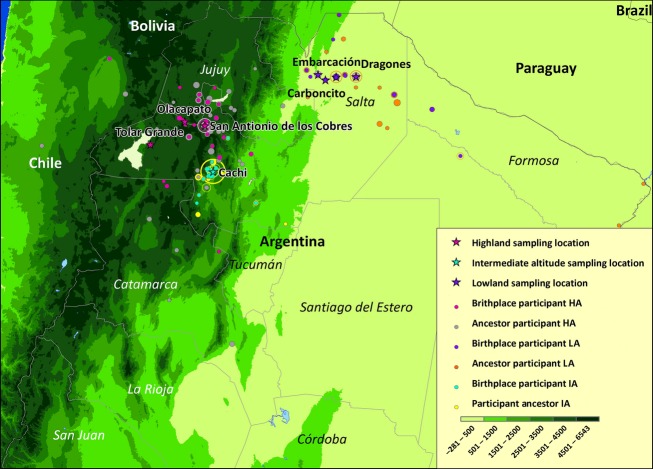
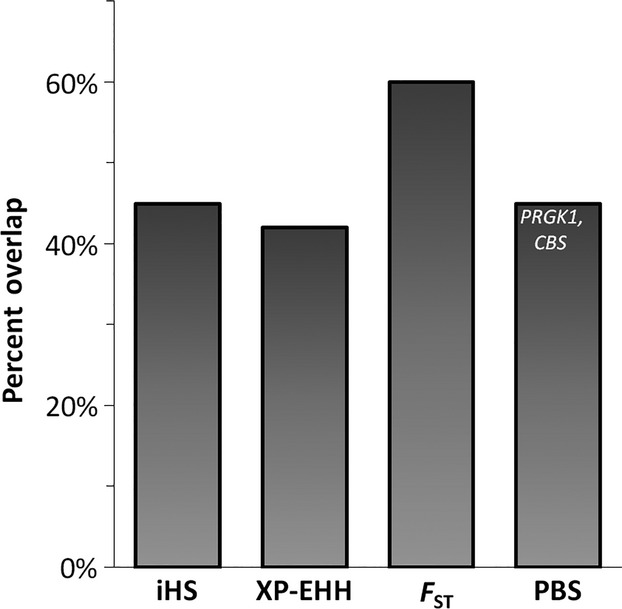
Highland populations living permanently under hypobaric hypoxia have been subject of extensive research because of the relevance of their physiological adaptations for the understanding of human health and disease. In this context, what is considered high altitude is a matter of interpretation and while the adaptive processes at high altitude (above 3000 m) are well documented, the effects of moderate altitude (below 3000 m) on the phenotype are less well established. In this study, we compare physiological and anthropometric characteristics as well as genetic variations in two Andean populations: the Calchaquíes (2300 m) and neighboring Collas (3500 m). We compare their phenotype and genotype to the sea-level Wichí population. We measured physiological (heart rate, oxygen saturation, respiration rate, and lung function) as well as anthropometric traits (height, sitting height, weight, forearm, and tibia length). We conducted genome-wide genotyping on a subset of the sample (n = 74) and performed various scans for positive selection. At the phenotypic level (n = 179), increased lung capacity stood out in both Andean groups, whereas a growth reduction in distal limbs was only observed at high altitude. At the genome level, Calchaquíes revealed strong signals around PRKG1, suggesting that the nitric oxide pathway may be a target of selection. PRKG1 was highlighted by one of four selection tests among the top five genes using the population branch statistic. Selection tests results of Collas were reported previously. Overall, our study shows that some phenotypic and genetic differentiation occurs at intermediate altitude in response to moderate lifelong selection pressures.
由于高原人群的生理适应对于理解人类健康和疾病具有重要意义,长期生活在低压低氧环境下的高原人群一直是广泛研究的对象。在这种背景下,什么被认为是高海拔是一个解释的问题,虽然高海拔(3000米以上)的适应过程已有充分记录,但中等海拔(3000米以下)对表型的影响尚不明确。在本研究中,我们比较了两个安第斯人群的生理和人体测量特征以及基因变异:卡尔查基人(2300米)和邻近的科利亚人(3500米)。我们将他们的表型和基因型与海平面的维奇人群进行比较。我们测量了生理特征(心率、血氧饱和度、呼吸频率和肺功能)以及人体测量特征(身高、坐高、体重、前臂和胫骨长度)。我们对样本的一个子集(n = 74)进行了全基因组基因分型,并进行了各种正向选择扫描。在表型水平(n = 179)上,两个安第斯人群的肺容量均增加,而仅在高海拔地区观察到远端肢体生长减少。在基因组水平上,卡尔查基人在PRKG1周围显示出强烈信号,表明一氧化氮途径可能是选择的目标。使用群体分支统计,PRKG1在五个基因中的四个选择测试中被列为前五位。科利亚人的选择测试结果先前已有报道。总体而言,我们的研究表明,在中等海拔地区,由于适度的终身选择压力,会出现一些表型和基因分化。