Kakimi Kazuhiro, Matsushita Hirokazu, Hosoi Akihiro, Miyai Manami, Ohara Osamu
Department of Immunotherapeutic; The University of Tokyo Hospital ; Tokyo, Japan.
Department of Immunotherapeutic; The University of Tokyo Hospital ; Tokyo, Japan ; Medinet Co Ltd.; Yokohama , Japan.
Oncoimmunology. 2014 Dec 3;4(3):e970464. doi: 10.4161/21624011.2014.970464. eCollection 2015 Mar.
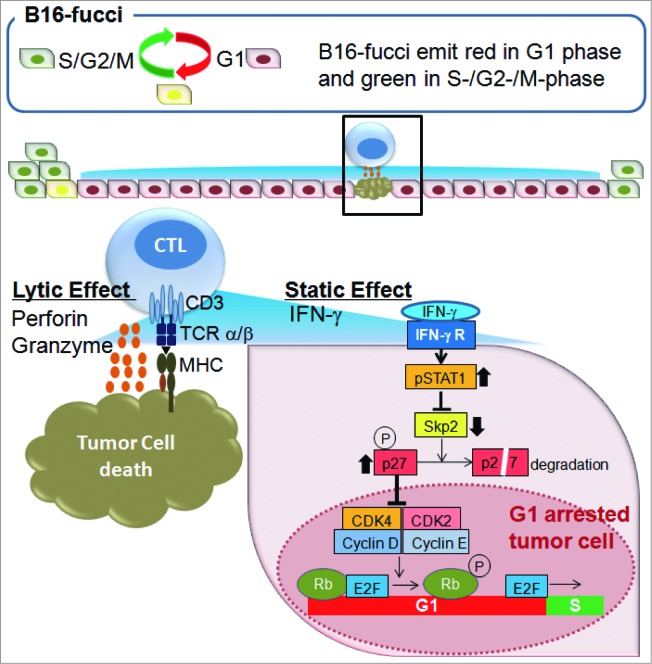
Cytotoxic T lymphocytes (CTLs) play a central role in antitumor immunity. We utilized B16 melanoma cells expressing the fluorescent ubiquitination-based cell cycle indicator B16-fucci implanted in host mice and adoptively transferred with pmel-1-TCR transgenic T cells to demonstrate that tumor growth reduction is largely dependent on interferon γ-mediated cell cycle arrest rather than the cytotoxic killing of tumor cells by CTLs.
细胞毒性T淋巴细胞(CTLs)在抗肿瘤免疫中发挥核心作用。我们利用植入宿主小鼠体内并过继转移pmel-1-TCR转基因T细胞的、表达基于荧光泛素化的细胞周期指示剂B16-fucci的B16黑色素瘤细胞,来证明肿瘤生长的减缓很大程度上依赖于干扰素γ介导的细胞周期停滞,而非CTLs对肿瘤细胞的细胞毒性杀伤作用。