Tan Xue-Mei, Ye Hua, Yang Kai, Chen Dan, Wang Qing-Qing, Tang Hong, Zhao Ning-Bo
Department of Oral and Maxillofacial Surgery, The First Affiliated Hospital of Chongqing Medical University, Chongqing 400016, China.
1] Department of Oral and Maxillofacial Surgery, The First Affiliated Hospital of Chongqing Medical University, Chongqing 400016, China [2] Chongqing key Laboratory of Oral Diseases and Biomedical Sciences.
Sci Rep. 2015 May 7;5:9997. doi: 10.1038/srep09997.
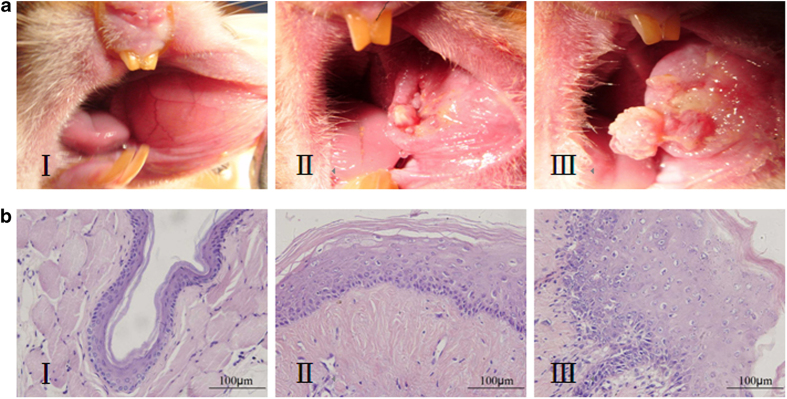
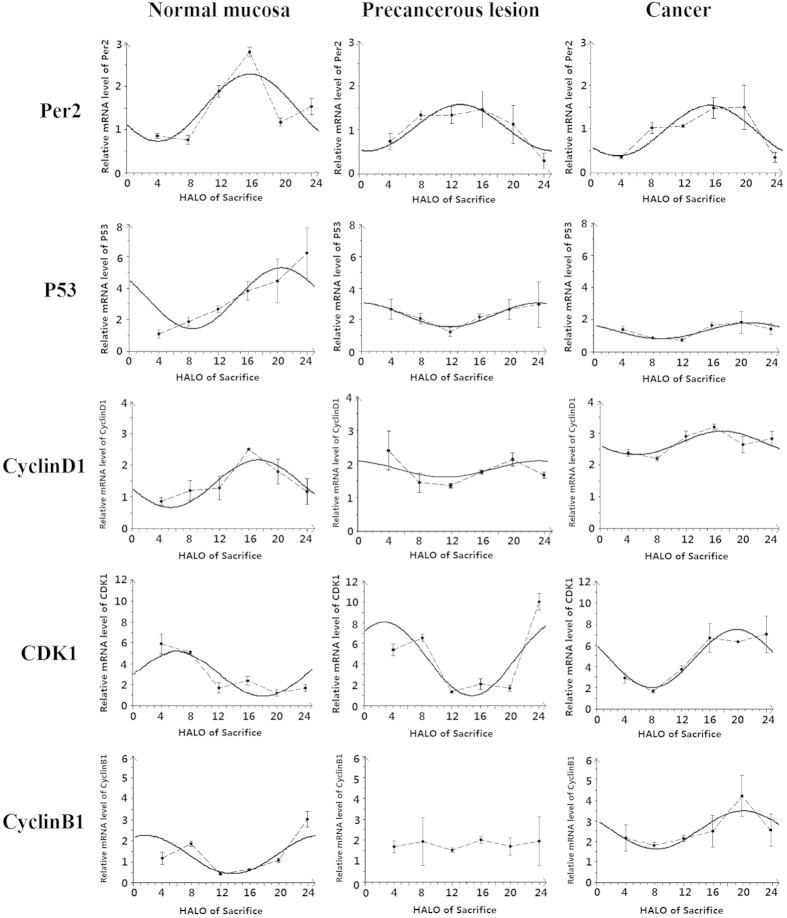
Previous studies have suggested that the expression of clock genes have circadian rhythms, and many cell cycle genes are regulated by clock genes. The disruption of circadian rhythms appears to be associated with the acceleration of cancer development. To investigate the circadian patterns of the clock gene Per2 and of cell cycle genes p53, Cyclin D1, CDK1 and Cyclin B1 in different stages of carcinogenesis, the daily mRNA profiles of these genes were detected by real-time RT-PCR in dimethylbenzanthracene-induced cancer, in precancerous lesions and in normal tissues. Per2, p53, Cyclin D1 and CDK1 showed circadian rhythms in the 3 different stages of carcinogenesis, whereas the circadian rhythm of Cyclin B1 was absent in the precancerous lesions. The mesors and amplitudes of Per2 and p53 were decreased (P < 0.05), but the mesors of Cyclin D1, CDK1 and Cyclin B1 were increased with the development of cancer (P < 0.05). Compared with the normal tissues, the acrophases of Per2 and CDK1 were earlier in precancerous lesions, and the acrophases of Cyclin D1, CDK1 and Cyclin B1 occurred later in the cancer cells. Our study represents the first demonstration of the circadian pattern variations of these genes in different stages of carcinogenesis.
先前的研究表明,生物钟基因的表达具有昼夜节律,并且许多细胞周期基因受生物钟基因调控。昼夜节律的破坏似乎与癌症发展的加速有关。为了研究生物钟基因Per2以及细胞周期基因p53、细胞周期蛋白D1、细胞周期蛋白依赖性激酶1(CDK1)和细胞周期蛋白B1在致癌作用不同阶段的昼夜模式,通过实时逆转录聚合酶链反应(RT-PCR)检测了这些基因在二甲基苯并蒽诱导的癌症、癌前病变和正常组织中的每日mRNA表达谱。Per2、p53、细胞周期蛋白D1和CDK1在致癌作用的3个不同阶段均表现出昼夜节律,而细胞周期蛋白B1在癌前病变中没有昼夜节律。随着癌症的发展,Per2和p53的中值及振幅降低(P<0.05),但细胞周期蛋白D1、CDK1和细胞周期蛋白B1的中值升高(P<0.05)。与正常组织相比,Per2和CDK1在癌前病变中的峰值相位更早,而细胞周期蛋白D1、CDK1和细胞周期蛋白B1在癌细胞中的峰值相位出现得更晚。我们的研究首次证明了这些基因在致癌作用不同阶段的昼夜模式变化。