Steele Colin W, Karim Saadia A, Foth Mona, Rishi Loveena, Leach Joshua D G, Porter Ross J, Nixon Colin, Jeffry Evans T R, Carter C Ross, Nibbs Robert J B, Sansom Owen J, Morton Jennifer P
Cancer Research UK Beatson Institute, Glasgow, UK.
Department of Surgery, Glasgow Royal Infirmary, Glasgow, UK.
J Pathol. 2015 Sep;237(1):85-97. doi: 10.1002/path.4555. Epub 2015 Jun 4.
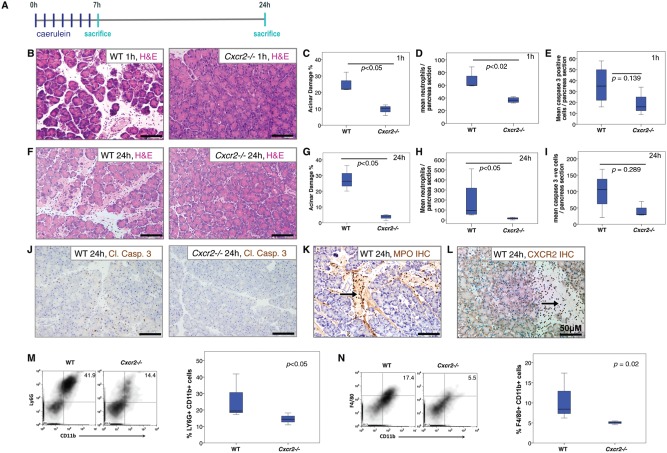
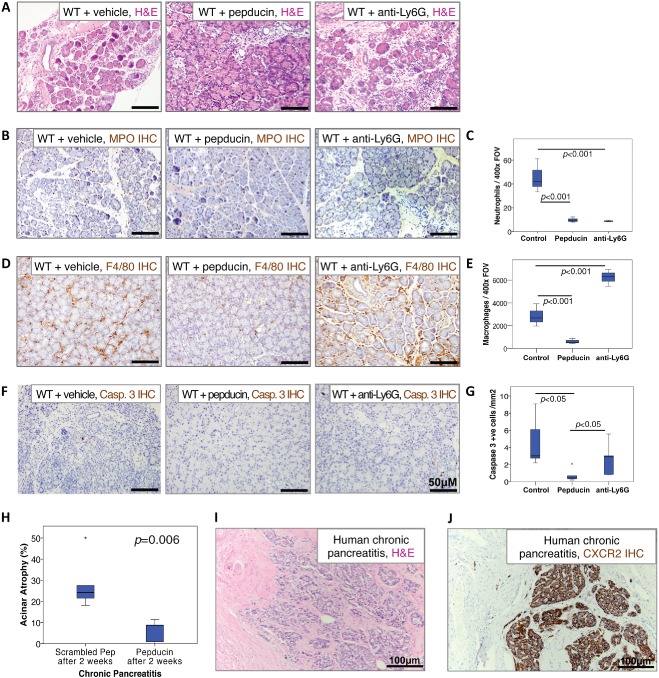
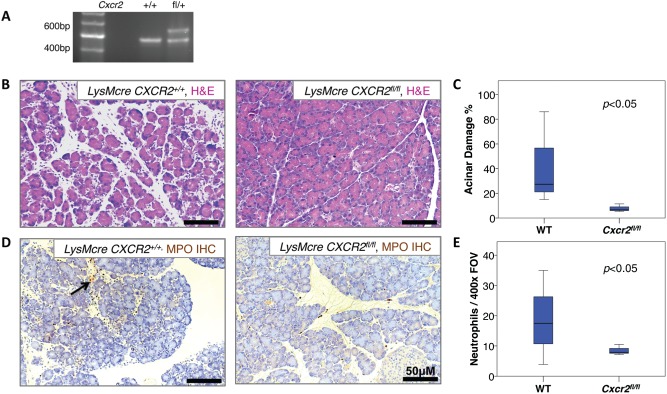
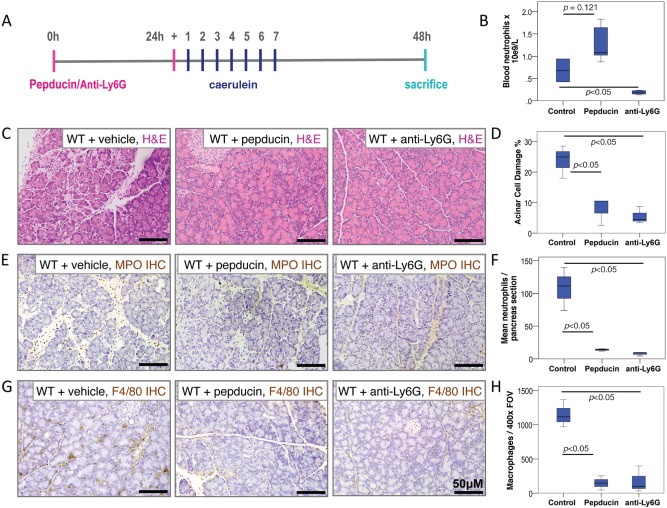
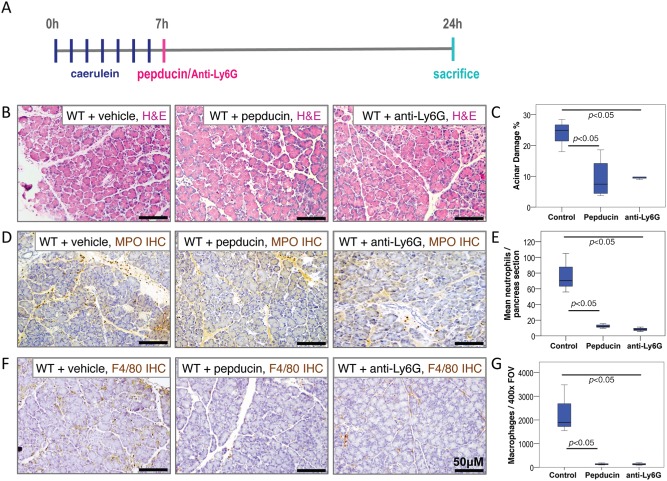
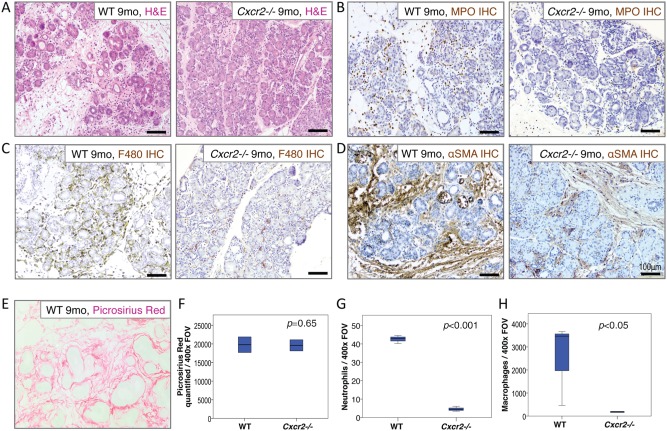
Pancreatitis is a significant clinical problem and the lack of effective therapeutic options means that treatment is often palliative rather than curative. A deeper understanding of the pathogenesis of both acute and chronic pancreatitis is necessary to develop new therapies. Pathological changes in pancreatitis are dependent on innate immune cell recruitment to the site of initial tissue damage, and on the coordination of downstream inflammatory pathways. The chemokine receptor CXCR2 drives neutrophil recruitment during inflammation, and to investigate its role in pancreatic inflammation, we induced acute and chronic pancreatitis in wild-type and Cxcr2(-/-) mice. Strikingly, Cxcr2(-/-) mice were strongly protected from tissue damage in models of acute pancreatitis, and this could be recapitulated by neutrophil depletion or by the specific deletion of Cxcr2 from myeloid cells. The pancreata of Cxcr2(-/-) mice were also substantially protected from damage during chronic pancreatitis. Neutrophil depletion was less effective in this model, suggesting that CXCR2 on non-neutrophils contributes to the development of chronic pancreatitis. Importantly, pharmacological inhibition of CXCR2 in wild-type mice replicated the protection seen in Cxcr2(-/-) mice in acute and chronic models of pancreatitis. Moreover, acute pancreatic inflammation was reversible by inhibition of CXCR2. Thus, CXCR2 is critically involved in the development of acute and chronic pancreatitis in mice, and its inhibition or loss protects against pancreatic damage. CXCR2 may therefore be a viable therapeutic target in the treatment of pancreatitis.
胰腺炎是一个重大的临床问题,由于缺乏有效的治疗选择,治疗往往只能缓解症状而非治愈疾病。深入了解急性和慢性胰腺炎的发病机制对于开发新的治疗方法至关重要。胰腺炎的病理变化取决于先天性免疫细胞向初始组织损伤部位的募集,以及下游炎症途径的协调。趋化因子受体CXCR2在炎症过程中驱动中性粒细胞的募集,为了研究其在胰腺炎症中的作用,我们在野生型和Cxcr2(-/-)小鼠中诱导了急性和慢性胰腺炎。令人惊讶的是,在急性胰腺炎模型中,Cxcr2(-/-)小鼠受到了强烈的保护,免受组织损伤,并且通过中性粒细胞耗竭或从髓样细胞中特异性删除Cxcr2可以重现这种保护作用。在慢性胰腺炎期间,Cxcr2(-/-)小鼠的胰腺也受到了显著的保护,免受损伤。在这个模型中,中性粒细胞耗竭的效果较差,这表明非中性粒细胞上的CXCR2有助于慢性胰腺炎的发展。重要的是,在野生型小鼠中对CXCR2进行药理抑制,在急性和慢性胰腺炎模型中重现了在Cxcr2(-/-)小鼠中看到的保护作用。此外,通过抑制CXCR2,急性胰腺炎症是可逆的。因此,CXCR2在小鼠急性和慢性胰腺炎的发展中起着关键作用,其抑制或缺失可防止胰腺损伤。因此,CXCR2可能是治疗胰腺炎的一个可行的治疗靶点。