Gerek Nevin Z, Liu Li, Gerold Kristyn, Biparva Pegah, Thomas Eric D, Kumar Sudhir
BMC Med Genomics. 2015;8 Suppl 1(Suppl 1):S6. doi: 10.1186/1755-8794-8-S1-S6. Epub 2015 Jan 15.
Many pharmaceutical drugs are known to be ineffective or have negative side effects in a substantial proportion of patients. Genomic advances are revealing that some non-synonymous single nucleotide variants (nsSNVs) may cause differences in drug efficacy and side effects. Therefore, it is desirable to evaluate nsSNVs of interest in their ability to modulate the drug response.
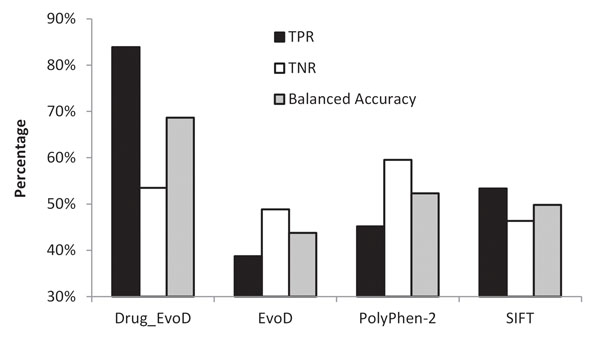
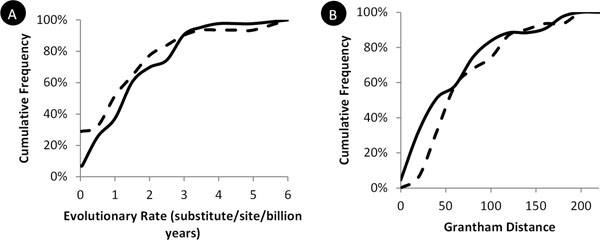
We found that the available data on the link between drug response and nsSNV is rather modest. There were only 31 distinct drug response-altering (DR-altering) and 43 distinct drug response-neutral (DR-neutral) nsSNVs in the whole Pharmacogenomics Knowledge Base (PharmGKB). However, even with this modest dataset, it was clear that existing bioinformatics tools have difficulties in correctly predicting the known DR-altering and DR-neutral nsSNVs. They exhibited an overall accuracy of less than 50%, which was not better than random diagnosis. We found that the underlying problem is the markedly different evolutionary properties between positions harboring nsSNVs linked to drug responses and those observed for inherited diseases. To solve this problem, we developed a new diagnosis method, Drug-EvoD, which was trained on the evolutionary properties of nsSNVs associated with drug responses in a sparse learning framework. Drug-EvoD achieves a TPR of 84% and a TNR of 53%, with a balanced accuracy of 69%, which improves upon other methods significantly.
The new tool will enable researchers to computationally identify nsSNVs that may affect drug responses. However, much larger training and testing datasets are needed to develop more reliable and accurate tools.
许多药物在相当一部分患者中被认为无效或有负面副作用。基因组学的进展表明,一些非同义单核苷酸变异(nsSNV)可能导致药物疗效和副作用的差异。因此,评估感兴趣的nsSNV调节药物反应的能力是很有必要的。
我们发现,关于药物反应与nsSNV之间联系的现有数据相当有限。在整个药物基因组学知识库(PharmGKB)中,只有31个不同的改变药物反应(DR改变)的nsSNV和43个不同的药物反应中性(DR中性)的nsSNV。然而,即使有这个有限的数据集,很明显现有的生物信息学工具在正确预测已知的DR改变和DR中性nsSNV方面存在困难。它们的总体准确率不到50%,并不比随机诊断好。我们发现根本问题是与药物反应相关的携带nsSNV的位置与遗传性疾病中观察到的位置在进化特性上有明显不同。为了解决这个问题,我们开发了一种新的诊断方法Drug-EvoD,它在稀疏学习框架中根据与药物反应相关的nsSNV的进化特性进行训练。Drug-EvoD的真阳性率(TPR)为84%,真阴性率(TNR)为53%,平衡准确率为69%,显著优于其他方法。
这个新工具将使研究人员能够通过计算识别可能影响药物反应的nsSNV。然而,需要更大的训练和测试数据集来开发更可靠、准确的工具。