Rutten-Jacobs Loes C A, Traylor Matthew, Adib-Samii Poneh, Thijs Vincent, Sudlow Cathie, Rothwell Peter M, Boncoraglio Giorgio, Dichgans Martin, Bevan Steve, Meschia James, Levi Christopher, Rost Natalia S, Rosand Jonathan, Hassan Ahamad, Markus Hugh S
From the Department of Clinical Neurosciences, University of Cambridge, Cambridge, United Kingdom (L.C.A.R.-J., M.T., S.B., H.S.M.); Stroke and Dementia Research Center, Department of Clinical Neuroscience, St George's University of London, London, United Kingdom (P.A.-S.); Department of Experimental Neurology, KULeuven and Leuven Research Institute for Neuroscience and Disease, University of Leuven, Leuven, Belgium (V.T.); Laboratory of Neurobiology, Vesalius Research Center, VIB, Leuven, Belgium (V.T.); Division of Clinical Neurosciences, Neuroimaging Sciences and Institute of Genetics and Molecular Medicine, University of Edinburgh, Edinburgh, United Kingdom (C.S.); Stroke Prevention Research Unit, Nuffield Department of Neuroscience, University of Oxford, Oxford, United Kingdom (P.M.R.); Department of Cerebrovascular Diseases, Fondazione IRCCS Istituto Neurologico "Carlo Besta", Milano, Italy (G.B.); Institute for Stroke and Dementia Research, Klinikum der Universität München, Ludwig-Maximilians-University Munich, Munich, Germany (M.D.); Department of Neurology, Mayo Clinic, Jacksonville, FL (J.M.); Center for Clinical Epidemiology and Biostatistics, Department of Neurology, Hunter Medical Research Institute and School of Medicine and Public Health, University of Newcastle, Callaghan, New South Wales, Australia (C.L.); Department of Neurology, Center for Human Genetic Research and Massachusetts General Hospital, Boston (N.S.R., J.R.); and Department of Neurology, Leeds General Infirmary, Leeds Teaching Hospitals NHS Trust, Leeds, United Kingdom (A.H.).
Stroke. 2015 Jun;46(6):1482-7. doi: 10.1161/STROKEAHA.114.008540. Epub 2015 May 7.
The most common monogenic cause of cerebral small-vessel disease is cerebral autosomal dominant arteriopathy with subcortical infarcts and leukoencephalopathy, caused by NOTCH3 gene mutations. It has been hypothesized that more common variants in NOTCH3 may also contribute to the risk of sporadic small-vessel disease. Previously, 4 common variants (rs10404382, rs1043994, rs10423702, and rs1043997) were found to be associated with the presence of white matter hyperintensity in hypertensive community-dwelling elderly.
We investigated the association of common single nucleotide polymorphisms (SNPs) in NOTCH3 in 1350 patients with MRI-confirmed lacunar stroke and 7397 controls, by meta-analysis of genome-wide association study data sets. In addition, we investigated the association of common SNPs in NOTCH3 with MRI white matter hyperintensity volumes in 3670 white patients with ischemic stroke. In each analysis, we considered all SNPs within the NOTCH3 gene, and within 50-kb upstream and downstream of the coding region. A total of 381 SNPs from the 1000 genome population with a mean allele frequency>0.01 were included in the analysis. A significance level of P<0.0015 was used, adjusted for the effective number of independent SNPs in the region using the Galwey method.
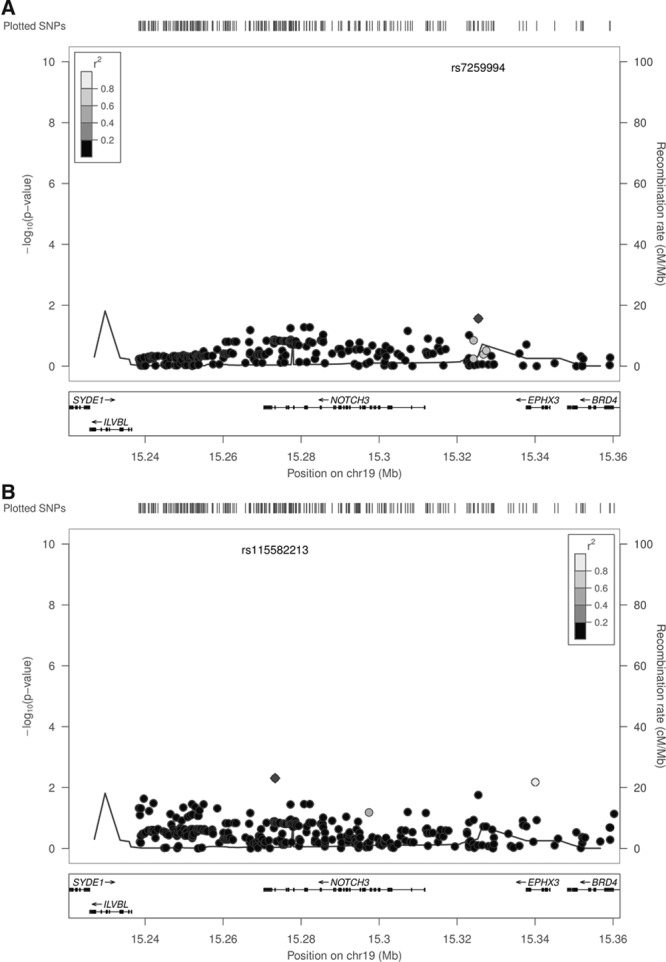
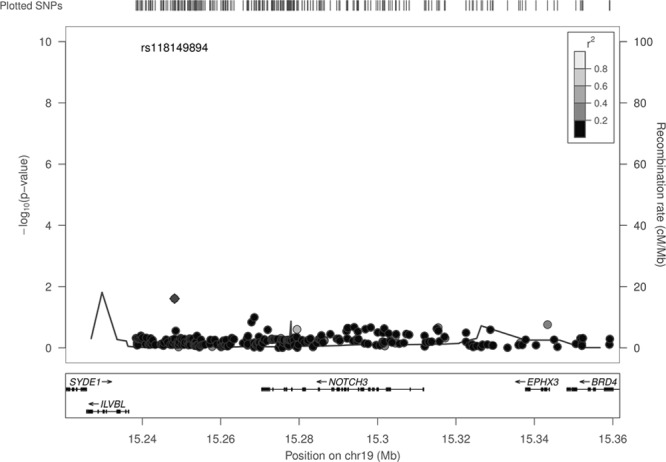
We found no association of any common variants in NOTCH3 (including rs10404382, rs1043994, rs10423702, and rs1043997) with lacunar stroke or white matter hyperintensity volume. We repeated our analysis stratified for hypertension but again found no association.
Our study does not support a role for common NOTCH3 variation in the risk of sporadic small-vessel disease.
脑小血管病最常见的单基因病因是由NOTCH3基因突变引起的脑常染色体显性遗传性动脉病伴皮质下梗死和白质脑病。有假说认为,NOTCH3中更常见的变异也可能增加散发性小血管病的风险。此前,已发现4种常见变异(rs10404382、rs1043994、rs10423702和rs1043997)与社区居住的高血压老年患者脑白质高信号的存在有关。
我们通过对全基因组关联研究数据集进行荟萃分析,调查了1350例经MRI确诊的腔隙性卒中患者和7397例对照中NOTCH3常见单核苷酸多态性(SNP)的相关性。此外,我们还调查了3670例白人缺血性卒中患者中NOTCH3常见SNP与MRI脑白质高信号体积的相关性。在每项分析中,我们考虑了NOTCH3基因内以及编码区上下游50 kb范围内的所有SNP。分析纳入了来自1000基因组人群的381个平均等位基因频率>0.01的SNP。使用Galwey方法根据该区域独立SNP的有效数量进行校正后,显著性水平设定为P<0.0015。
我们发现NOTCH3的任何常见变异(包括rs10404382、rs1043994、rs10423702和rs1043997)与腔隙性卒中或脑白质高信号体积均无关联。我们对高血压进行分层重复分析,但再次未发现关联。
我们的研究不支持NOTCH3常见变异在散发性小血管病风险中起作用。