Kim Youngwoo, Tanaka Chiaki, Tada Hiroshi, Kanoe Hiroshi, Shirai Takaaki
Department of Orthopaedic Surgery, Kyoto City Hospital, 1-2 Mibu,higashitakada-cho, Nakagyo, Kyoto, 604-8845, Japan.
BMC Musculoskelet Disord. 2015 May 10;16:113. doi: 10.1186/s12891-015-0565-7.
Periprosthetic femoral fractures are becoming increasingly common and are a major complication of total hip arthroplasty and hemiarthroplasty. The treatment of periprosthetic femoral fracture after femoral revision using a long stem is more complex and challenging. The purpose of this study was to identify the clinical and radiographical features of periprosthetic femoral fractures after revision using a long stem.
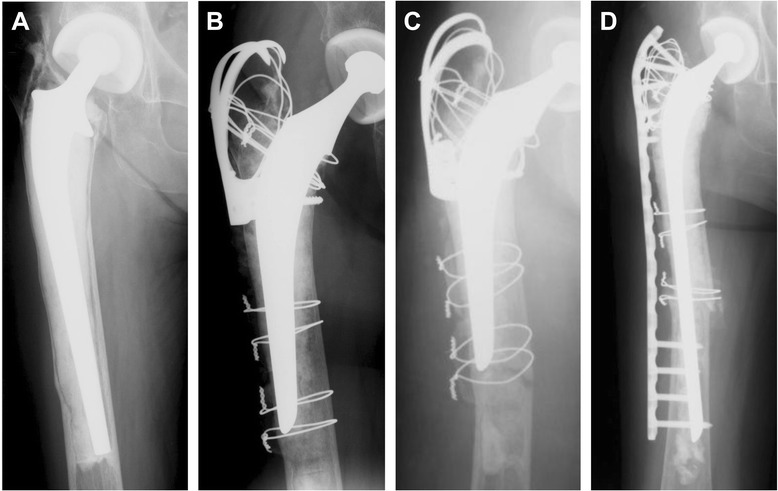
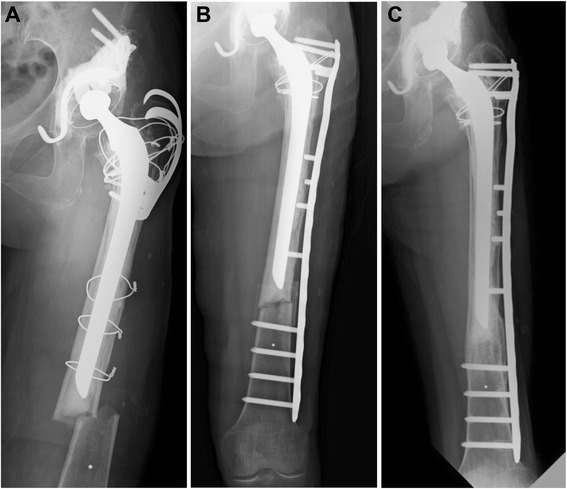
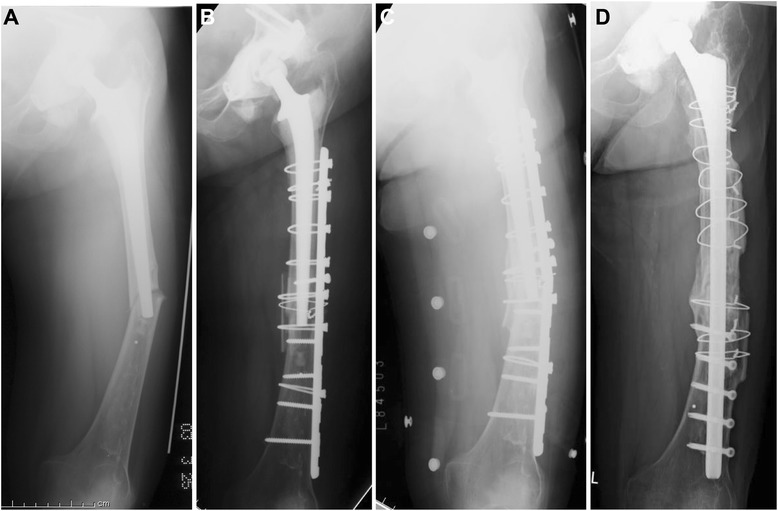
We report a retrospective review of the outcomes of treatment of 11 periprosthetic fractures after femoral revision using a long stem. Eleven female patients with a mean age of 79.2 years (70 to 91) were treated for a Vancouver type B1 fracture between 1998 and 2013. The mean numbers of previous surgeries were 3.1 (2 to 5).
The average follow-up was 58.9 months (8 to 180). We found several important features that might influence the outcome of treatment for periprosthetic femoral fractures after femoral revision using a long stem: 1) all cases were classified as Vancouver type B1. 2) 6 patients (55%) had a transverse fracture around the tip of the long stem. 3) 7 patients (64%) had a history of previous fracture of the ipsilateral femur. The type B1 fractures were treated with open reduction and internal fixation in 9 hips, 6 of which were reinforced with bone grafts. Two other periprosthetic fractures were treated with femoral revision. One was revised because of stem breakage, and the other was a transverse fracture associated with poor bone quality, which received a femoral revision with a long stem and a plate. All fractures except one achieved primary union. This failed case had a bone defect at the fracture site, and revision surgery using a cementless long stem and allografts was successful.
These findings suggest that most cases of type B1 fracture after revision using a long stem have been treated successfully with open reduction and internal fixation. However, a transverse fracture with very poor bone quality might be considered as a type B3 fracture, and femoral revision might be a treatment of choice.
人工关节周围股骨骨折越来越常见,是全髋关节置换术和半髋关节置换术的主要并发症。使用长柄假体进行股骨翻修术后人工关节周围股骨骨折的治疗更为复杂且具有挑战性。本研究的目的是确定使用长柄假体翻修术后人工关节周围股骨骨折的临床和影像学特征。
我们回顾性分析了11例使用长柄假体进行股骨翻修术后人工关节周围骨折的治疗结果。11例女性患者,平均年龄79.2岁(70至91岁),于1998年至2013年间接受了温哥华B1型骨折的治疗。既往手术的平均次数为3.1次(2至5次)。
平均随访时间为58.9个月(8至180个月)。我们发现了几个可能影响使用长柄假体进行股骨翻修术后人工关节周围股骨骨折治疗结果的重要特征:1)所有病例均归类为温哥华B1型。2)6例患者(55%)在长柄假体尖端周围发生横行骨折。3)7例患者(64%)有同侧股骨既往骨折史。9例髋关节的B1型骨折采用切开复位内固定治疗,其中6例采用植骨加强固定。另外2例人工关节周围骨折采用股骨翻修术治疗。1例因假体柄断裂而翻修,另1例为与骨质不佳相关的横行骨折,接受了长柄假体和钢板的股骨翻修术。除1例骨折外,所有骨折均实现一期愈合。该失败病例在骨折部位存在骨缺损,使用非骨水泥长柄假体和同种异体骨进行翻修手术获得成功。
这些发现表明,大多数使用长柄假体翻修术后的B1型骨折病例通过切开复位内固定治疗成功。然而,骨质非常差的横行骨折可能应视为B3型骨折,股骨翻修术可能是首选治疗方法。