Diaf Mustapha, Khaled Boumediene M, Sellam Fériel
Department of Biology, Faculty of Natural and Life Sciences, Djillali Liabes University, Sidi-Bel-Abbes, Algeria;
Department of Biology, Faculty of Natural and Life Sciences, Djillali Liabes University, Sidi-Bel-Abbes, Algeria.
Libyan J Med. 2015 May 8;10(1):27400. doi: 10.3402/ljm.v10.27400. eCollection 2015.
The incidence of diabetes co-morbidities could probably be better assessed by studying its associations with major corpulence parameters and glycaemic control indicators. We assessed the utility of body mass index (BMI), waist circumference (WC), and glycosylated haemoglobin (HbA1c) levels in metabolic control for type 2 diabetic patients.
Fasting and postprandial blood samples were collected from 238 type 2 diabetic patients aged 57.4±11.9 years. The sera were analysed for glucose, HbA1c, total cholesterol (TC), triglycerides (TG), high-density lipoprotein cholesterol (HDL-c), low-density lipoprotein cholesterol (LDL-c), and apolipoproteins (apoA-I and apoB). Ratios of lipids and apolipoproteins were calculated and their associations with BMI, WC, and HbA1c levels were analysed.
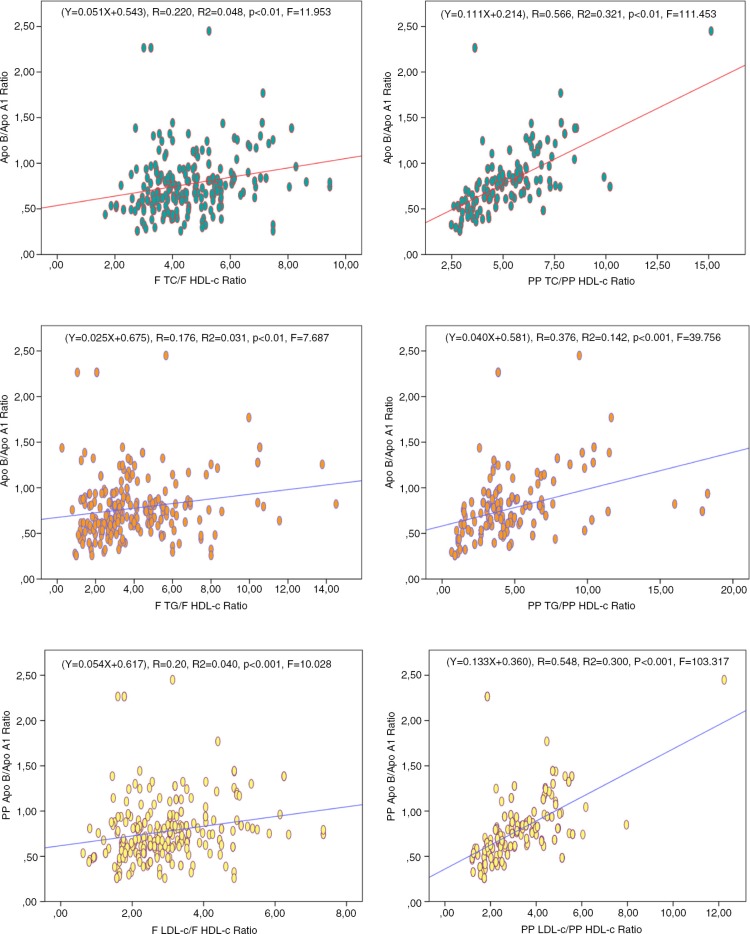
Our investigation showed increases in most fasting and postprandial lipid parameters according to BMI and WC. In men, postprandial HDL-c and TG levels were significantly higher (p<0.05) in overweight and obese patients, respectively, as well as in patients with abdominal obesity. Contrariwise, postprandial TC levels were significantly higher (p<0.01) in overweight and abdominal obese women. However, elevations of apoA-I and apoB levels were according to BMI and WC in both genders. There was a strong influence of BMI, WC, and HbA1c levels on the apoB/apoA-I ratio compared to traditional fasting and postprandial lipid ratios in both men and women. The apoB/apoA-I ratio was more correlated with postprandial TC/HDL and LDL-c/HDL-c ratios in men and with postprandial TG/HDL-c in women.
The apoB/apoA-I ratio is helpful in assessing metabolic risk caused by overall obesity, abdominal obesity and impaired glycaemia in type 2 diabetic patients.
通过研究糖尿病与主要肥胖参数及血糖控制指标之间的关联,或许能更好地评估糖尿病合并症的发病率。我们评估了体重指数(BMI)、腰围(WC)和糖化血红蛋白(HbA1c)水平在2型糖尿病患者代谢控制中的作用。
收集了238名年龄为57.4±11.9岁的2型糖尿病患者的空腹和餐后血样。对血清进行葡萄糖、HbA1c、总胆固醇(TC)、甘油三酯(TG)、高密度脂蛋白胆固醇(HDL-c)、低密度脂蛋白胆固醇(LDL-c)及载脂蛋白(apoA-I和apoB)分析。计算脂质和载脂蛋白的比率,并分析它们与BMI、WC和HbA1c水平的关联。
我们的研究表明,大多数空腹和餐后脂质参数随BMI和WC的增加而升高。在男性中,超重和肥胖患者以及腹部肥胖患者的餐后HDL-c和TG水平分别显著更高(p<0.05)。相反,超重和腹部肥胖女性的餐后TC水平显著更高(p<0.01)。然而,apoA-I和apoB水平在男女两性中均随BMI和WC升高。与传统的空腹和餐后脂质比率相比,BMI、WC和HbA1c水平对apoB/apoA-I比率有很强的影响。在男性中,apoB/apoA-I比率与餐后TC/HDL和LDL-c/HDL-c比率的相关性更强,在女性中与餐后TG/HDL-c的相关性更强。
apoB/apoA-I比率有助于评估2型糖尿病患者因整体肥胖、腹部肥胖和血糖受损所致的代谢风险。