Department of Internal Medicine, Hebei Medical University, Shijiazhuang, China.
Department of Endocrinology, Hebei General Hospital, Shijiazhuang, China.
Front Endocrinol (Lausanne). 2021 Apr 23;12:646185. doi: 10.3389/fendo.2021.646185. eCollection 2021.
To investigate possible mechanisms of postprandial hypertriglyceridemia (PPT), we analyzed serum lipid and apolipoprotein (Apo) AI, B, CII and CIII levels before and after a high-fat meal.
The study has been registered with the China Clinical Trial Registry (registration number:ChiCTR1800019514; URL: http://www.chictr.org.cn/index.aspx). We recruited 143 volunteers with normal fasting triglyceride (TG) levels. All subjects consumed a high-fat test meal. Venous blood samples were obtained during fasting and at 2, 4, and 6 hours after the high-fat meal. PPT was defined as TG ≥2.5 mmol/L any time after the meal. Subjects were divided into two groups according to the high-fat meal test results: postprandial normal triglyceride (PNT) and PPT. We compared the fasting and postprandial lipid and ApoAI, ApoB, ApoCII and ApoCIII levels between the two groups.
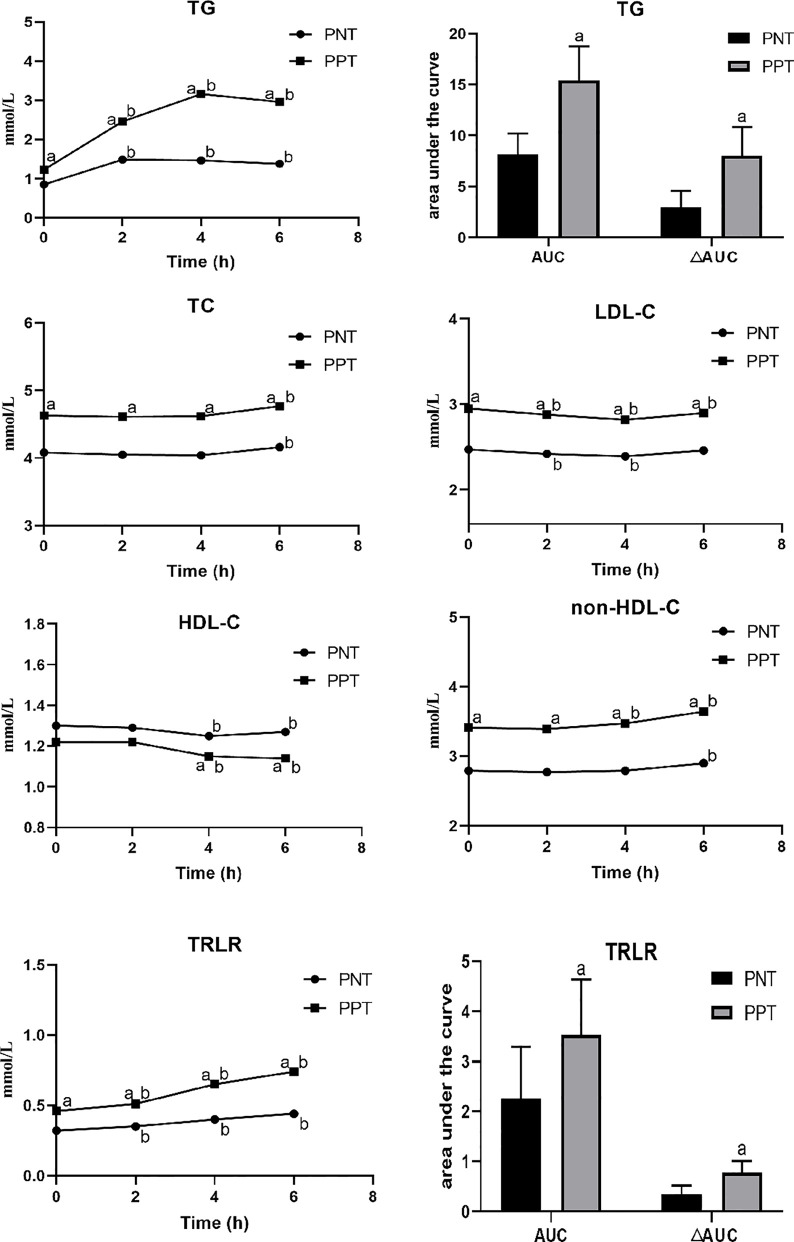
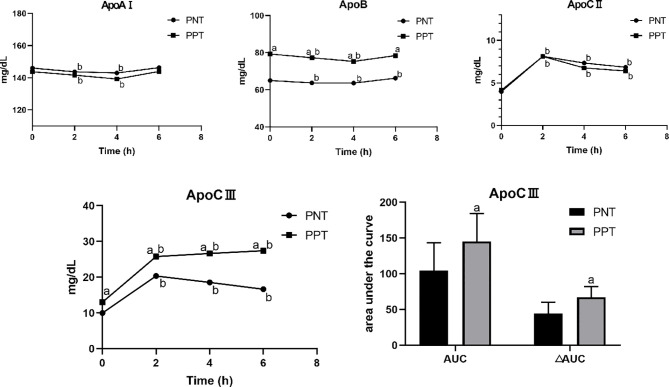
Significant differences were found between the groups in fasting insulin, homeostasis model assessment of insulin resistance (HOMA-IR), TG, total cholesterol (TC), low-density lipoprotein cholesterol (LDL-C), non-high-density lipoprotein cholesterol (non-HDL-C), TG-rich lipoprotein remnants (TRLRs), ApoB, ApoCIII, ApoAI/ApoB and ApoCII/ApoCIII. The insulin, HOMA-IR, TG, TC, LDL-C, non-HDL-C, TRLRs, ApoB, ApoCIII and ApoCII/ApoCIII values were higher in the PPT group, while the ApoAI/ApoB ratio was higher in the PNT group. The postprandial TG level peaked in the PNT group 2 hours after the meal but was significantly higher in the PPT group and peaked at 4 hours. TRLRs gradually increased within 6 hours after the high-fat meal in both groups. The area under the curve (AUC) of TG and TRLRs and the AUC increment were higher in the PPT group ( < 0.001). ApoCIII peaked in the PNT group 2 hours after the meal and gradually decreased. ApoCIII gradually increased in the PPT group within 6 hours after the meal, exhibiting a greater AUC increment ( < 0.001). Fasting ApoCIII was positively correlated with age, systolic and diastolic blood pressure, body mass index (BMI), waist circumference, TC, TG, LDL-C, non-HDL-C, TRLRs, and ApoB (<0.05). ApoCIII was an independent risk factor of PPT after adjustment for BMI, waist circumference, TC, LDL-C, and ApoB ( < 0.001, OR=1.188).
Elevated ApoCIII levels may cause PPT.
为了探究餐后高甘油三酯血症(PPT)的可能机制,我们分析了高脂肪餐后空腹和餐后 2、4、6 小时的血清脂质和载脂蛋白(Apo)AI、B、CII 和 CIII 水平。
本研究已在中国临床试验注册中心(注册号:ChiCTR1800019514;网址:http://www.chictr.org.cn/index.aspx)注册。我们招募了 143 名空腹甘油三酯(TG)水平正常的志愿者。所有受试者均食用高脂肪测试餐。禁食和高脂肪餐后 2、4 和 6 小时采集静脉血样。餐后任何时间 TG≥2.5mmol/L 定义为 PPT。根据高脂肪餐试验结果将受试者分为两组:餐后正常甘油三酯(PNT)和 PPT。我们比较了两组的空腹和餐后血脂及 ApoAI、ApoB、ApoCII 和 ApoCIII 水平。
两组间空腹胰岛素、稳态模型评估的胰岛素抵抗指数(HOMA-IR)、TG、总胆固醇(TC)、低密度脂蛋白胆固醇(LDL-C)、非高密度脂蛋白胆固醇(non-HDL-C)、富含 TG 的脂蛋白残粒(TRLRs)、ApoB、ApoCIII、ApoAI/ApoB 和 ApoCII/ApoCIII 存在显著差异。PPT 组胰岛素、HOMA-IR、TG、TC、LDL-C、non-HDL-C、TRLRs、ApoB、ApoCIII 和 ApoCII/ApoCIII 水平较高,而 PNT 组 ApoAI/ApoB 比值较高。PNT 组餐后 TG 水平在餐后 2 小时达到峰值,但明显高于 PPT 组,且在 4 小时达到峰值。TRLRs 在两组高脂餐后 6 小时内逐渐升高。PPT 组 TG 和 TRLRs 的曲线下面积(AUC)及 AUC 增量较高(<0.001)。ApoCIII 在 PNT 组餐后 2 小时达到峰值,随后逐渐下降。PPT 组餐后 6 小时内 ApoCIII 逐渐升高,AUC 增量较大(<0.001)。空腹 ApoCIII 与年龄、收缩压和舒张压、体重指数(BMI)、腰围、TC、TG、LDL-C、non-HDL-C、TRLRs 和 ApoB 呈正相关(<0.05)。ApoCIII 是 BMI、腰围、TC、LDL-C 和 ApoB 校正后的 PPT 的独立危险因素(<0.001,OR=1.188)。
ApoCIII 水平升高可能导致 PPT。