Dvir Zeevi
Department of Physical Therapy, Sackler Faculty of Medicine, Tel Aviv University, Israel.
J Exerc Rehabil. 2015 Apr 30;11(2):67-73. doi: 10.12965/jer.150199. eCollection 2015 Apr.
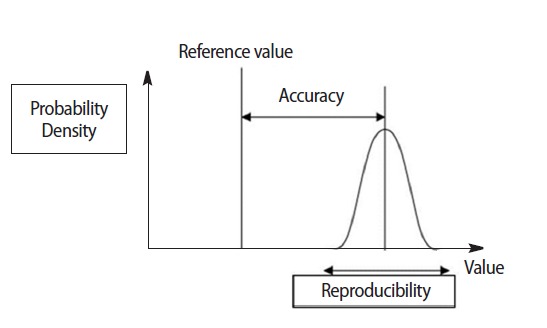
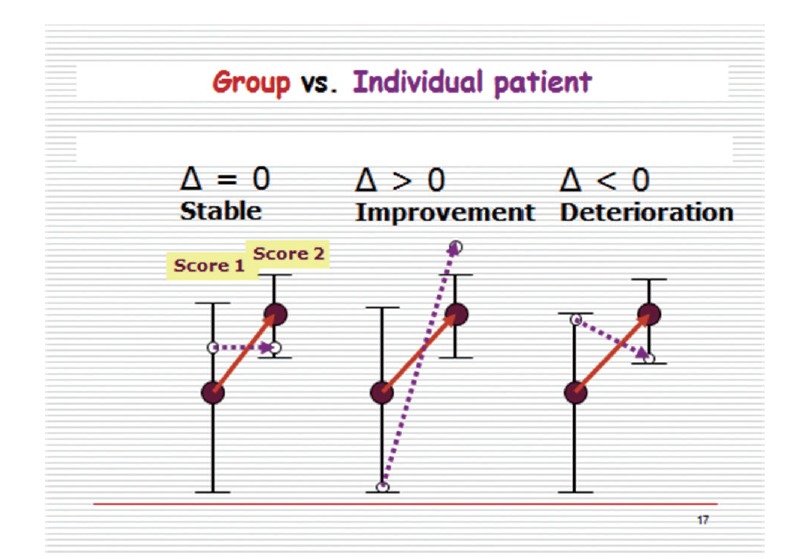
The valid confirmation of a positive change (improvement) in a patient's health status due to intervention has been at the core of medicine and rehabilitation since their very inception as clinicians always aspired to ensure that treating their patients had led to successful outcomes both in acute and chronic conditions. However what is change: either improvement or worsening (aggravation), is a complicated issue which involves clinical as well as statistical considerations. Change invariably relates to a difference in some measurable entity and almost always it relates to a time span. The confirmation of clinical change is important both for varying the treatment course (if necessary) and for the termination of treatment when the latter has reached wither its prescribed objective or a plateau. Since in the context of rehabilitation, the outcome measures (OM) are strongly linked to performance, determination of change in the latter is confounded by many factors, collectively known as the error of measurement, which render a decision regarding clinically meaningful change, highly involved. This is further complicated by the stability of the observed OM, the so-called reproducibility of the OM, and the accuracy of the measurement instrument. The higher the reproducibility the lower is the error. Moreover, in order to proclaim change, in most cases a positive one, it is necessary for the difference in outcome scores (i.e. the change) to surpass the error of measurement, in varying degree of rigor. This paper describes selected methods associated with determination of change and focuses predominantly on the difference between a simple difference in scores ('simple change'), a significant difference in scores and the so-called clinically meaningful change in scores which is considered today as the benchmark for confirmation of a real change.
自医学和康复诞生之初,有效确认患者健康状况因干预而出现的积极变化(改善)就一直是其核心内容,因为临床医生一直渴望确保对患者的治疗在急性和慢性疾病中都能取得成功的结果。然而,什么是变化,无论是改善还是恶化(加重),都是一个复杂的问题,涉及临床和统计方面的考量。变化总是与某个可测量实体的差异相关,而且几乎总是与一个时间跨度相关。临床变化的确认对于必要时改变治疗方案以及在治疗达到既定目标或进入平台期时终止治疗都很重要。由于在康复领域,结果测量指标(OM)与表现密切相关,后者变化的确定受到许多因素的混淆,这些因素统称为测量误差,这使得关于临床意义上变化的决策变得高度复杂。OM的稳定性、即所谓的OM的可重复性以及测量工具的准确性,进一步加剧了这一复杂性。可重复性越高,误差越低。此外,为了宣称有变化,在大多数情况下是积极的变化,结果分数的差异(即变化)必须在不同程度的严格性上超过测量误差。本文描述了与确定变化相关的选定方法,并主要关注分数的简单差异(“简单变化”)、分数的显著差异以及如今被视为确认真正变化基准的分数的所谓临床意义上的变化之间的差异。