Department of Health Economy, Institut Curie, 26 rue d'Ulm, 75005, Paris, France.
Department of Supportive Care, Institut Curie, 26 rue d'Ulm, 75005, Paris, France.
BMC Cancer. 2015 May 12;15:394. doi: 10.1186/s12885-015-1417-4.
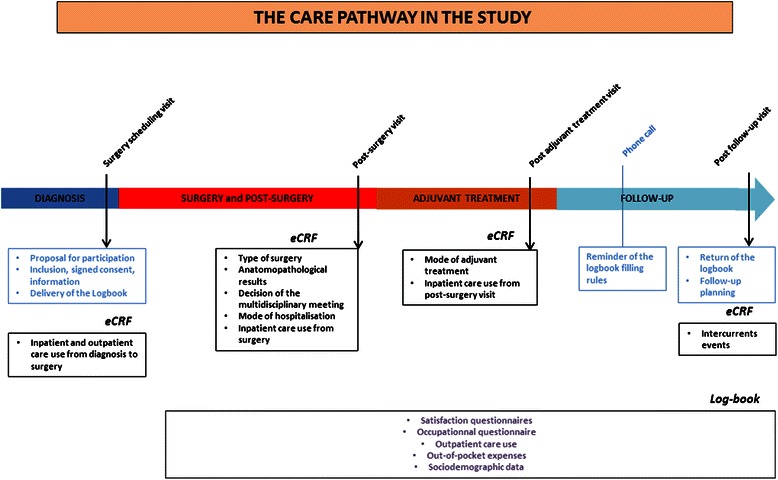
A care pathway is defined as patient-focused global care that addresses temporal (effective and coordinated management throughout the illness) and spatial issues (treatment is provided near the health territory in or around the patient's home). Heterogeneity of the care pathways in breast cancer (BC) is presumed but not well evaluated. The OPTISOINS01 study aims to assess every aspect of the care pathway for early BC patients using a temporal and spatial scope.
METHODS/DESIGN: An observational, prospective, multicenter study in a regional health territory (Ile-de-France, France) in different types of structures: university or local hospitals and comprehensive cancer centers. We will include and follow during 1 year 1,000 patients. The study consists of 3 work-packages: - Cost of pathway The aim of this WP is to calculate the overall costs of the early BC pathway at 1 year from different perspectives (society, health insurance and patient) using a cost-of-illness analysis. Using a bottom-up method, we will assess direct costs, including medical direct costs and nonmedical direct costs (transportation, home modifications, home care services, and social services), and indirect costs (loss of production). - Patient satisfaction and work reintegration Three questionnaires will assess the patients' satisfaction and possible return to work: the occupational questionnaire for employed women; the questionnaire on the need for supportive care, SCNS-SF34 ('breast cancer' module, SCNS-BR8); and the OUTPASSAT-35 questionnaire. - Quality, coordination and access to innovation Quality will be evaluated based on visits and treatment within a set period, whether the setting offers a multidisciplinary consultative framework, the management by nurse coordinators, the use of a personalized care plan, the provision of information via documents about treatments and the provision of supportive care. The coordination between structures and caregivers will be evaluated at several levels. Day surgery, home hospitalization and one-stop breast clinic visits will be recorded to assess the patient's access to innovation.
The assessment of care pathways encourages the implementation of new payment models. Our approach could help health care professionals and policymakers to establish other cost-of-illness studies and plan the allocation of resources on a patient basis rather than a visit basis.
护理路径被定义为以患者为中心的整体护理,可解决时间(疾病全程的有效且协调的管理)和空间问题(在患者住所或住所附近的卫生区域内提供治疗)。但是,尚未对乳腺癌(BC)护理路径的异质性进行很好的评估。 OPTISOINS01 研究旨在使用时间和空间范围评估早期 BC 患者护理路径的各个方面。
方法/设计:这是一项在区域卫生领域(法国法兰西岛大区)的不同类型机构(大学或当地医院和综合癌症中心)中进行的观察性、前瞻性、多中心研究。我们将在 1 年内纳入并随访 1000 名患者。该研究包括 3 个工作包:- 路径成本 该 WP 的目的是使用疾病成本分析从不同角度(社会,医疗保险和患者)计算早期 BC 路径 1 年的总费用。使用自下而上的方法,我们将评估直接成本,包括医疗直接成本和非医疗直接成本(交通,家庭改造,家庭护理服务和社会服务)以及间接成本(生产力损失)。 - 患者满意度和重返工作岗位 三个问卷将评估患者的满意度和可能的重返工作:针对在职女性的职业问卷;需要支持性护理的问卷,SCNS-SF34(“乳腺癌”模块,SCNS-BR8);以及 OUTPASSAT-35 问卷。 - 质量,协调和创新机会的获取 将根据在设定时间段内的就诊和治疗来评估质量,无论该环境是否提供多学科咨询框架,护士协调员的管理,个性化护理计划的使用,通过有关治疗的文件提供信息以及提供支持性护理。将在多个层面评估结构之间和护理人员之间的协调。将记录日间手术,家庭住院和一站式乳房诊所就诊情况,以评估患者获得创新的机会。
护理路径的评估鼓励实施新的支付模式。我们的方法可以帮助医疗保健专业人员和政策制定者进行其他疾病成本研究,并根据患者而不是就诊情况来计划资源分配。