Arfi Alexandra, Baffert Sandrine, Soilly Anne-Laure, Huchon Cyrille, Reyal Fabien, Asselain Bernard, Neffati Souhir, Rouzier Roman, Héquet Delphine
Department of Surgical Oncology, Institut Curie-Centre René Huguenin, Paris, France.
Health Economics Department, CEMKA-EVAL, Bourg-La-Reine, France.
BMJ Open. 2018 May 18;8(5):e020276. doi: 10.1136/bmjopen-2017-020276.
Return to work (RTW) after breast cancer (BC) is still a new field of research. The factors determining shorter sick leave duration of patients with BC have not been clearly identified. The aim of this study was to describe work during BC treatment and to identify factors associated with sick leave duration.
An observational, prospective, multicentre study was conducted among women with operable BC. A logbook was given to all working patients to record sociodemographic and work-related data over a 1-year period.
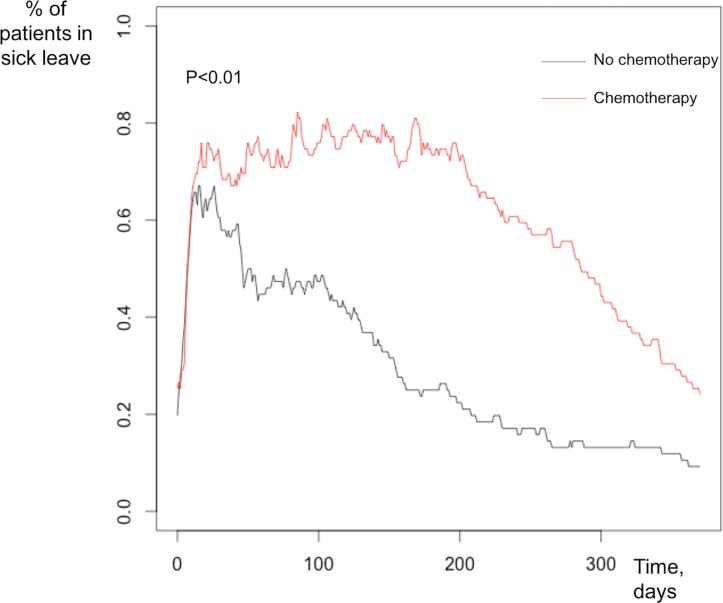
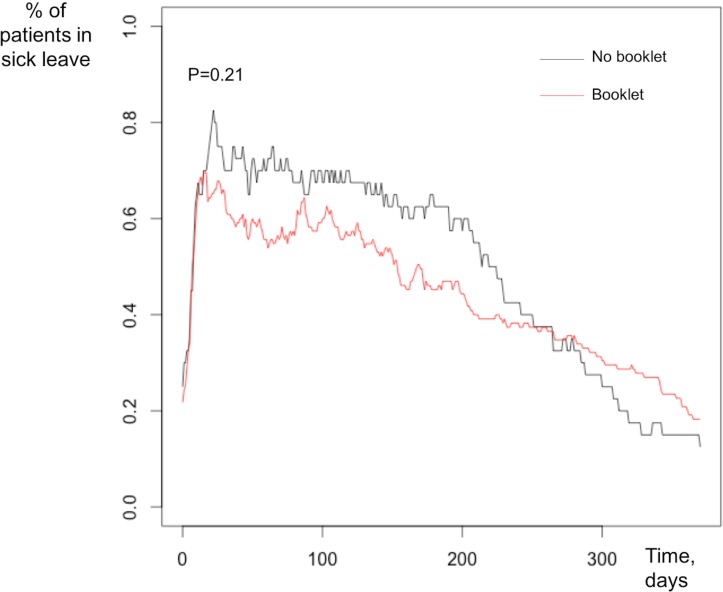
Work-related data after BC were available for 178 patients (60%). The median age at diagnosis was 50 years (27-77), 87.9% of patients had an invasive form of BC and 25.3% a lymph node involvement. 25.9% had a radical surgery and 24.2% had an axillary dissection. Radiotherapy was performed in 90.9% of patients and chemotherapy in 48.1%. Sick leave was prescribed for 165 patients (92.7%) for a median of 155 days. On univariate analysis, invasive BC (p=0.025), lymph node involvement (p=0.005), radical surgery (p=0.025), axillary dissection (p=0.004), chemotherapy (p<0.001), personal income <€1900/month (p=0.03) and not having received the patient information booklet on RTW (p=0.047) were found to be associated with a longer duration of sick leave. On multivariate analysis, chemotherapy was found to be associated with longer sick leave (OR: 3.5; 95% CI 1.6 to 7.9; p=0.002). The cost of sick leave to French National Health Insurance was fourfold higher in the case of chemotherapy (p<0.001).
Advanced disease and chemotherapy are major factors that influence sick leave duration during the management of BC.
NCT02813317.
乳腺癌(BC)后的重返工作岗位(RTW)仍是一个新的研究领域。尚未明确确定决定BC患者病假时间较短的因素。本研究的目的是描述BC治疗期间的工作情况,并确定与病假时间相关的因素。
对患有可手术BC的女性进行了一项观察性、前瞻性、多中心研究。为所有在职患者提供了一本日志,以记录1年内的社会人口统计学和工作相关数据。
178例患者(60%)提供了BC后的工作相关数据。诊断时的中位年龄为50岁(27 - 77岁),87.9%的患者患有浸润性BC,25.3%有淋巴结受累。25.9%接受了根治性手术,24.2%进行了腋窝清扫。90.9%的患者接受了放疗,48.1%接受了化疗。165例患者(92.7%)被开具病假,中位病假时间为155天。单因素分析发现,浸润性BC(p = 0.025)、淋巴结受累(p = 0.005)、根治性手术(p = 0.025)、腋窝清扫(p = 0.004)、化疗(p < 0.001)、个人月收入<1900欧元(p = 0.03)以及未收到RTW患者信息手册(p = 0.047)与病假时间较长有关。多因素分析发现,化疗与较长的病假时间相关(OR:3.5;95%CI 1.6至7.9;p = 0.002)。化疗情况下法国国家健康保险的病假费用高出四倍(p < 0.001)。
疾病进展和化疗是影响BC治疗期间病假时间的主要因素。
NCT02813317。