Mala Lucia, Maly Tomas, Zahalka František, Bunc Vaclav, Kaplan Ales, Jebavy Radim, Tuma Martin
Sport Research Center, Charles University in Prague, Prague, Czech Republic.
Department of track and field, Charles University in Prague, Prague, Czech Republic.
J Hum Kinet. 2015 Apr 7;45:207-15. doi: 10.1515/hukin-2015-0021. eCollection 2015 Mar 29.
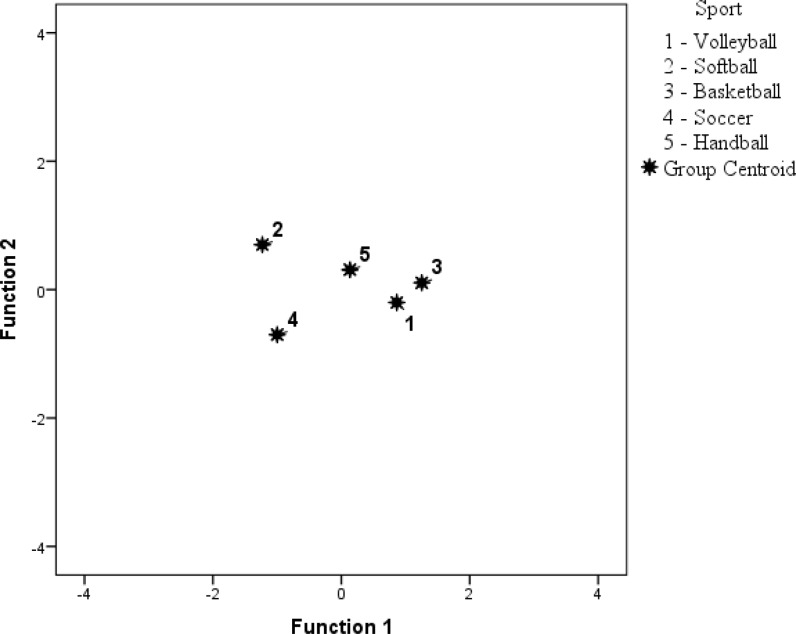
The goal of this study was to identify and compare body composition (BC) variables in elite female athletes (age ± years): volleyball (27.4 ± 4.1), softball (23.6 ± 4.9), basketball (25.9 ± 4.2), soccer (23.2 ± 4.2) and handball (24.0 ± 3.5) players. Fat-free mass (FFM), fat mass, percentage of fat mass (FMP), body cell mass (BCM), extracellular mass (ECM), their ratio, the percentage of BCM in FFM, the phase angle (α), and total body water, with a distinction between extracellular (ECW) and intracellular water, were measured using bioimpedance analysis. MANOVA showed significant differences in BC variables for athletes in different sports (F60.256 = 2.93, p < 0.01, η2 = 0.407). The results did not indicate any significant differences in FMP or α among the tested groups (p > 0.05). Significant changes in other BC variables were found in analyses when sport was used as an independent variable. Soccer players exhibited the most distinct BC, differing from players of other sports in 8 out of 10 variables. In contrast, the athletes with the most similar BC were volleyball and basketball players, who did not differ in any of the compared variables. Discriminant analysis revealed two significant functions (p < 0.01). The first discriminant function primarily represented differences based on the FFM proportion (volleyball, basketball vs. softball, soccer). The second discriminant function represented differences based on the ECW proportion (softball vs. soccer). Although all of the members of the studied groups competed at elite professional levels, significant differences in the selected BC variables were found. The results of the present study may serve as normative values for comparison or target values for training purposes.
本研究的目的是识别和比较精英女性运动员(年龄±岁)的身体成分(BC)变量:排球运动员(27.4±4.1)、垒球运动员(23.6±4.9)、篮球运动员(25.9±4.2)、足球运动员(23.2±4.2)和手球运动员(24.0±3.5)。使用生物电阻抗分析测量了去脂体重(FFM)、脂肪量、脂肪量百分比(FMP)、身体细胞量(BCM)、细胞外质量(ECM)、它们的比率、BCM在FFM中的百分比、相位角(α)以及总体水,并区分了细胞外水(ECW)和细胞内水。多变量方差分析显示不同运动项目的运动员在BC变量上存在显著差异(F60.256 = 2.93,p < 0.01,η2 = 0.407)。结果表明,测试组之间的FMP或α没有任何显著差异(p > 0.05)。当将运动项目作为自变量进行分析时,发现其他BC变量有显著变化。足球运动员表现出最独特的身体成分,在10个变量中有8个与其他运动项目的运动员不同。相比之下,身体成分最相似的运动员是排球运动员和篮球运动员,他们在任何比较变量上都没有差异。判别分析揭示了两个显著函数(p < 0.01)。第一个判别函数主要代表基于FFM比例的差异(排球、篮球与垒球、足球)。第二个判别函数代表基于ECW比例的差异(垒球与足球)。尽管研究组的所有成员都在精英职业水平上竞争,但在所选择的BC变量上发现了显著差异。本研究结果可作为比较用的标准值或训练目的的目标值。