Department of Health Promotion and Community Health Sciences, Texas A&M Health Science Center, School of Public Health , College Station, TX , USA.
Department of Health Promotion and Behavior, College of Public Health, University of Georgia , Athens, GA , USA.
Front Public Health. 2015 Apr 27;2:172. doi: 10.3389/fpubh.2014.00172. eCollection 2014.
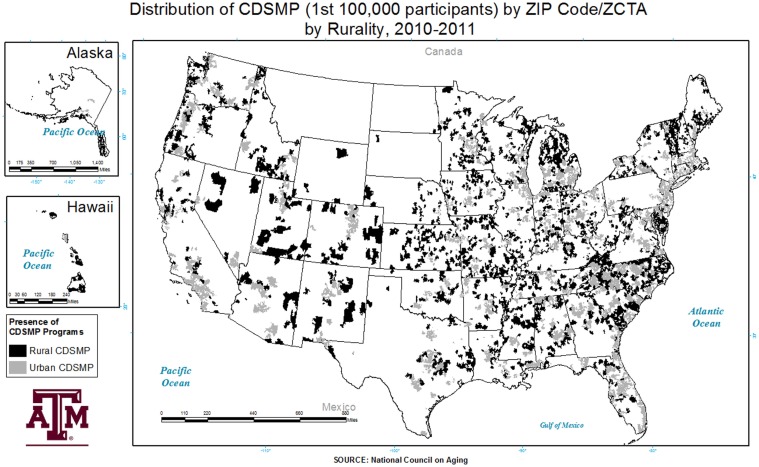
This study assessed the sociodemographic characteristics of rural residents who participated in chronic-disease self-management education (CDSME) program workshops and the extent to which CDSME programs were utilized by those with limited access to health care services. We analyzed data from the first 100,000 adults who attended CDSME program workshops during a national dissemination spanning 45 states, the District of Columbia, and Puerto Rico. Approximately 24% of participants lived in rural areas. Overall, 42% of all participants were minorities; urban areas reached more minority participants (48%) than rural areas (25%). The average age of participants was high in rural (age, μ = 66.1) and urban (age, μ = 67.3) areas. In addition, the average number of chronic conditions was higher (p < 0.01) in rural (μ = 2.6 conditions) versus urban (μ = 2.4 conditions) areas. Successful completion of CDSME programs (i.e., attending four or more of the six workshop sessions) was higher (p < 0.01) in rural versus urban areas (78% versus 77%). Factors associated with higher likelihood of successful completion of CDSME programs included being Black (OR = 1.25) versus White and living in rural (versus urban) areas (OR = 1.09). Factors associated with lower likelihood of successful completion included being male (OR = 0.92) and residing in a primary care Health Professional Shortage Area or HPSA (versus a non-HPSA) (OR = 0.93). Findings highlight the capability of CDSME programs to reach rural residents, yet dissemination efforts can be further enhanced to ensure minorities and individuals in a HPSA utilize this program. Tailored strategies are needed to increase participant recruitment and retention in rural areas to overcome traditional barriers to health service access.
本研究评估了参加慢性病自我管理教育(CDSME)计划研讨会的农村居民的社会人口特征,以及医疗服务有限的人群对 CDSME 计划的利用程度。我们分析了在跨越 45 个州、哥伦比亚特区和波多黎各的全国推广期间参加 CDSME 计划研讨会的前 10 万名成年人的数据。大约 24%的参与者居住在农村地区。总体而言,所有参与者中有 42%是少数族裔;城市地区的少数族裔参与者(48%)多于农村地区(25%)。农村(年龄,μ=66.1)和城市(年龄,μ=67.3)地区参与者的平均年龄都较高。此外,农村地区(μ=2.6 种疾病)慢性疾病的平均数量高于城市地区(μ=2.4 种疾病)(p<0.01)。完成 CDSME 计划(即参加六次研讨会中的四次或更多次)的比例在农村地区(78%)高于城市地区(77%)(p<0.01)。与更高的 CDSME 计划完成率相关的因素包括是黑人(OR=1.25)而不是白人,以及居住在农村(而不是城市)地区(OR=1.09)。与较低的 CDSME 计划完成率相关的因素包括男性(OR=0.92)和居住在初级保健卫生专业人员短缺区或 HPSA(而不是非 HPSA)(OR=0.93)。研究结果突显了 CDSME 计划能够覆盖农村居民,但传播工作可以进一步加强,以确保少数民族和 HPSA 中的个人利用该计划。需要制定有针对性的策略来增加农村地区的参与者招募和保留,以克服获得卫生服务的传统障碍。