Nori Javier, Loyola Rafael
Centro de Zoología Aplicada, Facultad de Ciencias Exactas Físicas y Naturales, Universidad Nacional de Córdoba and Instituto de Diversidad y Ecología Animal-Consejo Nacional de Investigaciones Científicas y Técnicas and Universidad Nacional de Córdoba, Córdoba, Córdoba, X5000AVP, Argentina.
Laboratório de Biogeografia da Conservação, Departmento de Ecologia, Universidade Federal de Goiás, CP 131, CEP 74001-970, Goiânia, Goiás, Brazil.
PLoS One. 2015 May 12;10(5):e0125055. doi: 10.1371/journal.pone.0125055. eCollection 2015.
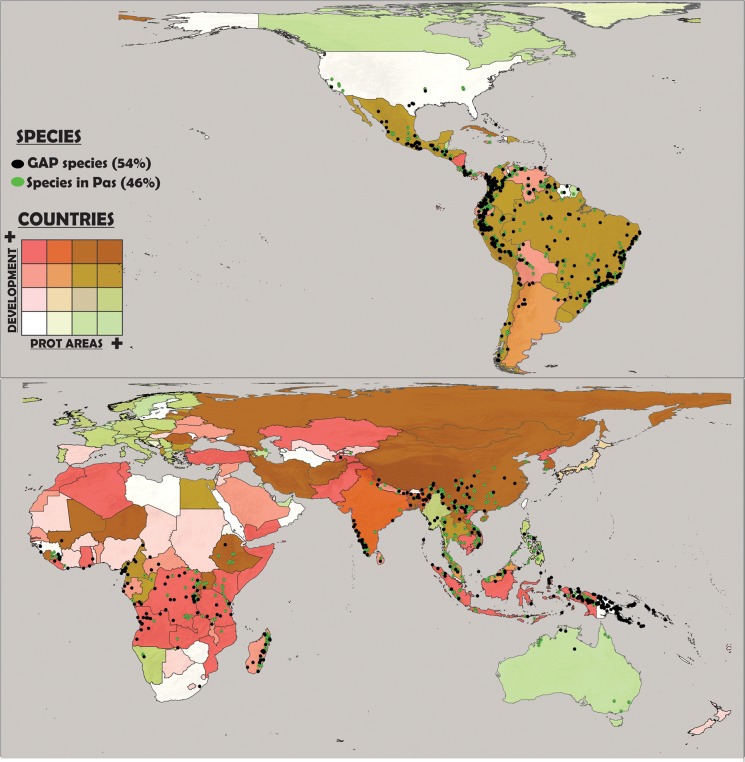
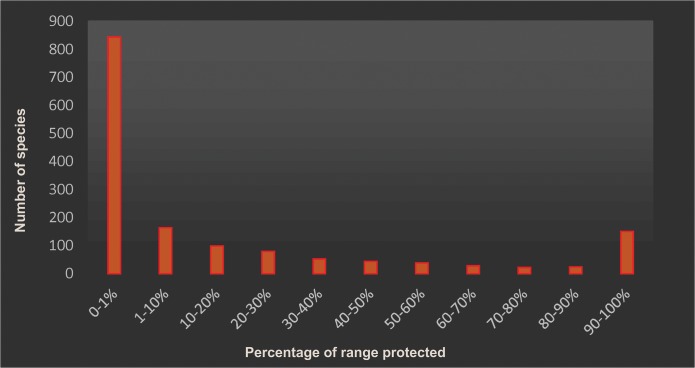
The 'Data Deficient' (DD) category of the IUCN Red List assembles species that cannot be placed in another category due to insufficient information. This process generates uncertainty about whether these species are safe or actually in danger. Here, we give a global overview on the current situation of DD amphibian species (almost a quarter of living amphibians) considering land-use change through habitat modification, the degree of protection of each species and the socio-political context of each country harboring DD species. We found that DD amphibians have, on average, 81% of their ranges totally outside protected areas. Worryingly, more than half of DD species have less than 1% of their distribution represented in protected areas. Furthermore, the percentage of overlap between species' range and human-modified landscapes is high, at approximately 58%. Many countries harboring a large number of DD species show a worrying socio-political trend illustrated by substantial, recent incremental increases in the Human Development Index and lower incremental increases in the establishment of protected areas. Most of these are African countries, which are located mainly in the central and southern regions of the continent. Other countries with similar socio-political trends are in southeastern Asia, Central America, and in the northern region of South America. This situation is concerning, but it also creates a huge opportunity for considering DD amphibians in future conservation assessments, planning, and policy at different levels of government administration.
世界自然保护联盟(IUCN)红色名录中的“数据缺乏”(DD)类别收录了因信息不足而无法归入其他类别的物种。这一情况使得人们无法确定这些物种是安全的还是实际上处于危险之中。在此,我们从全球角度概述了DD两栖动物物种(几乎占现存两栖动物的四分之一)的现状,考量了栖息地改造导致的土地利用变化、每个物种的保护程度以及每个有DD物种国家的社会政治背景。我们发现,DD两栖动物平均有81%的分布范围完全不在保护区内。令人担忧的是,超过半数的DD物种在保护区内的分布占比不到1%。此外,物种分布范围与人类改造景观的重叠比例很高,约为58%。许多拥有大量DD物种的国家呈现出令人担忧的社会政治趋势,表现为人类发展指数近期大幅递增,而保护区设立的增幅较小。其中大多数是非洲国家,主要位于非洲大陆的中部和南部地区。其他具有类似社会政治趋势的国家位于东南亚、中美洲以及南美洲北部地区。这种情况令人担忧,但也为在各级政府管理的未来保护评估、规划和政策中考虑DD两栖动物创造了巨大机遇。