Touvykine Boris, Mansoori Babak K, Jean-Charles Loyda, Deffeyes Joan, Quessy Stephan, Dancause Numa
Département de Neurosciences, Université de Montréal, Montréal, QC, Canada.
Département de Biologie moléculaire, Biochimie médicale et pathologie, Université Laval, Québec, QC, Canada.
Neurorehabil Neural Repair. 2016 Mar;30(3):280-92. doi: 10.1177/1545968315585356. Epub 2015 May 12.
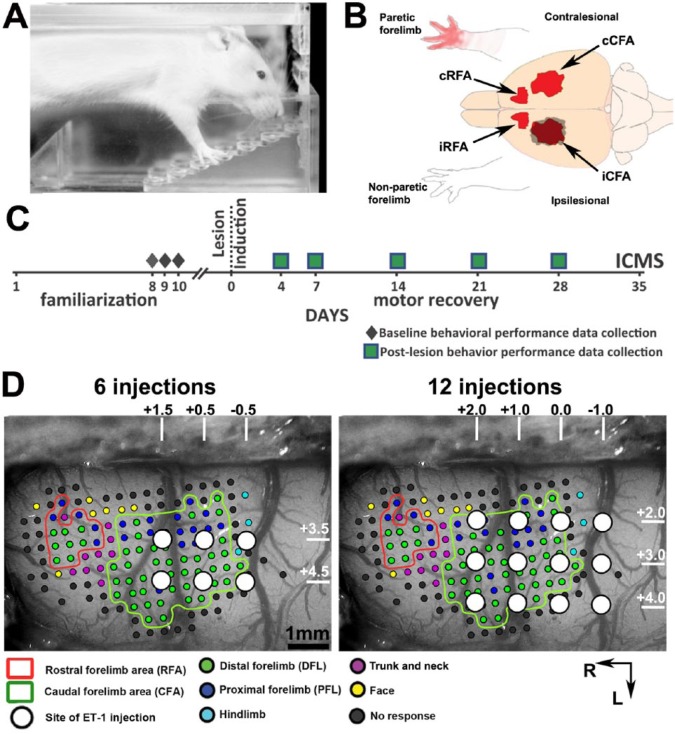
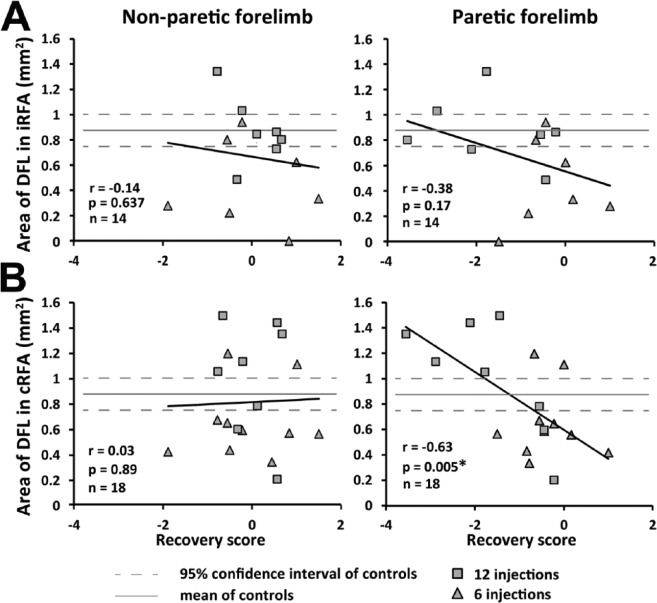
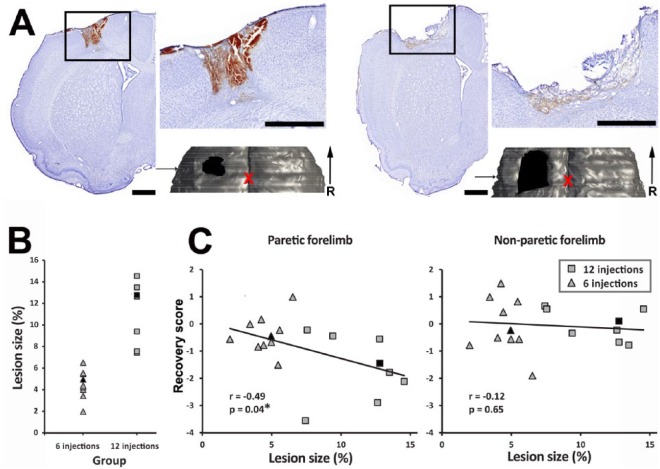
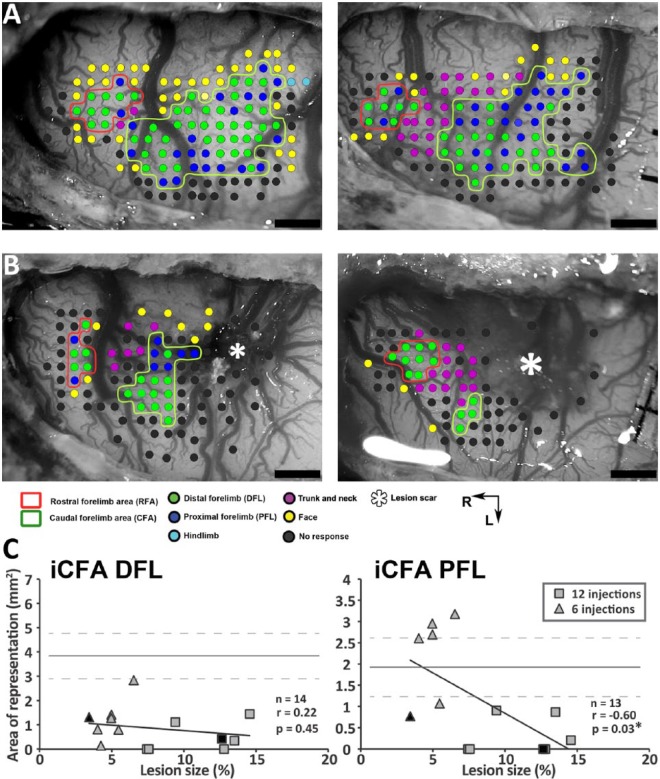
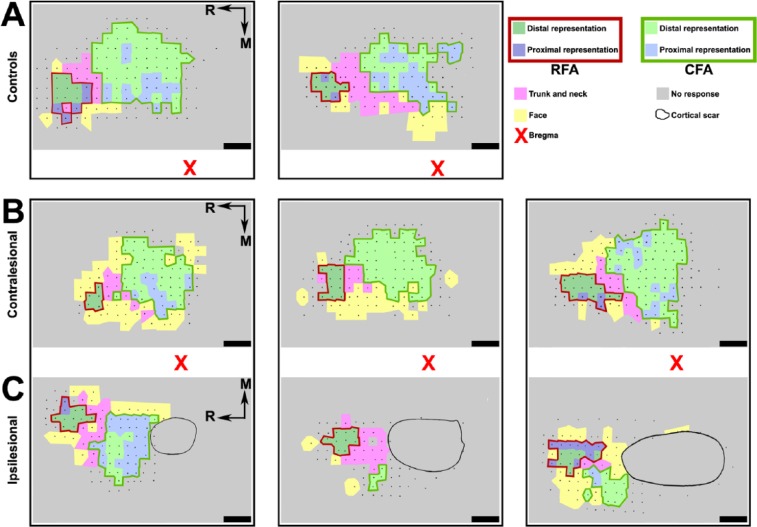
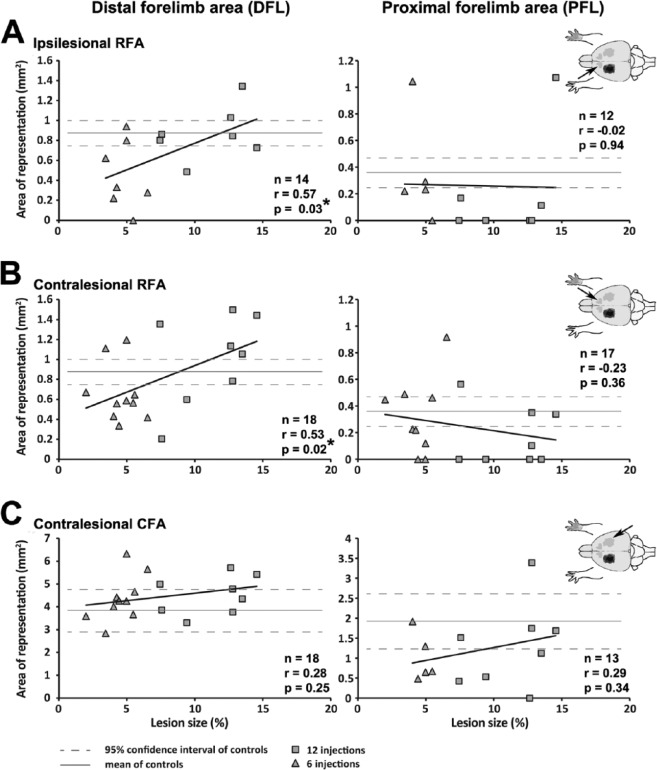
Recovery of hand function following lesions in the primary motor cortex (M1) is associated with a reorganization of premotor areas in the ipsilesional hemisphere, and this reorganization depends on the size of the lesion. It is not clear how lesion size affects motor representations in the contralesional hemisphere and how the effects in the 2 hemispheres compare. Our goal was to study how lesion size affects motor representations in the ipsilesional and contralesional hemispheres. In rats, we induced lesions of different sizes in the caudal forelimb area (CFA), the equivalent of M1. The effective lesion volume in each animal was quantified histologically. Behavioral recovery was evaluated with the Montoya Staircase task for 28 days after the lesion. Then, the organization of the CFA and the rostral forelimb area (RFA)--the putative premotor area in rats--in the 2 cerebral hemispheres was studied with intracortical microstimulation mapping techniques. The distal forelimb representation in the RFA of both the ipsilesional and contralesional hemispheres was positively correlated with the size of the lesion. In contrast, lesion size had no effect on the contralesional CFA, and there was no relationship between movement representations in the 2 hemispheres. Finally, only the contralesional RFA was negatively correlated with chronic motor deficits of the paretic forelimb. Our data show that lesion size has comparable effects on motor representations in premotor areas of both hemispheres and suggest that the contralesional premotor cortex may play a greater role in the recovery of the paretic forelimb following large lesions.
初级运动皮层(M1)损伤后手功能的恢复与同侧半球运动前区的重组有关,且这种重组取决于损伤的大小。目前尚不清楚损伤大小如何影响对侧半球的运动表征,以及两个半球的影响有何差异。我们的目标是研究损伤大小如何影响同侧和对侧半球的运动表征。在大鼠中,我们在相当于M1的尾侧前肢区(CFA)诱导了不同大小的损伤。通过组织学方法对每只动物的有效损伤体积进行了量化。损伤后28天,使用蒙托亚阶梯任务评估行为恢复情况。然后,采用皮层内微刺激映射技术研究了两个大脑半球中CFA和喙侧前肢区(RFA)——大鼠假定的运动前区——的组织情况。同侧和对侧半球RFA中前肢远端的表征与损伤大小呈正相关。相比之下,损伤大小对对侧CFA没有影响,且两个半球的运动表征之间没有关联。最后,只有对侧RFA与患侧前肢的慢性运动缺陷呈负相关。我们的数据表明,损伤大小对两个半球运动前区的运动表征有类似影响,并表明在大损伤后,对侧运动前皮层可能在患侧前肢的恢复中发挥更大作用。