Topaz Chad M, Ziegelmeier Lori, Halverson Tom
Department of Mathematics, Statistics, and Computer Science, Macalester College, Saint Paul, Minnesota, United States of America.
PLoS One. 2015 May 13;10(5):e0126383. doi: 10.1371/journal.pone.0126383. eCollection 2015.
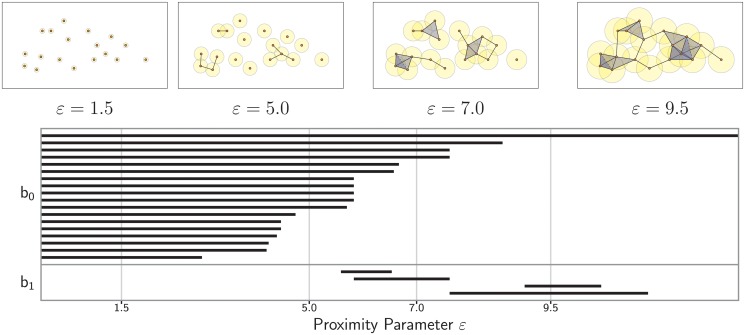
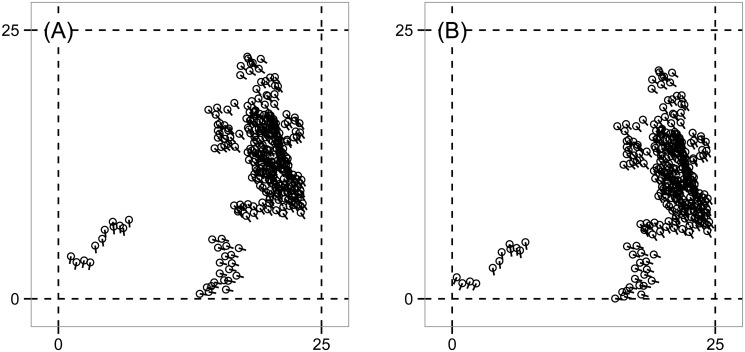
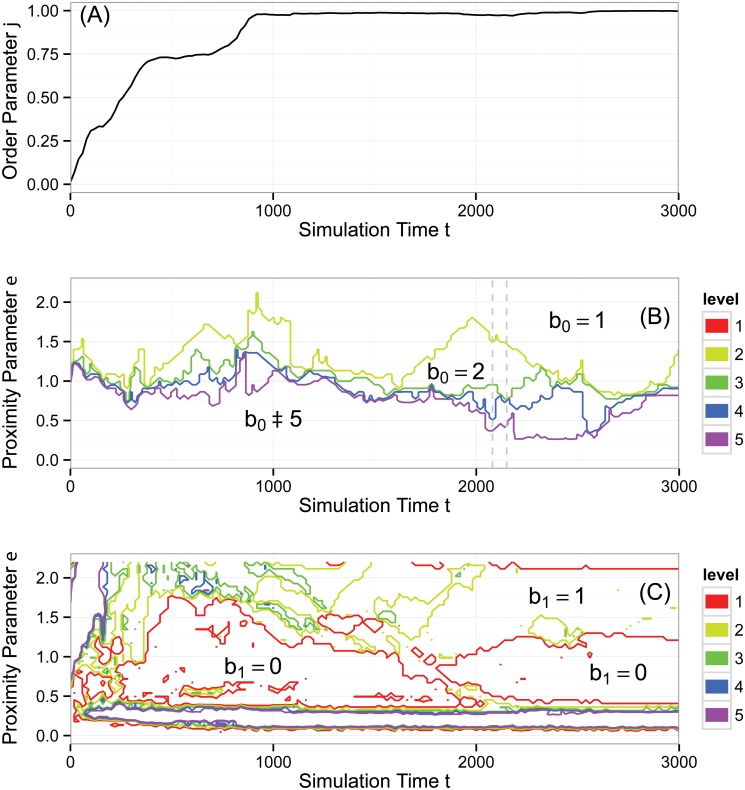
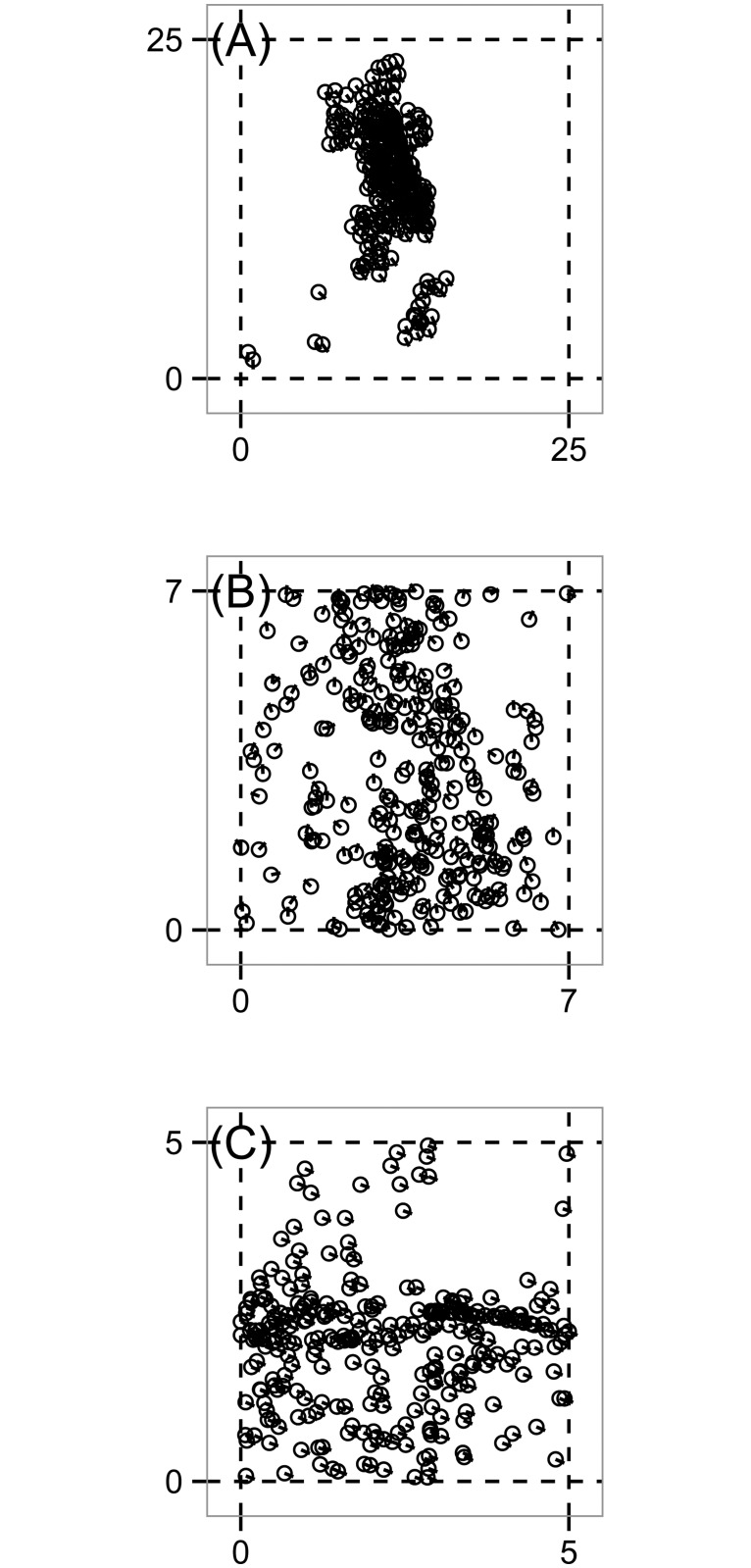
We apply tools from topological data analysis to two mathematical models inspired by biological aggregations such as bird flocks, fish schools, and insect swarms. Our data consists of numerical simulation output from the models of Vicsek and D'Orsogna. These models are dynamical systems describing the movement of agents who interact via alignment, attraction, and/or repulsion. Each simulation time frame is a point cloud in position-velocity space. We analyze the topological structure of these point clouds, interpreting the persistent homology by calculating the first few Betti numbers. These Betti numbers count connected components, topological circles, and trapped volumes present in the data. To interpret our results, we introduce a visualization that displays Betti numbers over simulation time and topological persistence scale. We compare our topological results to order parameters typically used to quantify the global behavior of aggregations, such as polarization and angular momentum. The topological calculations reveal events and structure not captured by the order parameters.
我们将拓扑数据分析工具应用于受鸟群、鱼群和昆虫群等生物聚集启发的两个数学模型。我们的数据由Vicsek模型和D'Orsogna模型的数值模拟输出组成。这些模型是动态系统,描述了通过对齐、吸引和/或排斥相互作用的主体的运动。每个模拟时间框架都是位置-速度空间中的点云。我们分析这些点云的拓扑结构,通过计算前几个贝蒂数来解释持久同调。这些贝蒂数计算数据中存在的连通分量、拓扑圆和被困体积。为了解释我们的结果,我们引入了一种可视化方法,该方法显示模拟时间和拓扑持久尺度上的贝蒂数。我们将拓扑结果与通常用于量化聚集全局行为的序参量进行比较,如极化和角动量。拓扑计算揭示了序参量未捕捉到的事件和结构。