Department of Mathematics, Statistics, and Computer Science, Macalester College, Saint Paul, Minnesota, United States of America.
Department of Mathematics, Harvey Mudd College, Claremont, California, United States of America.
PLoS One. 2013 Dec 20;8(12):e83343. doi: 10.1371/journal.pone.0083343. eCollection 2013.
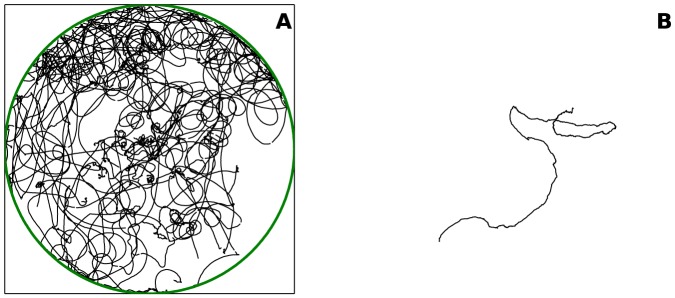
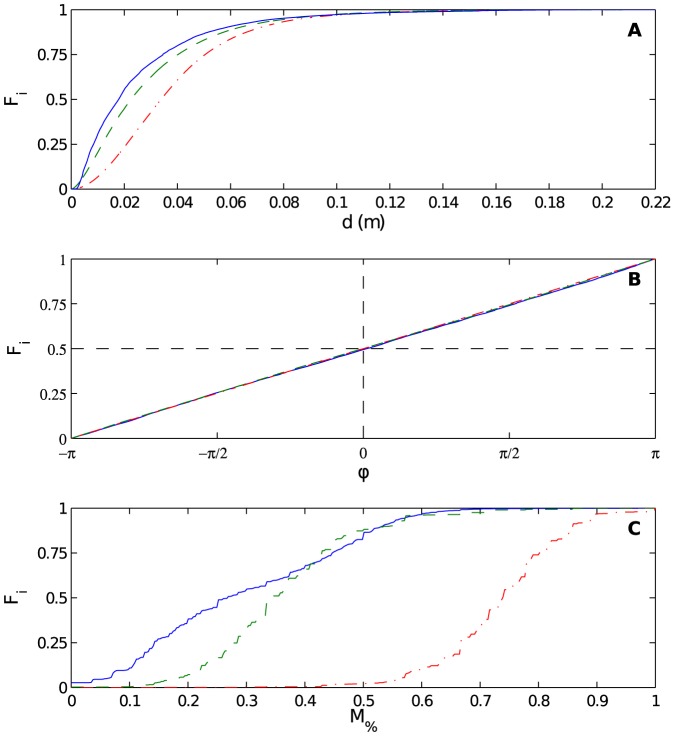
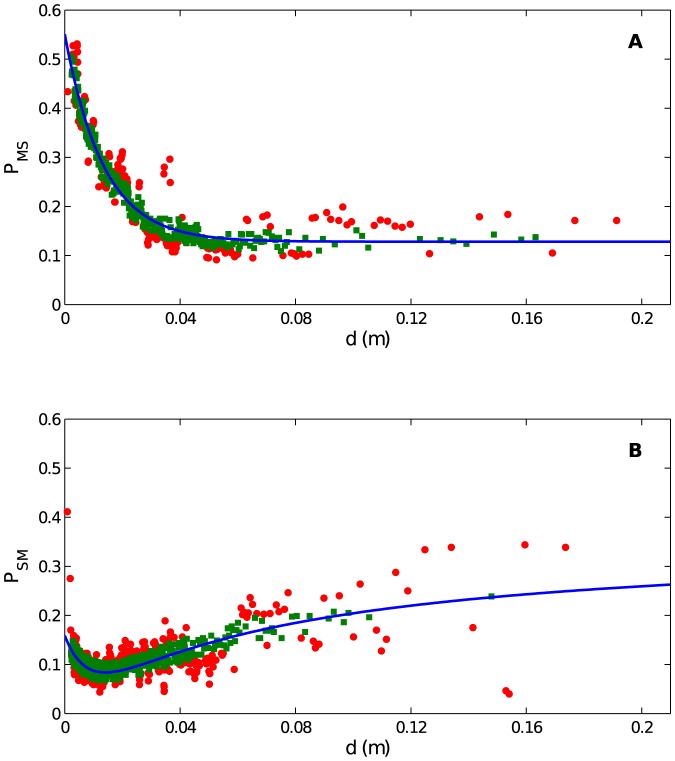
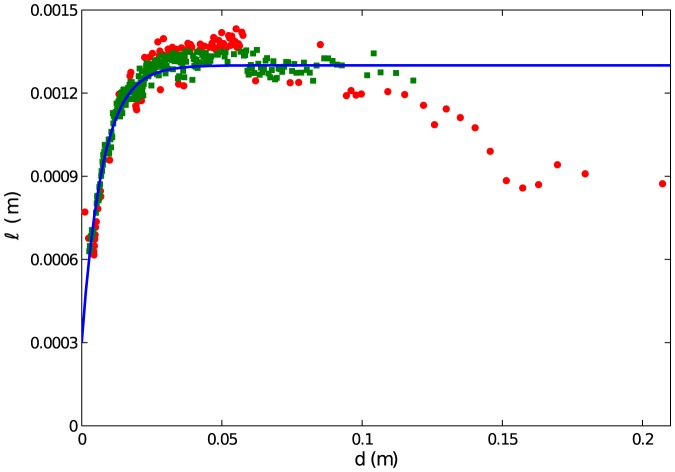
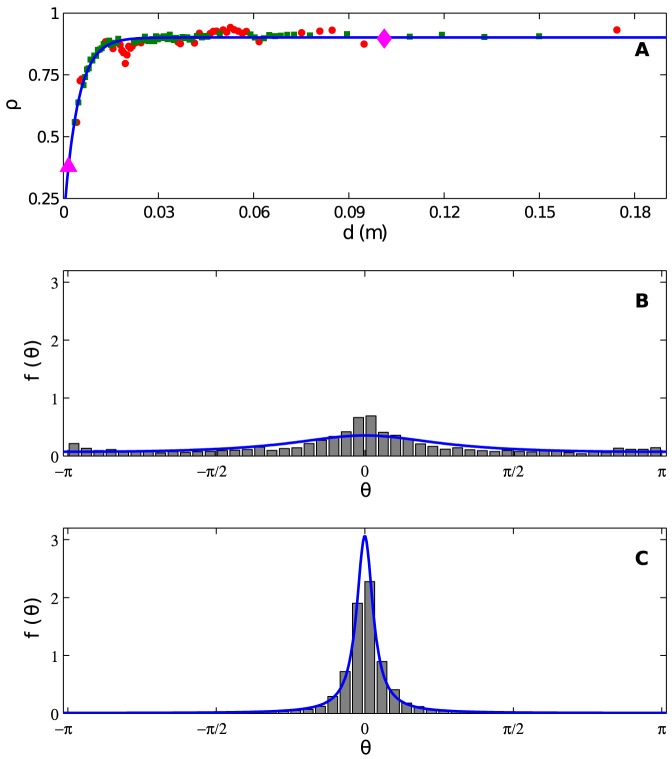
From bird flocks to fish schools and ungulate herds to insect swarms, social biological aggregations are found across the natural world. An ongoing challenge in the mathematical modeling of aggregations is to strengthen the connection between models and biological data by quantifying the rules that individuals follow. We model aggregation of the pea aphid, Acyrthosiphon pisum. Specifically, we conduct experiments to track the motion of aphids walking in a featureless circular arena in order to deduce individual-level rules. We observe that each aphid transitions stochastically between a moving and a stationary state. Moving aphids follow a correlated random walk. The probabilities of motion state transitions, as well as the random walk parameters, depend strongly on distance to an aphid's nearest neighbor. For large nearest neighbor distances, when an aphid is essentially isolated, its motion is ballistic with aphids moving faster, turning less, and being less likely to stop. In contrast, for short nearest neighbor distances, aphids move more slowly, turn more, and are more likely to become stationary; this behavior constitutes an aggregation mechanism. From the experimental data, we estimate the state transition probabilities and correlated random walk parameters as a function of nearest neighbor distance. With the individual-level model established, we assess whether it reproduces the macroscopic patterns of movement at the group level. To do so, we consider three distributions, namely distance to nearest neighbor, angle to nearest neighbor, and percentage of population moving at any given time. For each of these three distributions, we compare our experimental data to the output of numerical simulations of our nearest neighbor model, and of a control model in which aphids do not interact socially. Our stochastic, social nearest neighbor model reproduces salient features of the experimental data that are not captured by the control.
从鸟群到鱼群,从有蹄动物群到昆虫群,社会生物聚集现象存在于自然界的各个角落。在聚集现象的数学建模中,一个持续存在的挑战是通过量化个体遵循的规则,加强模型与生物数据之间的联系。我们对豌豆蚜(Acyrthosiphon pisum)的聚集进行了建模。具体来说,我们进行了实验来跟踪在无特征圆形竞技场中行走的蚜虫的运动,以推导出个体层面的规则。我们观察到每只蚜虫在移动和静止状态之间随机转换。移动的蚜虫遵循相关的随机漫步。运动状态转换的概率,以及随机漫步参数,强烈依赖于蚜虫与其最近邻居的距离。对于较大的最近邻居距离,当蚜虫基本上处于孤立状态时,它的运动是弹道式的,蚜虫移动得更快,转弯更少,停止的可能性更小。相比之下,对于较短的最近邻居距离,蚜虫移动得更慢,转弯更多,更容易静止;这种行为构成了聚集机制。从实验数据中,我们估计了状态转换概率和相关随机漫步参数作为最近邻居距离的函数。建立了个体层面的模型后,我们评估它是否可以再现群体层面的运动宏观模式。为此,我们考虑了三个分布,即距离最近的邻居、角度到最近的邻居和任何给定时间移动的种群百分比。对于这三个分布中的每一个,我们将我们的实验数据与我们的最近邻居模型的数值模拟输出进行比较,以及与不进行社会相互作用的控制模型进行比较。我们的随机、社交最近邻居模型再现了实验数据中控制模型无法捕捉到的显著特征。