Lau Esther Yuet Ying, Wong Mark Lawrence, Lau Kristy Nga Ting, Hui Florence Wai Ying, Tseng Chia-huei
Sleep Laboratory, The University of Hong Kong, Hong Kong, China; Department of Psychology, The University of Hong Kong, Hong Kong, China; Department of Psychiatry, The University of Hong Kong, Hong Kong, China.
Sleep Laboratory, The University of Hong Kong, Hong Kong, China; Department of Psychology, The University of Hong Kong, Hong Kong, China.
PLoS One. 2015 May 13;10(5):e0125752. doi: 10.1371/journal.pone.0125752. eCollection 2015.
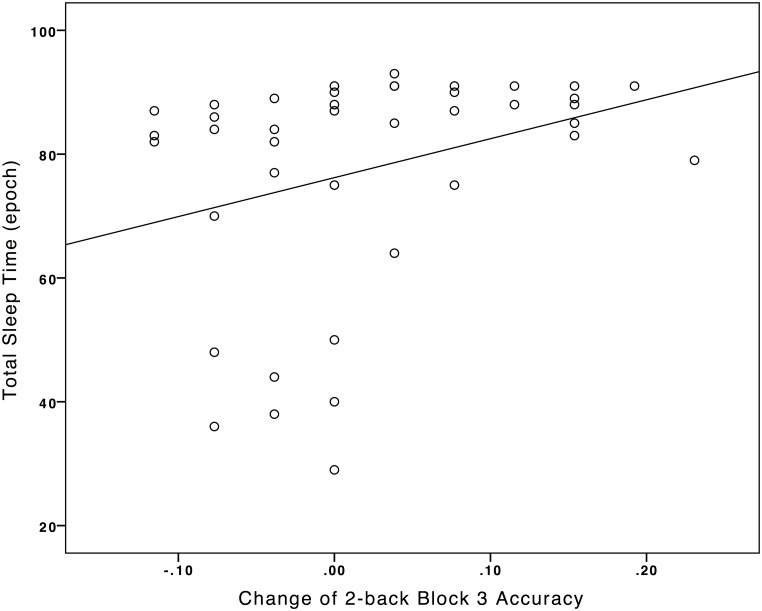
The main objective was to study the impact of a daytime sleep opportunity on working memory and the mechanism behind such impact. This study adopted an experimental design in a sleep research laboratory. Eighty healthy college students (Age:17-23, 36 males) were randomized to either have a polysomnography-monitored daytime sleep opportunity (Nap-group, n=40) or stay awake (Wake-group, n=40) between the two assessment sessions. All participants completed a sleep diary and wore an actigraph-watch for 5 days before and one day after the assessment sessions. They completed the state-measurement of sleepiness and affect, in addition to a psychomotor vigilance test and a working memory task before and after the nap/wake sessions. The two groups did not differ in their sleep characteristics prior to and after the lab visit. The Nap-group had higher accuracy on the working memory task, fewer lapses on the psychomotor vigilance test and lower state-sleepiness than the Wake-group. Within the Nap-group, working memory accuracy was positively correlated with duration of rapid eye movement sleep (REM) and total sleep time during the nap. Our findings suggested that "sleep gain" during a daytime sleep opportunity had significant positive impact on working memory performance, without affecting subsequent nighttime sleep in young adult, and such impact was associated with the duration of REM. While REM abnormality has long been noted in pathological conditions (e.g. depression), which are also presented with cognitive dysfunctions (e.g. working memory deficits), this was the first evidence showing working memory enhancement associated with REM in daytime napping in college students, who likely had habitual short sleep duration but were otherwise generally healthy.
主要目的是研究白天睡眠机会对工作记忆的影响以及这种影响背后的机制。本研究在睡眠研究实验室采用了实验设计。80名健康大学生(年龄:17 - 23岁,36名男性)被随机分为两组,在两次评估之间,一组有经多导睡眠图监测的白天睡眠机会(午睡组,n = 40),另一组保持清醒(清醒组,n = 40)。所有参与者在评估前5天和评估后1天完成睡眠日记并佩戴活动记录仪手表。他们在午睡/清醒前后完成了困倦和情绪的状态测量,以及心理运动警觉性测试和工作记忆任务。两组在实验室访问前后的睡眠特征没有差异。午睡组在工作记忆任务上的准确性更高,在心理运动警觉性测试中的失误更少,且状态困倦程度低于清醒组。在午睡组中,工作记忆准确性与快速眼动睡眠(REM)持续时间和午睡期间的总睡眠时间呈正相关。我们的研究结果表明,白天睡眠机会中的“睡眠增益”对工作记忆表现有显著的积极影响,且不影响年轻成年人随后的夜间睡眠,这种影响与REM持续时间有关。虽然长期以来在病理状况(如抑郁症)中已注意到REM异常,这些病理状况也伴有认知功能障碍(如工作记忆缺陷),但这是首次有证据表明在可能习惯性睡眠时长较短但总体健康的大学生白天小睡中,工作记忆增强与REM有关。