Tsai Wen-Chan, Ou Tsan-Teng, Yen Jeng-Hsien, Wu Cheng-Chin, Tung Yi-Ching
Department of Internal Medicine, Kaohsiung Medical University Hospital, Kaohsiung, Taiwan.
Department of Public Health and Environmental Medicine, College of Medicine, Kaohsiung Medical University, Kaohsiung, Taiwan.
PLoS One. 2015 May 13;10(5):e0126347. doi: 10.1371/journal.pone.0126347. eCollection 2015.
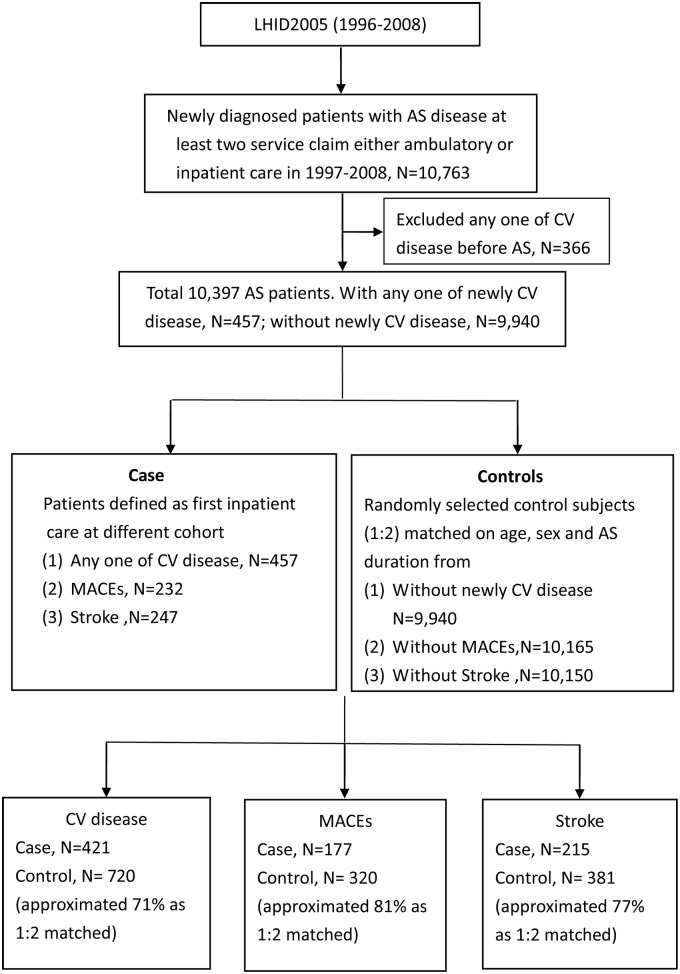
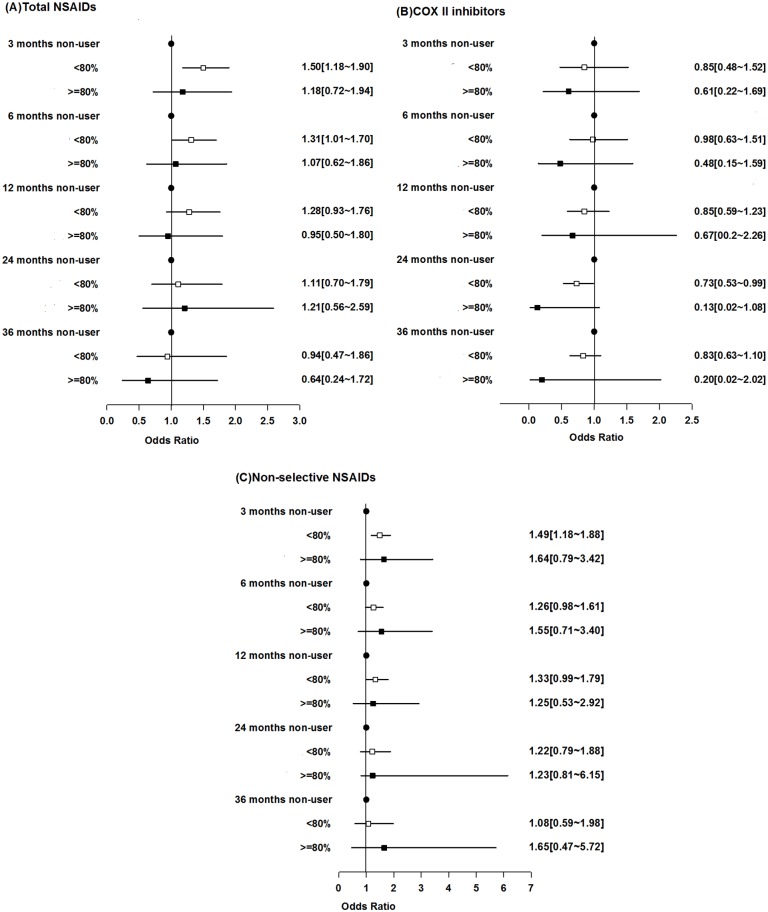
The objective of this case-control study was to investigate the risk of cardiovascular disease (CVD) following non-steroidal anti-inflammatory drug (NSAID) use in patients with ankylosing spondylitis (AS). A total of 10,763 new AS patients were identified from the National Taiwan Health Insurance claims database during the period from 1997 to 2008. In all, 421 AS patients with CVD were recruited as cases, and up to 2-fold as many sex- and age-matched controls were selected. Logistic regression models were used to estimate the odds ratio (OR) between NSAID use and CVD incidence. The medication possession rate (MPR) was used to evaluate NSAID exposure during the study period. AS patients had increased risk of CVD (OR, 1.68; 95% confidence interval (CI), 1.57 to 1.80). Among frequent (MPR≥80%) COX II users, the risks for all types of CVD were ten times lower than those among non-users at 24 months (OR, 0.08; 95% CI, 0.01 to 0.92). Among frequent NSAID users, the risks of major adverse cardiac event (MACE) were significantly lower at 12 months (OR, 0.23; 95% CI, 0.07 to 0.76)--a trend showing that longer exposure correlated with lower risk. Regarding non-frequent NSAID users (MPR<80%), short-term exposure did carry higher risk (for 6 months: OR, 1.41; 95% CI, 1.07 to 1.86), but after 12 months, the risk no longer existed. We conclude that long-term frequent use of NSAIDs might protect AS patients from CVD; however, NSAIDs still carried higher short-term risk in the non-frequent users.
这项病例对照研究的目的是调查强直性脊柱炎(AS)患者使用非甾体抗炎药(NSAID)后发生心血管疾病(CVD)的风险。1997年至2008年期间,从台湾国民健康保险索赔数据库中识别出总共10763例新的AS患者。总共招募了421例患有CVD的AS患者作为病例,并选择了多达两倍的性别和年龄匹配的对照。使用逻辑回归模型估计NSAID使用与CVD发病率之间的比值比(OR)。用药占有率(MPR)用于评估研究期间NSAID的暴露情况。AS患者发生CVD的风险增加(OR,1.68;95%置信区间(CI),1.57至1.80)。在频繁(MPR≥80%)使用COX II的患者中,24个月时所有类型CVD的风险比非使用者低10倍(OR,0.08;95%CI,0.01至0.92)。在频繁使用NSAID的患者中,12个月时主要不良心脏事件(MACE)的风险显著降低(OR,0.23;95%CI,0.07至0.76)——一种显示暴露时间越长风险越低的趋势。对于非频繁使用NSAID的患者(MPR<80%),短期暴露确实具有较高风险(6个月时:OR,1.41;95%CI,1.07至1.86),但12个月后,风险不再存在。我们得出结论,长期频繁使用NSAIDs可能会保护AS患者免受CVD的影响;然而,NSAIDs在非频繁使用者中仍具有较高的短期风险。