Warth Benedikt, Parich Alexandra, Bueschl Christoph, Schoefbeck Denise, Neumann Nora Katharina Nicole, Kluger Bernhard, Schuster Katharina, Krska Rudolf, Adam Gerhard, Lemmens Marc, Schuhmacher Rainer
Department for Agrobiotechnology (IFA-Tulln), Center for Analytical Chemistry and Institute for Biotechnology in Plant Production, University of Natural Resources and Life Sciences, Vienna (BOKU), Konrad-Lorenz-Str. 20, 3430 Tulln, Austria.
Department of Applied Genetics and Cell Biology, University of Natural Resources and Life Sciences, Vienna (BOKU), Konrad-Lorenz-Str. 24, 3430 Tulln, Austria.
Metabolomics. 2015;11(3):722-738. doi: 10.1007/s11306-014-0731-1. Epub 2014 Sep 27.
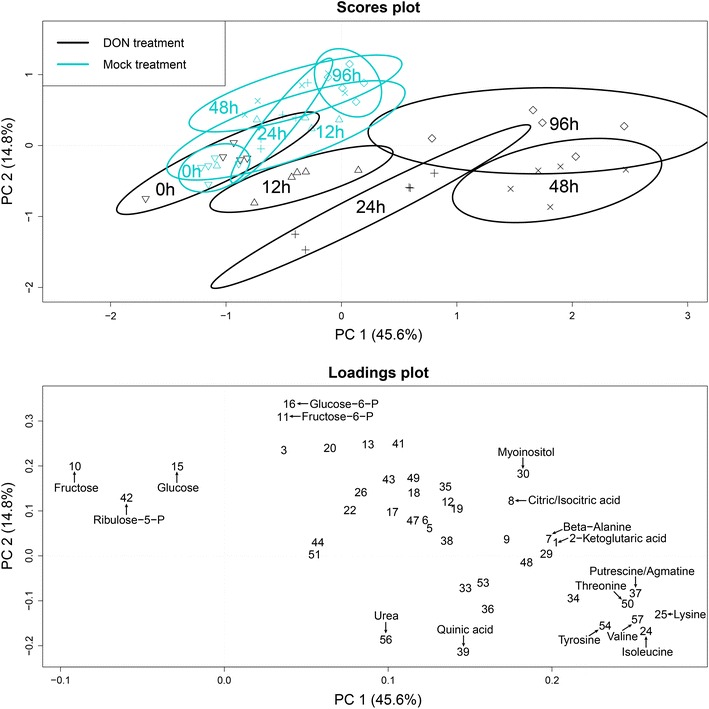
and related species commonly infest grains causing the devastating plant disease Fusarium head blight (FHB) and the formation of trichothecene mycotoxins. The most relevant toxin is deoxynivalenol (DON), which acts as a virulence factor of the pathogen. FHB is difficult to control and resistance to this disease is a polygenic trait, mainly mediated by the quantitative trait loci (QTL) and -. In this study we established a targeted GC-MS based metabolomics workflow comprising a standardized experimental setup for growth, treatment and sampling of wheat ears and subsequent GC-MS analysis followed by data processing and evaluation of QC measures using tailored statistical and bioinformatics tools. This workflow was applied to wheat samples of six genotypes with varying levels of resistance, treated with either DON or water, and harvested 0, 12, 24, 48 and 96 h after treatment. The results suggest that the primary carbohydrate metabolism and transport, the citric acid cycle and the primary nitrogen metabolism of wheat are clearly affected by DON treatment. Most importantly significantly elevated levels of amino acids and derived amines were observed. In particular, the concentrations of the three aromatic amino acids phenylalanine, tyrosine, and tryptophan increased. No clear QTL specific difference in the response could be observed except a generally faster increase in shikimate pathway intermediates in genotypes containing . The overall workflow proved to be feasible and facilitated to obtain a more comprehensive picture on the effect of DON on the central metabolism of wheat.
及其相关物种通常侵染谷物,引发毁灭性的植物病害小麦赤霉病(FHB)并产生单端孢霉烯族毒素。最相关的毒素是脱氧雪腐镰刀菌烯醇(DON),它是病原体的一种毒力因子。小麦赤霉病难以防治,对该病的抗性是一个多基因性状,主要由数量性状位点(QTL)和介导。在本研究中,我们建立了一种基于靶向气相色谱 - 质谱联用的代谢组学工作流程,包括用于小麦穗生长、处理和采样的标准化实验设置,随后进行气相色谱 - 质谱分析,接着使用定制的统计和生物信息学工具进行数据处理和质量控制措施评估。该工作流程应用于六个具有不同抗性水平的小麦基因型样本,分别用DON或水处理,并在处理后0、12、24、48和96小时收获。结果表明,DON处理明显影响了小麦的初级碳水化合物代谢与转运、柠檬酸循环和初级氮代谢。最重要的是,观察到氨基酸和衍生胺的水平显著升高。特别是,三种芳香族氨基酸苯丙氨酸、酪氨酸和色氨酸的浓度增加。除了在含有QTL的基因型中莽草酸途径中间体通常增加得更快外,未观察到明显的QTL特异性反应差异。总体工作流程被证明是可行的,有助于更全面地了解DON对小麦中心代谢的影响。