Avanzino Laura, Gueugneau Nicolas, Bisio Ambra, Ruggeri Piero, Papaxanthis Charalambos, Bove Marco
Department of Experimental Medicine, Section of Human Physiology, University of Genoa Genoa, Italy.
Department of Experimental Medicine, Section of Human Physiology, University of Genoa Genoa, Italy ; Université de Bourgogne, Unité de Formation et de Recherche en Sciences et Techniques des Activités Physiques et Sportives Dijon, France ; Laboratoire Institut National de la Santé et de la Recherche Médicale (INSERM), Unité 1093, Cognition, Action et Plasticité Sensorimotrice, Université de Bourgogne Dijon, France.
Front Behav Neurosci. 2015 Apr 28;9:105. doi: 10.3389/fnbeh.2015.00105. eCollection 2015.
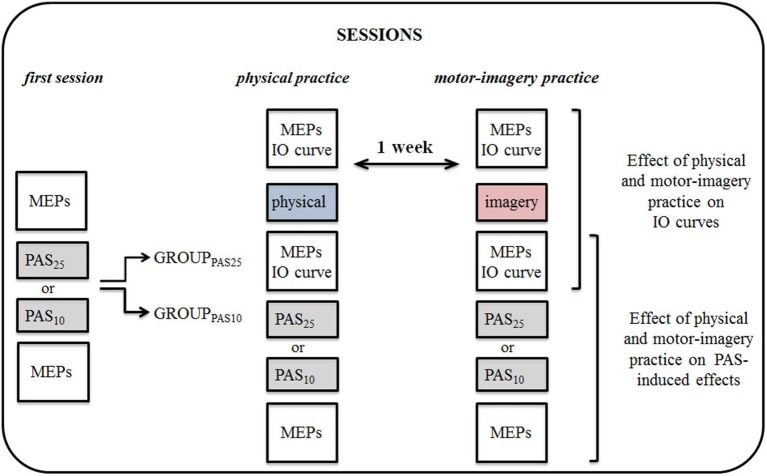
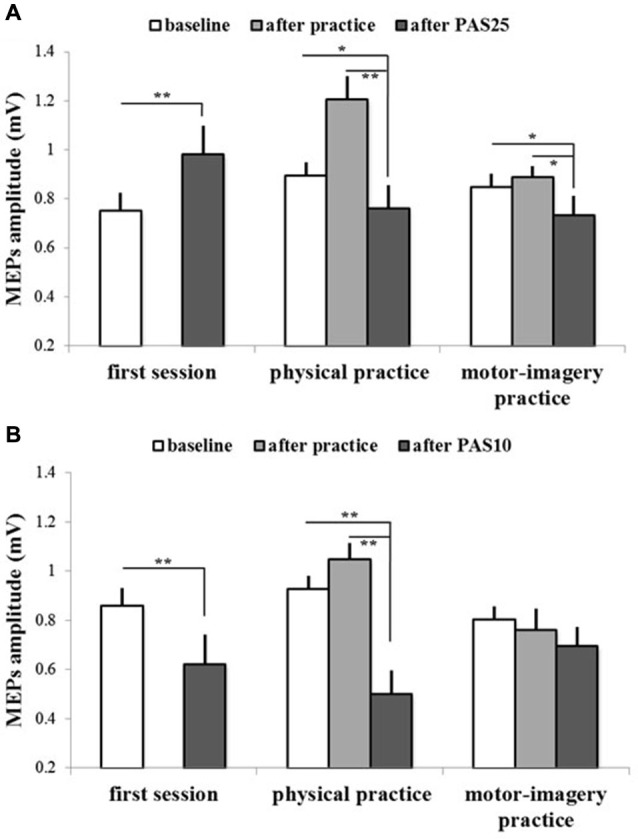
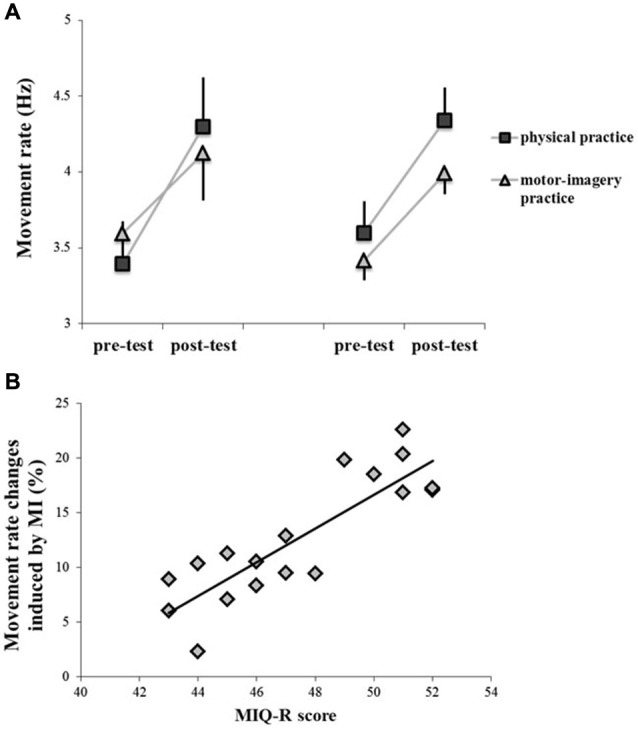
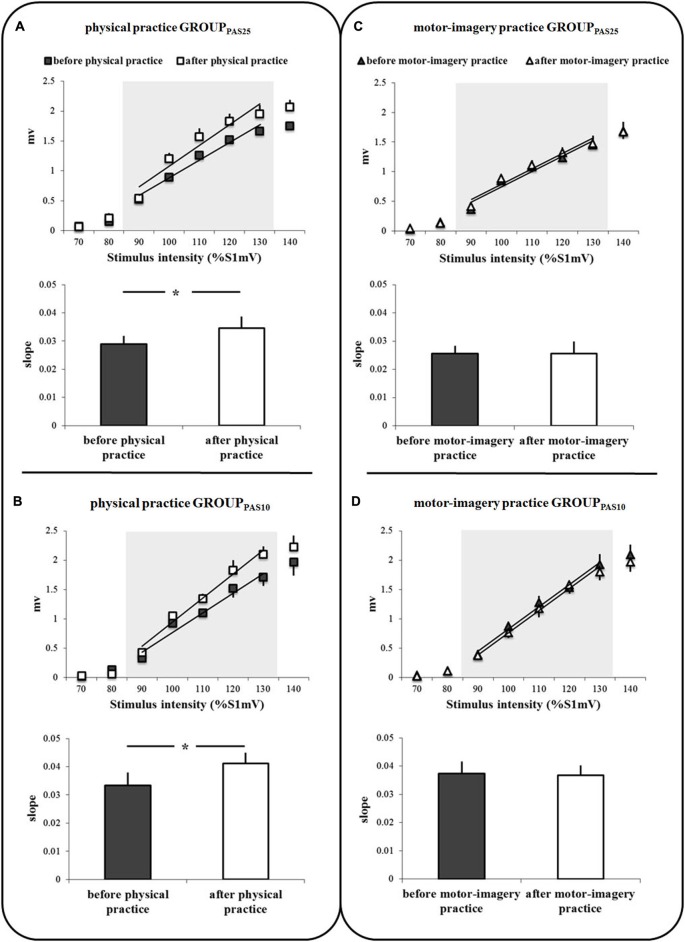
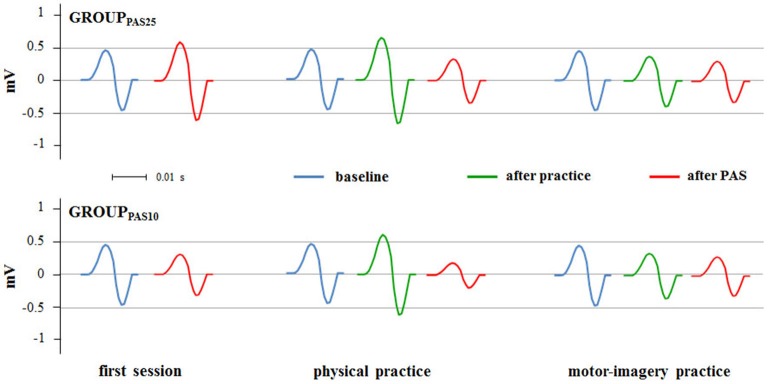
Several investigations suggest that actual and mental actions trigger similar neural substrates. Motor learning via physical practice results in long-term potentiation (LTP)-like plasticity processes, namely potentiation of M1 and a temporary occlusion of additional LTP-like plasticity. However, whether this neuroplasticity process contributes to improve motor performance through mental practice remains to be determined. Here, we tested skill learning-dependent changes in primary motor cortex (M1) excitability and plasticity by means of transcranial magnetic stimulation (TMS) in subjects trained to physically execute or mentally perform a sequence of finger opposition movements. Before and after physical practice and motor-imagery practice, M1 excitability was evaluated by measuring the input-output (IO) curve of motor evoked potentials. M1 LTP and long-term depression (LTD)-like plasticity was assessed with paired-associative stimulation (PAS) of the median nerve and motor cortex using an interstimulus interval of 25 ms (PAS25) or 10 ms (PAS10), respectively. We found that even if after both practice sessions subjects significantly improved their movement speed, M1 excitability and plasticity were differentially influenced by the two practice sessions. First, we observed an increase in the slope of IO curve after physical but not after MI practice. Second, there was a reversal of the PAS25 effect from LTP-like plasticity to LTD-like plasticity following physical and MI practice. Third, LTD-like plasticity (PAS10 protocol) increased after physical practice, whilst it was occluded after MI practice. In conclusion, we demonstrated that MI practice lead to the development of neuroplasticity, as it affected the PAS25- and PAS10- induced plasticity in M1. These results, expanding the current knowledge on how MI training shapes M1 plasticity, might have a potential impact in rehabilitation.
多项研究表明,实际动作和心理动作会触发相似的神经基质。通过身体练习进行运动学习会导致类似长时程增强(LTP)的可塑性过程,即M1的增强以及额外的类似LTP可塑性的暂时阻断。然而,这种神经可塑性过程是否通过心理练习有助于改善运动表现仍有待确定。在此,我们通过经颅磁刺激(TMS)测试了在经过训练以实际执行或在心理上执行一系列手指对指运动的受试者中,与技能学习相关的初级运动皮层(M1)兴奋性和可塑性的变化。在身体练习和运动想象练习之前及之后,通过测量运动诱发电位的输入-输出(IO)曲线来评估M1兴奋性。分别使用25毫秒(PAS25)或10毫秒(PAS10)的刺激间隔,通过正中神经和运动皮层的配对联想刺激(PAS)来评估M1的LTP和类似长时程抑制(LTD)的可塑性。我们发现,即使在两次练习之后受试者的运动速度都显著提高,但两种练习对M1兴奋性和可塑性的影响却有所不同。首先,我们观察到身体练习后IO曲线的斜率增加,而运动想象练习后则没有。其次,在身体练习和运动想象练习后,PAS25效应从类似LTP的可塑性转变为类似LTD的可塑性。第三,类似LTD的可塑性(PAS10方案)在身体练习后增加,而在运动想象练习后则被阻断。总之,我们证明运动想象练习导致了神经可塑性的发展,因为它影响了PAS25和PAS10在M1中诱导的可塑性。这些结果扩展了关于运动想象训练如何塑造M1可塑性的现有知识,可能对康复有潜在影响。