Nguyen Van Thu, Nguyen Huyen Thanh, Nguyen Quoc Cuong, Duong Phuong Thi Bich, West Gary
FHI 360/Vietnam, 7th floor, Hanoi Tourist Building, 18 Ly Thuong Kiet street, Hanoi, Vietnam.
PLoS One. 2015 May 15;10(5):e0126659. doi: 10.1371/journal.pone.0126659. eCollection 2015.
Currently, HIV testing and counseling (HTC) services in Vietnam are primarily funded by international sources. However, international funders are now planning to withdraw their support and the Government of Vietnam (GVN) is seeking to identify domestic funding and generate client fees to continue services. A clear understanding of the cost to sustain current HTC services is becoming increasingly important to facilitate planning that can lead to making HTC and other HIV services more affordable and sustainable in Vietnam. The objectives of this analysis were to provide a snapshot of current program costs to achieve key program outcomes including 1) testing and identifying PLHIV unaware of their HIV status and 2) successfully enrolling HIV (+) clients in care.
We reviewed expenditure data reported by 34 HTC sites in nine Vietnamese provinces over a one-year period from October 2012 to September 2013. Data on program outcomes were extracted from the HTC database of 42,390 client records. Analysis was carried out from the service providers' perspective.
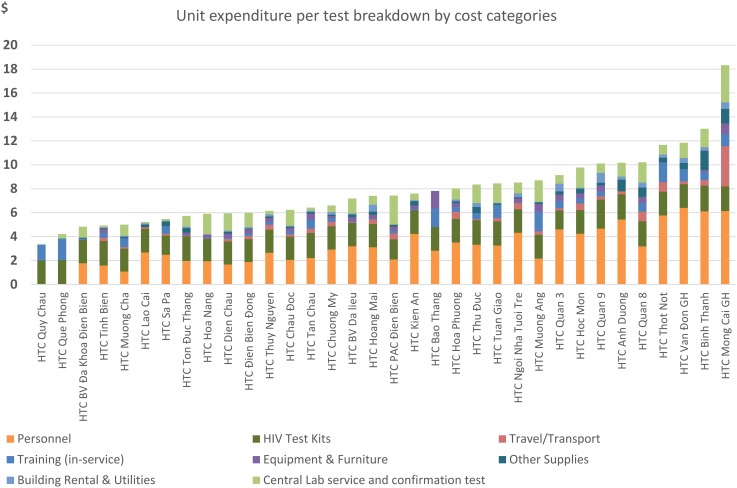
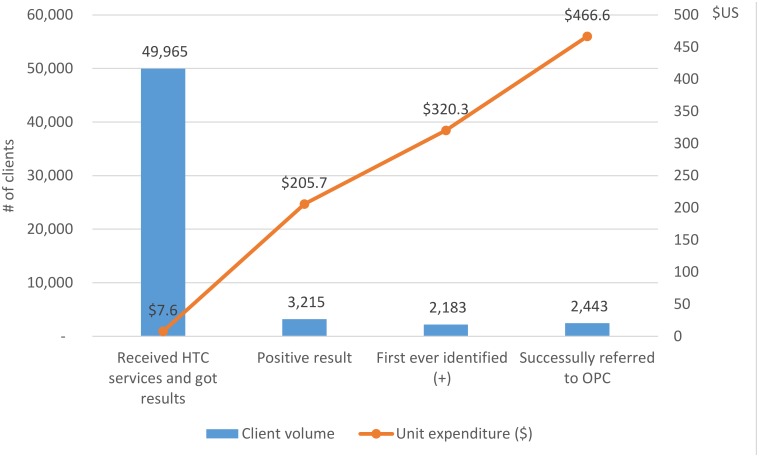
The mean expenditure for a single client provided HTC services (testing, receiving results and referral for care/treatment) was US $7.6. The unit expenditure per PLHIV identified through these services varied widely from US $22.8 to $741.5 (median: $131.8). Excluding repeat tests, the range for expenditure to newly diagnose a PLHIV was even wider (from US $30.8 to $1483.0). The mean expenditure for one successfully referred HIV client to care services was US $466.6. Personnel costs contributed most to the total cost.
Our analysis found a wide range of expenditures by site for achieving the same outcomes. Re-designing systems to provide services at the lowest feasible cost is essential to making HIV services more affordable and treatment for prevention programs feasible in Vietnam. The analysis also found that understanding the determinants and reasons for variance in service costs by site is an important enhancement to the cascade of HIV services framework now adapted for and extensively used in Vietnam for planning and evaluation.
目前,越南的艾滋病毒检测与咨询(HTC)服务主要由国际资金提供支持。然而,国际资助方现正计划撤回其支持,越南政府(GVN)正在寻求确定国内资金来源并收取客户费用以继续提供服务。清楚了解维持当前HTC服务的成本对于推动规划变得日益重要,该规划能够使越南的HTC及其他艾滋病毒服务更具可承受性和可持续性。本分析的目标是提供当前项目成本的概况,以实现关键项目成果,包括:1)检测并识别未意识到自身艾滋病毒感染状况的艾滋病毒感染者(PLHIV);2)成功使艾滋病毒阳性(HIV+)客户登记接受治疗。
我们回顾了2012年10月至2013年9月这一年期间越南9个省份34个HTC站点报告的支出数据。项目成果数据从包含42390条客户记录的HTC数据库中提取。分析是从服务提供者的角度进行的。
为单个客户提供HTC服务(检测、获取结果并转介接受护理/治疗)的平均支出为7.6美元。通过这些服务识别出的每名PLHIV的单位支出差异很大,从22.8美元到741.5美元不等(中位数:131.8美元)。排除重复检测,新诊断一名PLHIV的支出范围甚至更广(从30.8美元到1483.0美元)。成功将一名艾滋病毒客户转介到护理服务的平均支出为466.6美元。人员成本在总成本中占比最大。
我们的分析发现,各站点为实现相同成果的支出差异很大。重新设计系统以尽可能低的成本提供服务对于使越南的艾滋病毒服务更具可承受性以及使预防项目的治疗可行至关重要。分析还发现,了解各站点服务成本差异的决定因素和原因对于目前适用于越南并广泛用于规划和评估的艾滋病毒服务框架的层级是一项重要补充。