Moon Hana, Kim Min Jung, Son Hee Jin, Kweon Hae-Jin, Kim Jung Tae, Kim Yiseul, Shim Jaewon, Suh Byung-Chang, Rhyu Mee-Ra
Research Group of Food Functionality, Korea Food Research Institute, Bundang-gu, Sungnam-si, Gyeonggi-do, Republic of Korea.
Department of Brain Science, Daegu Gyeongbuk Institute of Science and Technology (DGIST), Daegu, Republic of Korea.
PLoS One. 2015 May 15;10(5):e0127060. doi: 10.1371/journal.pone.0127060. eCollection 2015.
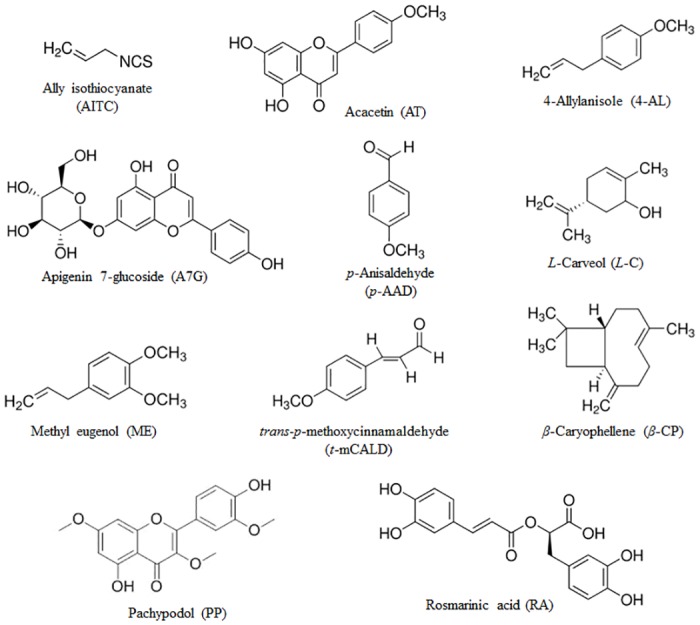
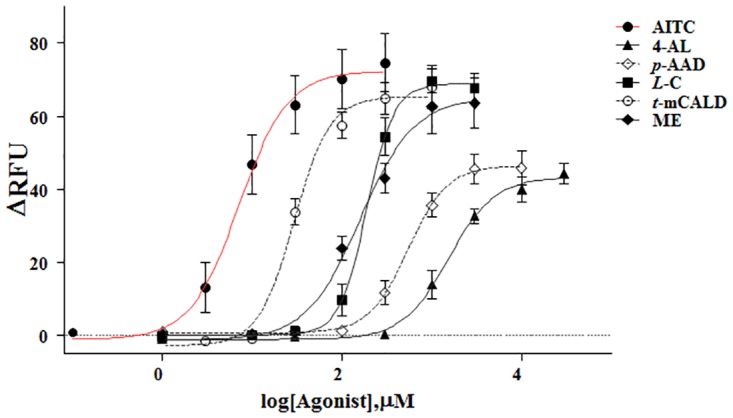
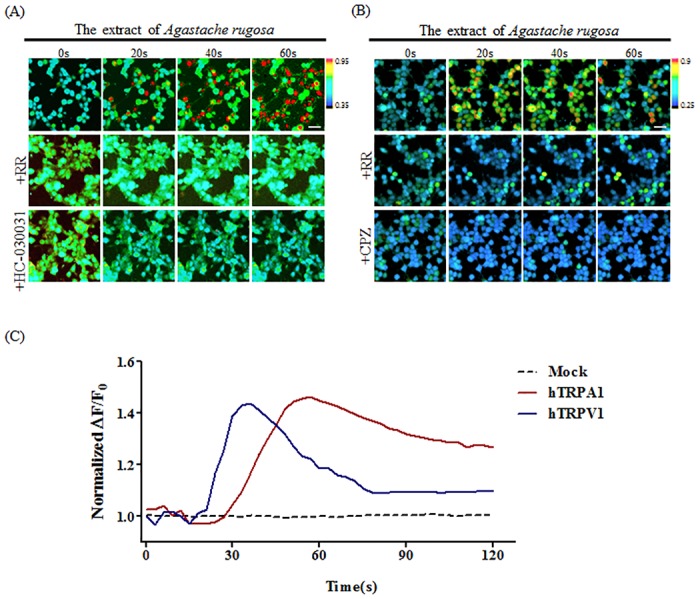
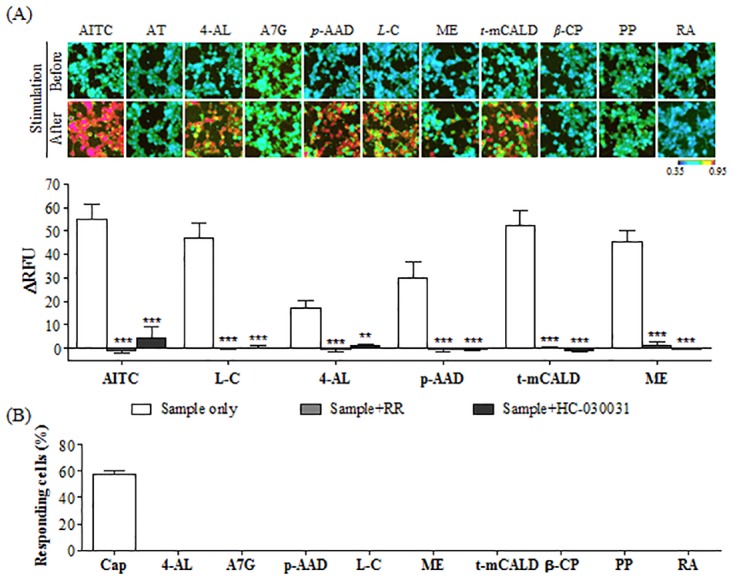
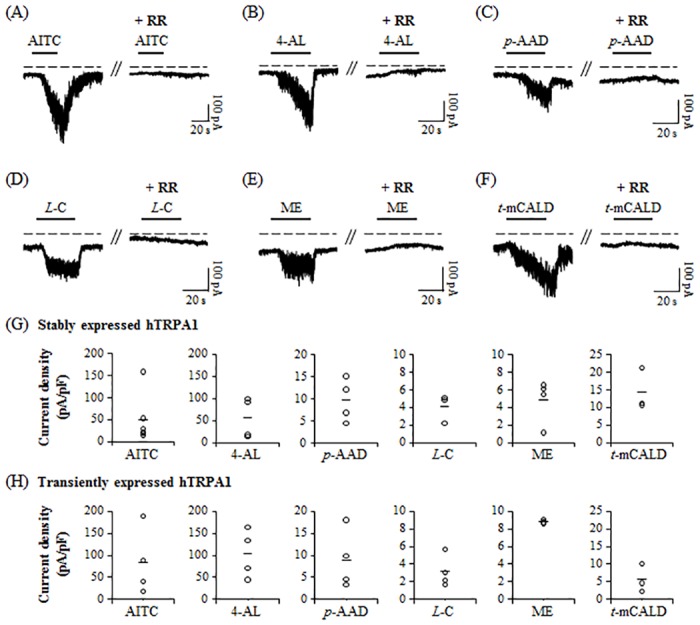
Transient receptor potential ankyrin1 (TRPA1) and transient receptor potential vanilloid 1 (TRPV1) are members of the TRP superfamily of structurally related, nonselective cation channels and mediators of several signaling pathways. Previously, we identified methyl syringate as an hTRPA1 agonist with efficacy against gastric emptying. The aim of this study was to find hTRPA1 and/or hTRPV1 activators in Agastache rugosa (Fisch. et Meyer) O. Kuntze (A.rugosa), commonly known as Korean mint to improve hTRPA1-related phenomena. An extract of the stem and leaves of A.rugosa (Labiatae) selectively activated hTRPA1 and hTRPV1. We next investigated the effects of commercially available compounds found in A.rugosa (acacetin, 4-allylanisole, p-anisaldehyde, apigenin 7-glucoside, L-carveol, β-caryophyllene, trans-p-methoxycinnamaldehyde, methyl eugenol, pachypodol, and rosmarinic acid) on cultured hTRPA1- and hTRPV1-expressing cells. Of the ten compounds, L-carveol, trans-p-methoxycinnamaldehyde, methyl eugenol, 4-allylanisole, and p-anisaldehyde selectively activated hTRPA1, with EC50 values of 189.1±26.8, 29.8±14.9, 160.2±21.9, 1535±315.7, and 546.5±73.0 μM, respectively. The activities of these compounds were effectively inhibited by the hTRPA1 antagonists, ruthenium red and HC-030031. Although the five active compounds showed weaker calcium responses than allyl isothiocyanate (EC50=7.2±1.4 μM), our results suggest that these compounds from the stem and leaves of A.rugosa are specific and selective agonists of hTRPA1.
瞬时受体电位锚蛋白1(TRPA1)和瞬时受体电位香草酸受体1(TRPV1)是结构相关的非选择性阳离子通道TRP超家族的成员,也是多种信号通路的介质。此前,我们鉴定出丁香酸甲酯是一种hTRPA1激动剂,对胃排空有效。本研究的目的是在广为人知的韩国薄荷藿香中寻找hTRPA1和/或hTRPV1激活剂,以改善与hTRPA1相关的现象。藿香(唇形科)茎叶提取物可选择性激活hTRPA1和hTRPV1。接下来,我们研究了藿香中发现的市售化合物(刺槐素、4-烯丙基苯甲醚、对茴香醛、芹菜素7-葡萄糖苷、L-香芹醇、β-石竹烯、反式对甲氧基肉桂醛、甲基丁香酚、厚壳桂醇和迷迭香酸)对表达hTRPA1和hTRPV1的培养细胞的影响。在这十种化合物中,L-香芹醇、反式对甲氧基肉桂醛、甲基丁香酚、4-烯丙基苯甲醚和对茴香醛可选择性激活hTRPA1,其半数有效浓度(EC50)分别为189.1±26.8、29.8±14.9、160.2±21.9、1535±315.7和546.5±73.0μM。hTRPA1拮抗剂钌红和HC-030031可有效抑制这些化合物的活性。尽管这五种活性化合物的钙反应比异硫氰酸烯丙酯(EC50=7.2±1.4μM)弱,但我们的结果表明,藿香茎叶中的这些化合物是hTRPA1的特异性和选择性激动剂。