Griffiths Sarah, Penton-Voak Ian S, Jarrold Chris, Munafò Marcus R
School of Experimental Psychology, University of Bristol, Bristol, United Kingdom; Medical Research Council Integrative Epidemiology Unit (MRC IEU) at the University of Bristol, Bristol, United Kingdom.
School of Experimental Psychology, University of Bristol, Bristol, United Kingdom.
PLoS One. 2015 May 15;10(5):e0125256. doi: 10.1371/journal.pone.0125256. eCollection 2015.
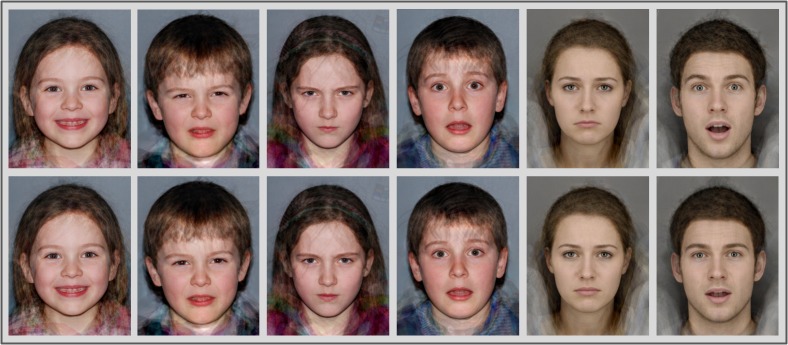
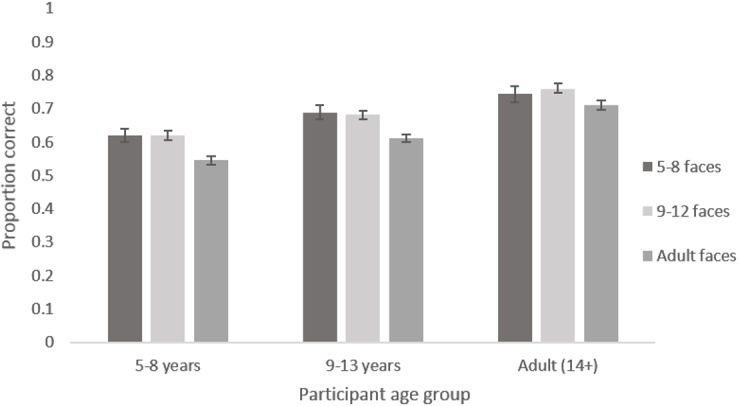
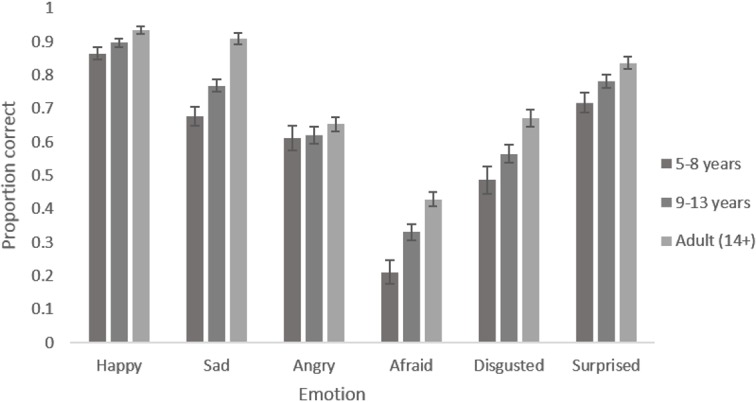
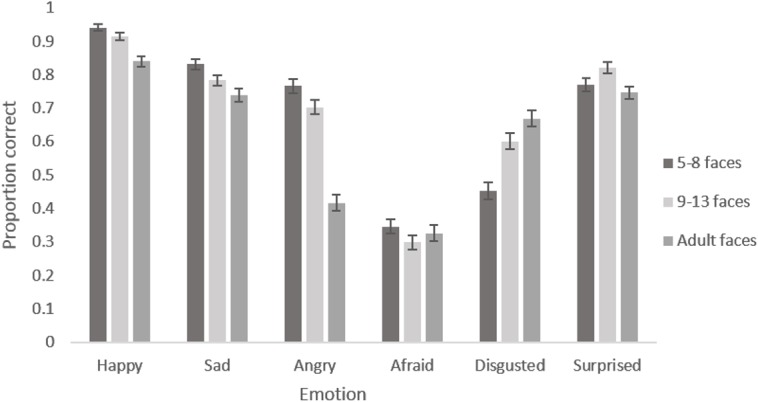
We test whether there is an own-age advantage in emotion recognition using prototypical younger child, older child and adult faces displaying emotional expressions. Prototypes were created by averaging photographs of individuals from 6 different age and sex categories (male 5-8 years, male 9-12 years, female 5-8 years, female 9-12 years, adult male and adult female), each posing 6 basic emotional expressions. In the study 5-8 year old children (n = 33), 9-13 year old children (n = 70) and adults (n = 92) labelled these expression prototypes in a 6-alternative forced-choice task. There was no evidence that children or adults recognised expressions better on faces from their own age group. Instead, child facial expression prototypes were recognised as accurately as adult expression prototypes by all age groups. This suggests there is no substantial own-age advantage in children's emotion recognition.
我们使用展示情绪表情的典型幼儿、年长儿童和成人面孔来测试在情绪识别中是否存在年龄相近优势。通过对来自6个不同年龄和性别类别的个体照片求平均值来创建原型(5 - 8岁男性、9 - 12岁男性、5 - 8岁女性、9 - 12岁女性、成年男性和成年女性),每个类别都摆出6种基本情绪表情。在该研究中,5 - 8岁儿童(n = 33)、9 - 13岁儿童(n = 70)和成年人(n = 92)在一个6选1的强制选择任务中对这些表情原型进行标注。没有证据表明儿童或成年人在识别来自自己年龄组的面孔表情时表现更好。相反,所有年龄组对儿童面部表情原型的识别与对成人表情原型的识别一样准确。这表明在儿童的情绪识别中不存在实质性的年龄相近优势。