Kim Boseon, Ha Minju, Loeff Luuk, Chang Hyeshik, Simanshu Dhirendra K, Li Sisi, Fareh Mohamed, Patel Dinshaw J, Joo Chirlmin, Kim V Narry
Center for RNA Research, Institute for Basic Science, Seoul, Korea School of Biological Sciences, Seoul National University, Seoul, Korea.
Kavli Institute of NanoScience, Department of BioNanoScience, Delft University of Technology, Delft, The Netherlands.
EMBO J. 2015 Jul 2;34(13):1801-15. doi: 10.15252/embj.201590931. Epub 2015 May 15.
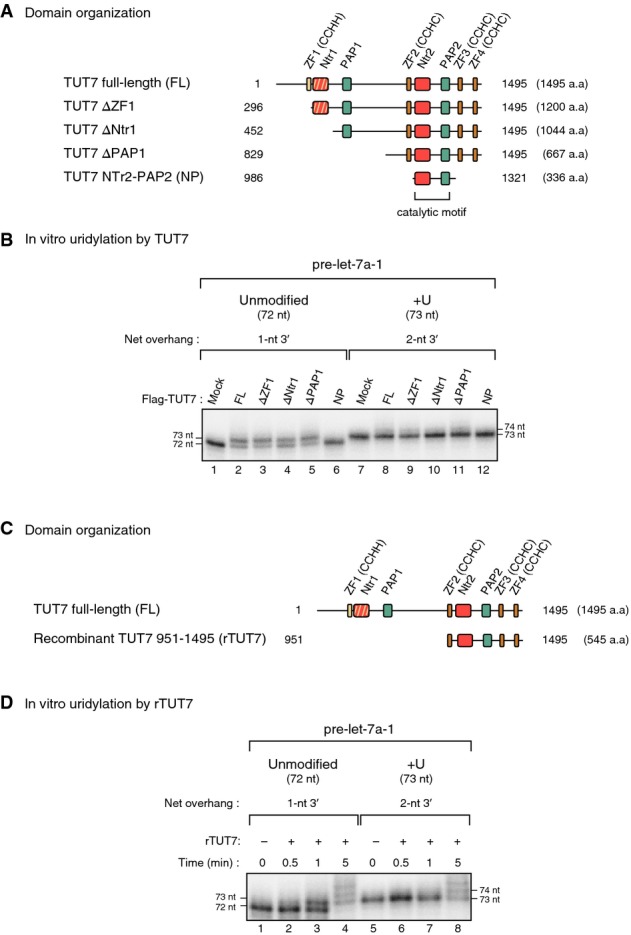
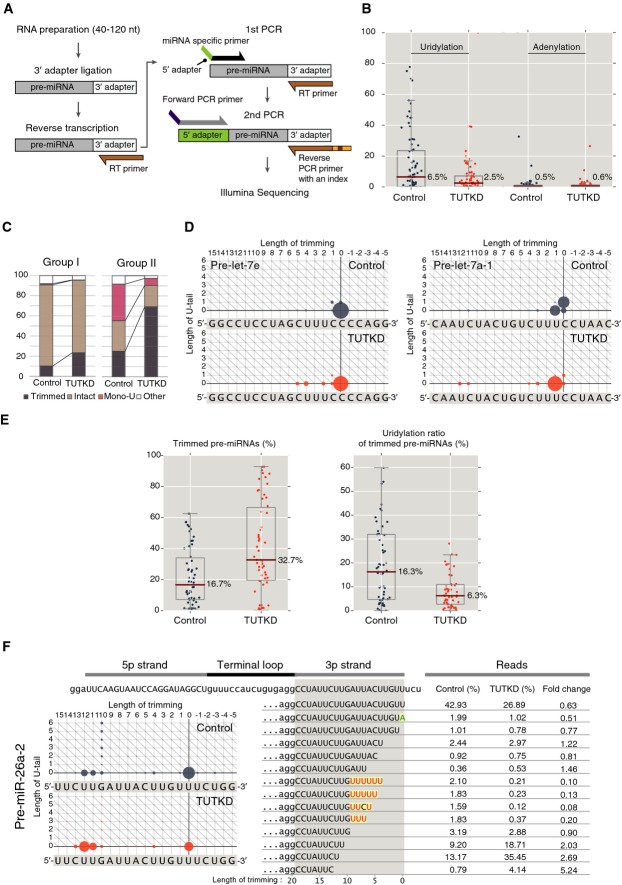
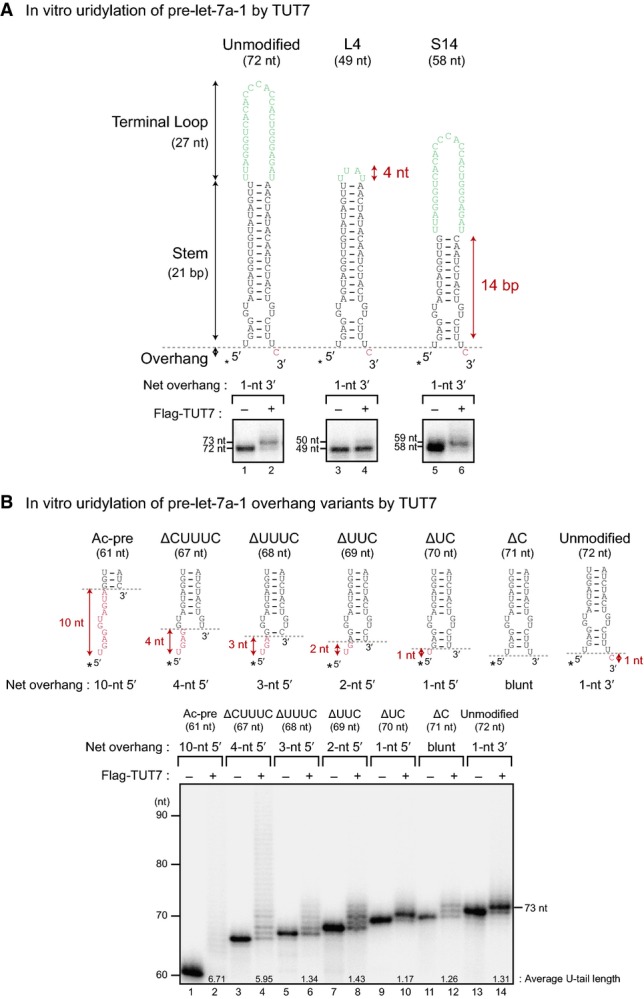
Terminal uridylyl transferases (TUTs) function as integral regulators of microRNA (miRNA) biogenesis. Using biochemistry, single-molecule, and deep sequencing techniques, we here investigate the mechanism by which human TUT7 (also known as ZCCHC6) recognizes and uridylates precursor miRNAs (pre-miRNAs) in the absence of Lin28. We find that the overhang of a pre-miRNA is the key structural element that is recognized by TUT7 and its paralogues, TUT4 (ZCCHC11) and TUT2 (GLD2/PAPD4). For group II pre-miRNAs, which have a 1-nt 3' overhang, TUT7 restores the canonical end structure (2-nt 3' overhang) through mono-uridylation, thereby promoting miRNA biogenesis. For pre-miRNAs where the 3' end is further recessed into the stem (as in 3' trimmed pre-miRNAs), TUT7 generates an oligo-U tail that leads to degradation. In contrast to Lin28-stimulated oligo-uridylation, which is processive, a distributive mode is employed by TUT7 for both mono- and oligo-uridylation in the absence of Lin28. The overhang length dictates the frequency (but not duration) of the TUT7-RNA interaction, thus explaining how TUT7 differentiates pre-miRNA species with different overhangs. Our study reveals dual roles and mechanisms of uridylation in repair and removal of defective pre-miRNAs.
末端尿苷酰转移酶(TUTs)作为微小RNA(miRNA)生物合成的重要调节因子发挥作用。我们利用生物化学、单分子和深度测序技术,研究了人类TUT7(也称为ZCCHC6)在没有Lin28的情况下识别前体miRNA(pre-miRNA)并对其进行尿苷酰化的机制。我们发现,pre-miRNA的突出端是被TUT7及其旁系同源物TUT4(ZCCHC11)和TUT2(GLD2/PAPD4)识别的关键结构元件。对于具有1个核苷酸3'突出端的II组pre-miRNA,TUT7通过单尿苷酰化恢复经典的末端结构(2个核苷酸3'突出端),从而促进miRNA生物合成。对于3'端进一步凹陷到茎中的pre-miRNA(如3'修剪的pre-miRNA),TUT7会产生一个寡聚U尾,导致其降解。与Lin28刺激的寡聚尿苷酰化(其是持续性的)相反,在没有Lin28的情况下,TUT7在单尿苷酰化和寡聚尿苷酰化过程中都采用了分布模式。突出端的长度决定了TUT7与RNA相互作用的频率(而非持续时间),从而解释了TUT7如何区分具有不同突出端的pre-miRNA种类。我们的研究揭示了尿苷酰化在修复和去除有缺陷的pre-miRNA中的双重作用和机制。