Suppr超能文献

迟钝的感官:嗅觉语言的神经认知局限

The muted sense: neurocognitive limitations of olfactory language.

作者信息

Olofsson Jonas K, Gottfried Jay A

机构信息

Department of Psychology, Stockholm University, SE-10691 Stockholm, Sweden; Swedish Collegium for Advanced Study, SE-75238 Uppsala, Sweden.

Department of Neurology, Northwestern University Feinberg School of Medicine, Chicago, IL 60611, USA.

出版信息

Trends Cogn Sci. 2015 Jun;19(6):314-21. doi: 10.1016/j.tics.2015.04.007. Epub 2015 May 12.

Abstract

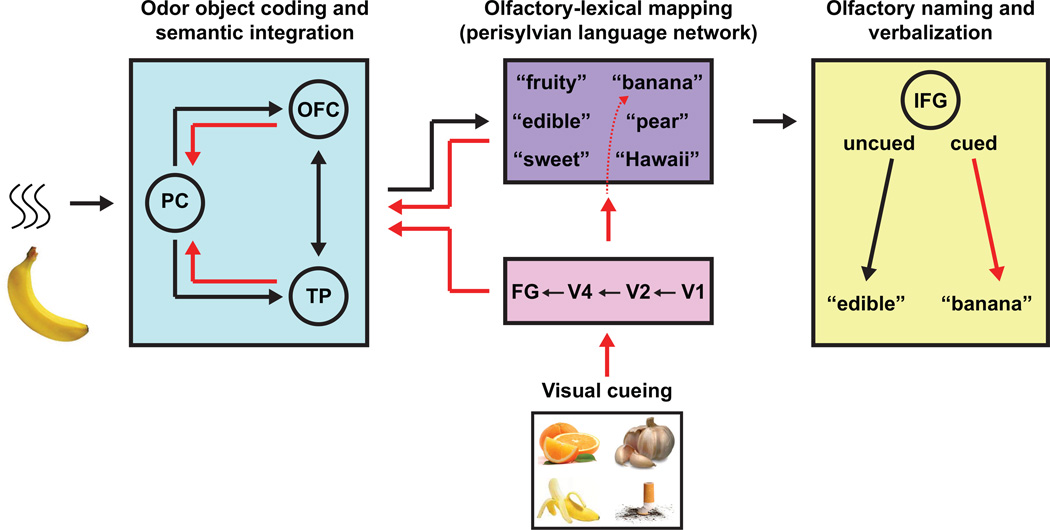
Most people find it profoundly difficult to name familiar smells. This difficulty persists even when perceptual odor processing and visual object naming are unimpaired, implying deficient sensory-specific interactions with the language system. Here we synthesize recent behavioral and neuroimaging data to develop a biologically informed framework for olfactory lexical processing in the human brain. Our central premise is that the difficulty in naming common objects through olfactory (compared with visual) stimulation is the end result of cumulative effects occurring at three successive stages of the olfactory language pathway: object perception, lexical-semantic integration, and verbalization. Understanding the neurocognitive mechanisms by which the language network interacts with olfaction can yield unique insights into the elusive nature of olfactory naming.

摘要

大多数人发现很难说出熟悉的气味。即使嗅觉感知处理和视觉物体命名未受损,这种困难依然存在,这意味着与语言系统的特定感觉交互存在缺陷。在这里,我们综合了最近的行为和神经成像数据,以建立一个关于人类大脑嗅觉词汇处理的基于生物学的框架。我们的核心前提是,通过嗅觉(与视觉相比)刺激来命名常见物体的困难是嗅觉语言通路三个连续阶段累积效应的最终结果:物体感知、词汇语义整合和言语表达。理解语言网络与嗅觉相互作用的神经认知机制,可以为嗅觉命名难以捉摸的本质提供独特的见解。
相似文献

1
The muted sense: neurocognitive limitations of olfactory language.迟钝的感官:嗅觉语言的神经认知局限
Trends Cogn Sci. 2015 Jun;19(6):314-21. doi: 10.1016/j.tics.2015.04.007. Epub 2015 May 12.
3
Cultural Factors Shape Olfactory Language.文化因素塑造嗅觉语言。
Trends Cogn Sci. 2015 Nov;19(11):629-630. doi: 10.1016/j.tics.2015.06.009. Epub 2015 Oct 1.
4
Central mechanisms of odour object perception.气味物体感知的中枢机制。
Nat Rev Neurosci. 2010 Sep;11(9):628-41. doi: 10.1038/nrn2883. Epub 2010 Aug 11.
5
Olfactory-visual integration facilitates perception of subthreshold negative emotion.嗅觉-视觉整合促进阈下负性情绪的感知。
Neuropsychologia. 2015 Oct;77:288-97. doi: 10.1016/j.neuropsychologia.2015.09.005. Epub 2015 Sep 8.
7
Superior olfactory language and cognition in odor-color synaesthesia.嗅觉-颜色联觉中卓越的嗅觉语言与认知能力
J Exp Psychol Hum Percept Perform. 2018 Mar;44(3):468-481. doi: 10.1037/xhp0000469. Epub 2017 Aug 17.

引用本文的文献

3
Predictive coding in the human olfactory system.人类嗅觉系统中的预测编码。
Trends Cogn Sci. 2025 May 8. doi: 10.1016/j.tics.2025.04.005.
6
Four odorants for olfactory training are enough: a pilot study.四种气味用于嗅觉训练已足够:一项初步研究。
Eur Arch Otorhinolaryngol. 2024 Dec;281(12):6445-6458. doi: 10.1007/s00405-024-08930-4. Epub 2024 Sep 6.
8
Aging and Olfactory Training: A Scoping Review.衰老与嗅觉训练:一项范围综述
Innov Aging. 2024 May 30;8(6):igae044. doi: 10.1093/geroni/igae044. eCollection 2024.

本文引用的文献

8
Revisiting the limits of language: the odor lexicon of Maniq.重新审视语言的极限:Maniq 的气味词汇。
Cognition. 2014 Apr;131(1):125-38. doi: 10.1016/j.cognition.2013.12.008. Epub 2014 Jan 23.
9
The impact of expertise in olfaction.嗅觉专业知识的影响。
Front Psychol. 2013 Dec 13;4:928. doi: 10.3389/fpsyg.2013.00928.

文献AI研究员

20分钟写一篇综述,助力文献阅读效率提升50倍。

立即体验

用中文搜PubMed

大模型驱动的PubMed中文搜索引擎

马上搜索

文档翻译

学术文献翻译模型,支持多种主流文档格式。

立即体验