Oostendorp Linda J M, Ottevanger Petronella B, van de Wouw Agnes J, Honkoop Aafke H, Los Maartje, van der Graaf Winette T A, Stalmeier Peep F M
Department for Health Evidence, Radboudumc, PO Box 9101, 6500 HB, Nijmegen, The Netherlands.
Department of Medical Oncology, Radboudumc, Nijmegen, The Netherlands.
J Cancer Educ. 2016 Sep;31(3):443-8. doi: 10.1007/s13187-015-0845-9.
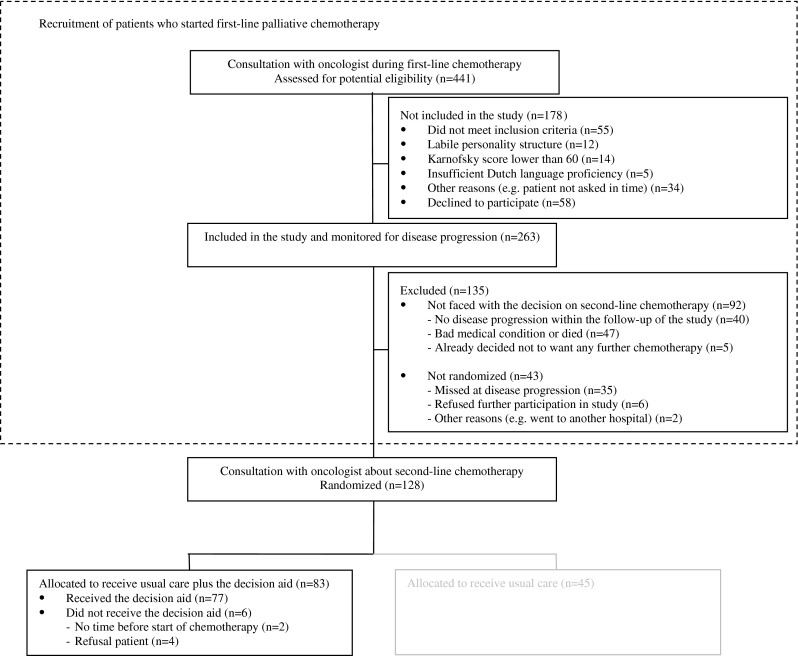
Communication about palliative treatment options requires a balance between providing patients with sufficient information and not providing unwanted information. Surveys have indicated that many patients with advanced cancer express a wish to receive detailed information. In this prospective multicenter study, the information desire of patients with advanced breast or colorectal cancer was further investigated by offering treatment-related information to patients using a decision aid (DA). In addition, this study explored oncologists' awareness of their patients' information desire. Seventy-seven patients with advanced breast or colorectal cancer facing the decision whether to start second-line palliative chemotherapy were offered a DA by a nurse. This DA contained information on adverse events, tumor response, and survival. The nurse asked the patient whether each information item was desired. Ninety-five percent of patients chose to receive information on adverse events, 91 % chose to receive information on tumor response, and 74 % chose to receive information on survival. Oncologists' judgment of patients' information desire was 100, 97, and 81 %, respectively. For all three information items together, oncologists correctly judged the information desire of 62 % of patients. This study confirms that many patients with advanced cancer wish to receive detailed information on the benefits and risks of palliative treatment options when the information is actually available. Oncologists were adequately aware of this high information desire, but had some difficulty judging the information desire of individual patients. A stepped approach to giving information ("preview, ask, tell, ask") may help to better meet patients' information needs.
关于姑息治疗方案的沟通需要在为患者提供足够信息和不提供不必要信息之间取得平衡。调查表明,许多晚期癌症患者表示希望获得详细信息。在这项前瞻性多中心研究中,通过使用决策辅助工具(DA)向患者提供与治疗相关的信息,进一步调查了晚期乳腺癌或结直肠癌患者的信息需求。此外,本研究还探讨了肿瘤学家对患者信息需求的认知情况。77名面临是否开始二线姑息化疗决策的晚期乳腺癌或结直肠癌患者由一名护士提供了决策辅助工具。该决策辅助工具包含有关不良事件、肿瘤反应和生存情况的信息。护士询问患者是否希望了解每个信息项目。95%的患者选择接收有关不良事件的信息,91%选择接收有关肿瘤反应的信息,74%选择接收有关生存情况的信息。肿瘤学家对患者信息需求的判断分别为100%、97%和81%。对于所有三个信息项目,肿瘤学家正确判断了62%患者的信息需求。本研究证实,许多晚期癌症患者希望在实际有信息可用时,获得有关姑息治疗方案的益处和风险的详细信息。肿瘤学家充分意识到这种对信息的高需求,但在判断个别患者的信息需求方面存在一些困难。一种分阶段提供信息的方法(“预览、询问、告知、询问”)可能有助于更好地满足患者的信息需求。