Oostendorp Linda J M, Ottevanger Petronella B, Donders A Rogier T, van de Wouw Agnes J, Schoenaker Ivonne J H, Smilde Tineke J, van der Graaf Winette T A, Stalmeier Peep F M
Department for Health Evidence, Radboudumc, Nijmegen, the Netherlands.
Department of Medical Oncology, Radboudumc, Nijmegen, the Netherlands.
BMC Med Inform Decis Mak. 2017 Aug 31;17(1):130. doi: 10.1186/s12911-017-0529-y.
There is increasing recognition of the delicate balance between the modest benefits of palliative chemotherapy and the burden of treatment. Decision aids (DAs) can potentially help patients with advanced cancer with these difficult treatment decisions, but providing detailed information could have an adverse impact on patients' well-being. The objective of this randomised phase II study was to evaluate the safety and efficacy of DAs for patients with advanced cancer considering second-line chemotherapy.
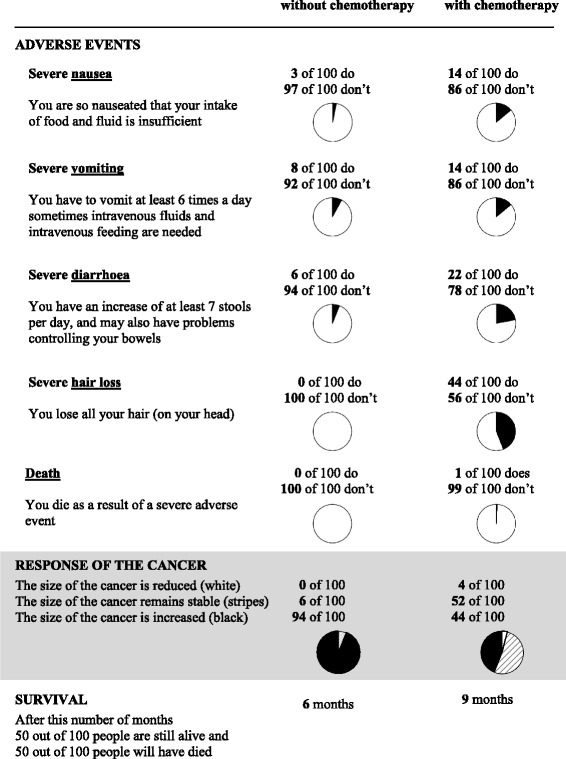
Patients with advanced breast or colorectal cancer considering second-line treatment were randomly assigned to usual care (control group) or usual care plus a DA (intervention group) in a 1:2 ratio. A nurse offered a DA with information on adverse events, tumour response and survival. Outcome measures included patient-reported well-being (primary outcome: anxiety) and quality of the decision-making process and the resulting choice.
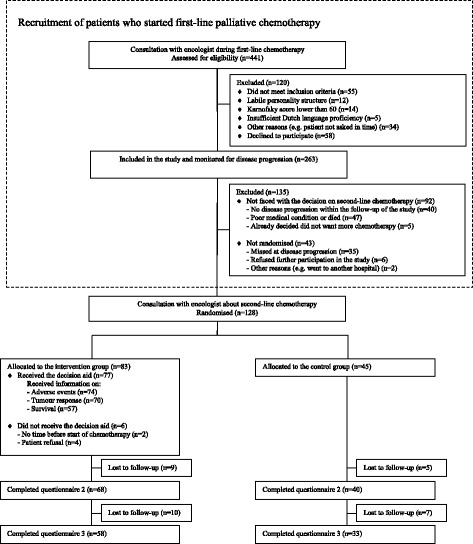
Of 128 patients randomised, 45 were assigned to the control group and 83 to the intervention group. Median age was 62 years (range 32-81), 63% were female, and 73% had colorectal cancer. The large majority of patients preferred treatment with chemotherapy (87%) and subsequently commenced treatment with chemotherapy (86%). No adverse impact on patients' well-being was found and nurses reported that consultations in which the DAs were offered went well. Being offered the DA was associated with stronger treatment preferences (3.0 vs. 2.5; p=0.030) and increased subjective knowledge (6.7 vs. 6.3; p=0.022). Objective knowledge, risk perception and perceived involvement were comparable between the groups.
DAs containing detailed risk information on second-line palliative treatment could be delivered to patients with advanced cancer without having an adverse impact on patient well-being. Surprisingly, the DAs only marginally improved the quality of the decision-making process. The effectiveness of DAs for palliative treatment decisions needs further exploration.
Netherlands Trial Registry (NTR): NTR1113 (registered on 2 November 2007).
姑息性化疗的适度益处与治疗负担之间的微妙平衡日益受到关注。决策辅助工具(DAs)可能有助于晚期癌症患者做出这些艰难的治疗决策,但提供详细信息可能会对患者的幸福感产生不利影响。这项随机II期研究的目的是评估决策辅助工具对考虑二线化疗的晚期癌症患者的安全性和有效性。
考虑二线治疗的晚期乳腺癌或结直肠癌患者按1:2的比例随机分配至常规护理组(对照组)或常规护理加决策辅助工具组(干预组)。一名护士提供了一份包含不良事件、肿瘤反应和生存信息的决策辅助工具。结果指标包括患者报告的幸福感(主要指标:焦虑)以及决策过程的质量和最终选择。
128名随机分组的患者中,45名被分配至对照组,83名被分配至干预组。中位年龄为62岁(范围32 - 81岁),63%为女性,73%患有结直肠癌。绝大多数患者倾向于接受化疗治疗(87%),随后开始接受化疗治疗(86%)。未发现对患者幸福感有不利影响,护士报告提供决策辅助工具的咨询进展顺利。提供决策辅助工具与更强的治疗偏好相关(3.0对2.5;p = 0.030),主观知识增加(6.7对6.3;p = 0.022)。两组之间的客观知识、风险认知和参与感相当。
可以向晚期癌症患者提供包含二线姑息治疗详细风险信息的决策辅助工具,而不会对患者幸福感产生不利影响。令人惊讶的是,决策辅助工具仅略微改善了决策过程的质量。决策辅助工具在姑息治疗决策中的有效性需要进一步探索。
荷兰试验注册库(NTR):NTR1113(于2007年11月2日注册)。