
皮质类固醇或安慰剂注射联合深层横向摩擦按摩、米尔斯手法、拉伸及离心运动治疗急性外侧上髁炎:一项随机对照试验
Corticosteroid or placebo injection combined with deep transverse friction massage, Mills manipulation, stretching and eccentric exercise for acute lateral epicondylitis: a randomised, controlled trial.
作者信息
Olaussen Morten, Holmedal Øystein, Mdala Ibrahimu, Brage Søren, Lindbæk Morten
机构信息
Department of General Practice, Institute of Health and Society, University of Oslo, Kirkeveien 166, 0450, Oslo, Norway.
Research section, Directorate for Labour and Welfare, Oslo, Norway.
出版信息
BMC Musculoskelet Disord. 2015 May 20;16:122. doi: 10.1186/s12891-015-0582-6.
BACKGROUND
Lateral epicondylitis of the elbow is a frequent condition with long-lasting symptoms. Corticosteroid injection is increasingly discouraged and there is little knowledge on the combined effect of corticosteroid injection and physiotherapy for acute conditions. We wanted to investigate the efficacy of physiotherapy alone and combined with corticosteroid injection for acute lateral epicondylitis.
METHODS
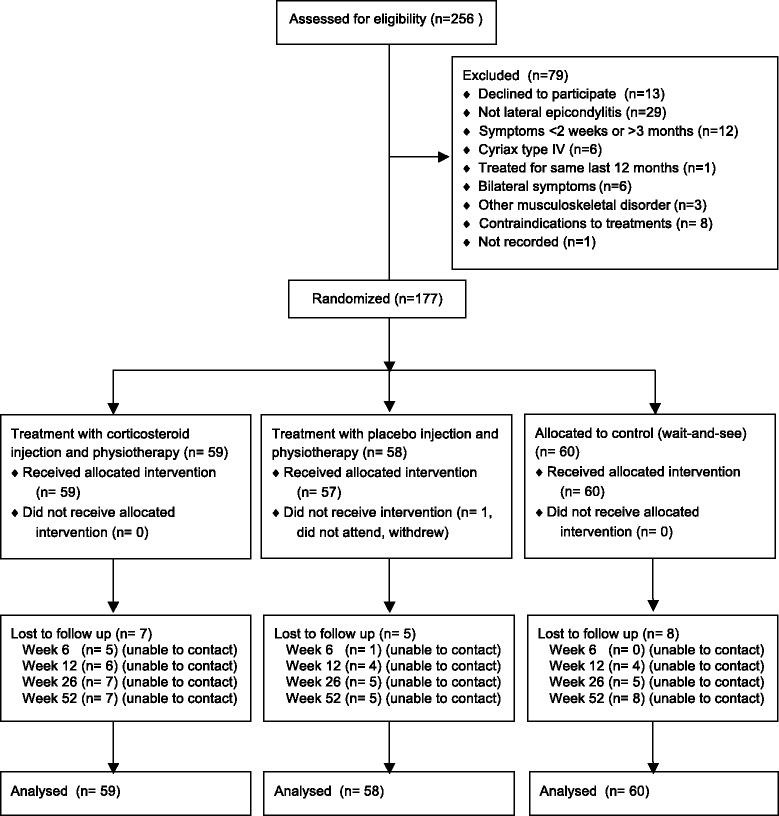
A randomized, controlled study with one-year follow-up was conducted in a general practice setting in Sarpsborg, Norway. We included 177 men and women aged 18 to 70 with clinically diagnosed lateral epicondylitis of recent onset (2 weeks to 3 months). They were randomly assigned to one of three treatments: physiotherapy with two corticosteroid injections, physiotherapy with two placebo injections or wait-and-see (control). Physiotherapy consisted of deep transverse friction massage, Mills manipulation, stretching, and eccentric exercises. We used double blind injection of corticosteroid and single blind assessments. The main outcome measure was treatment success defined as patients rating themselves completely recovered or much better on a six-point scale.
RESULTS
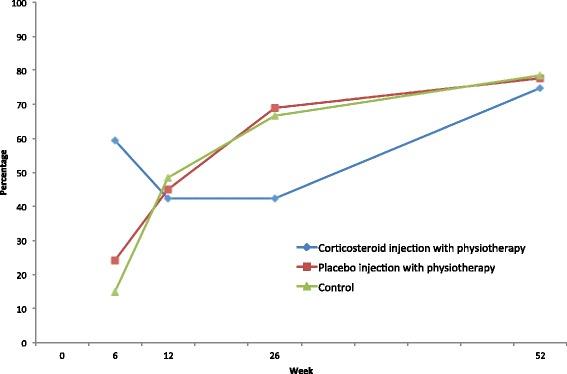
One hundred fifty-seven patients (89 %) completed the trial. Placebo injection with physiotherapy showed no significant difference compared to control or to corticosteroid injection with physiotherapy at any follow-up. Corticosteroid injection with physiotherapy had a 10.6 times larger odds for success at six weeks (odds ratio 10.60, p < 0.01) compared to control (NNT = 3, 99 % CI 1.5 to 4.2). At 12 weeks there was no significant difference between these groups, but at 26 weeks the odds for success were 91 % lower (OR 0.09, p < 0.01) compared to control, showing a large negative effect (NNT = 5, 99 % CI 2.1 to 67.4). At 52 weeks there was no significant difference. Both control and placebo injection with physiotherapy showed a gradual increase in success.
CONCLUSIONS
Acute lateral epicondylitis is a self-limiting condition where 3/4 of patients recover within 52 weeks. Physiotherapy with deep transverse friction massage, Mills manipulation, stretching, and eccentric exercises showed no clear benefit, and corticosteroid injection gave no added effect. Corticosteroid injections combined with physiotherapy might be considered for patients needing a quick improvement, but intermediate (12 to 26 weeks) worsening of symptoms makes the treatment difficult to recommend.
TRIAL REGISTRATION
ClinicalTrials.gov Identifier: NCT00826462.
背景
肱骨外上髁炎是一种常见疾病,症状持续时间长。目前越来越不提倡使用皮质类固醇注射治疗,对于皮质类固醇注射与物理治疗联合用于急性病症的综合效果了解甚少。我们旨在研究单独物理治疗以及物理治疗联合皮质类固醇注射治疗急性肱骨外上髁炎的疗效。
方法
在挪威萨尔普斯堡的一家普通诊所进行了一项为期一年随访的随机对照研究。我们纳入了177名年龄在18至70岁之间、临床诊断为近期发病(2周至3个月)的肱骨外上髁炎的男性和女性。他们被随机分配到三种治疗方法之一:接受两次皮质类固醇注射的物理治疗、接受两次安慰剂注射的物理治疗或观察等待(对照组)。物理治疗包括深部横向摩擦按摩、米尔斯手法、拉伸和离心运动。我们采用皮质类固醇双盲注射和单盲评估。主要结局指标为治疗成功,定义为患者在六点量表上自我评定为完全康复或明显好转。
结果
157名患者(89%)完成了试验。在任何随访中,接受安慰剂注射的物理治疗与对照组或接受皮质类固醇注射的物理治疗相比均无显著差异。与对照组相比,接受皮质类固醇注射的物理治疗在六周时成功的几率高10.6倍(优势比10.60,p<0.01)(NNT=3,99%CI 1.5至4.2)。在12周时,这些组之间没有显著差异,但在26周时,与对照组相比,成功的几率低91%(OR 0.09,p<0.01),显示出较大的负面影响(NNT=5,99%CI 2.1至67.4)。在52周时没有显著差异。对照组和接受安慰剂注射的物理治疗均显示成功率逐渐增加。
结论
急性肱骨外上髁炎是一种自限性疾病,3/4的患者在52周内康复。深部横向摩擦按摩、米尔斯手法、拉伸和离心运动的物理治疗未显示出明显益处,皮质类固醇注射也未产生额外效果。对于需要快速改善的患者,可以考虑皮质类固醇注射联合物理治疗,但症状在中期(12至26周)恶化使得这种治疗难以推荐。
试验注册
ClinicalTrials.gov标识符:NCT00826462。
 Zotero 插件